 Add to Chrome
 Add to Firefox
 Add to Edge
Personalized Graph-Empowered Large Language Model for Proactive Information Access
Feb 25, 2026
Since individuals may struggle to recall all life details and often confuse events, establishing a system to assist users in recalling forgotten experiences is essential. While numerous studies have proposed memory recall systems, these primarily rely on deep learning techniques that require extensive training and often face data scarcity due to the limited availability of personal lifelogs. As lifelogs grow over time, systems must also adapt quickly to newly accumulated data. Recently, large language models (LLMs) have demonstrated remarkable capabilities across various tasks, making them promising for personalized applications. In this work, we present a framework that leverages LLMs for proactive information access, integrating personal knowledge graphs to enhance the detection of access needs through a refined decision-making process. Our framework offers high flexibility, enabling the replacement of base models and the modification of fact retrieval methods for continuous improvement. Experimental results demonstrate that our approach effectively identifies forgotten events, supporting users in recalling past experiences more efficiently.

Prediction and compression of lattice QCD data using machine learning algorithms on quantum annealer
Dec 03, 2021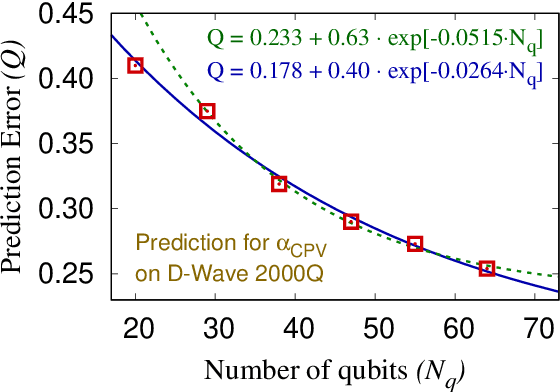
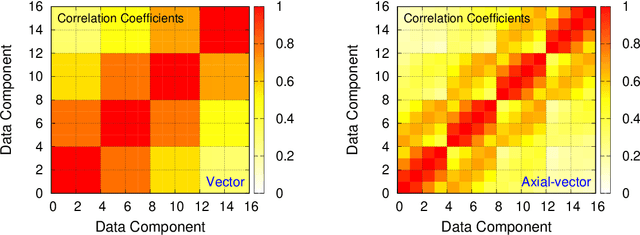
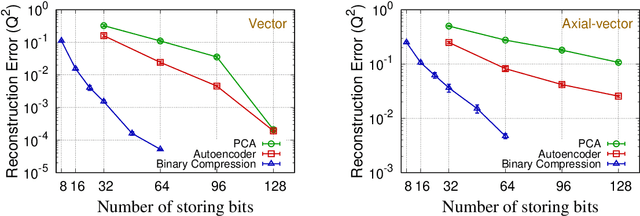
We present regression and compression algorithms for lattice QCD data utilizing the efficient binary optimization ability of quantum annealers. In the regression algorithm, we encode the correlation between the input and output variables into a sparse coding machine learning algorithm. The trained correlation pattern is used to predict lattice QCD observables of unseen lattice configurations from other observables measured on the lattice. In the compression algorithm, we define a mapping from lattice QCD data of floating-point numbers to the binary coefficients that closely reconstruct the input data from a set of basis vectors. Since the reconstruction is not exact, the mapping defines a lossy compression, but, a reasonably small number of binary coefficients are able to reconstruct the input vector of lattice QCD data with the reconstruction error much smaller than the statistical fluctuation. In both applications, we use D-Wave quantum annealers to solve the NP-hard binary optimization problems of the machine learning algorithms.
* 9 pages, 3 figures, Proceedings of the 38th International Symposium on Lattice Field Theory, LATTICE2021
Lossy compression of statistical data using quantum annealer
Oct 05, 2021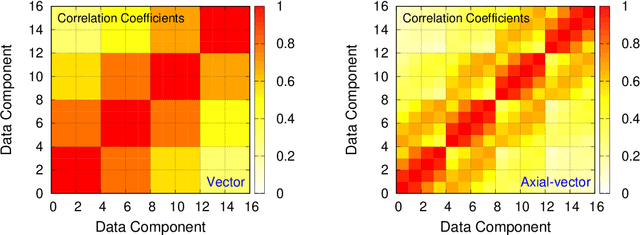
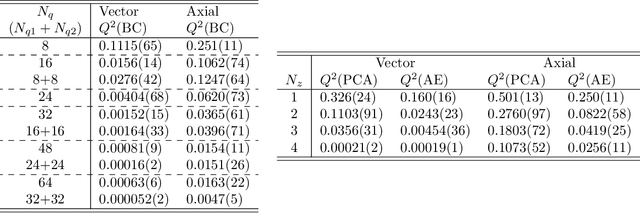
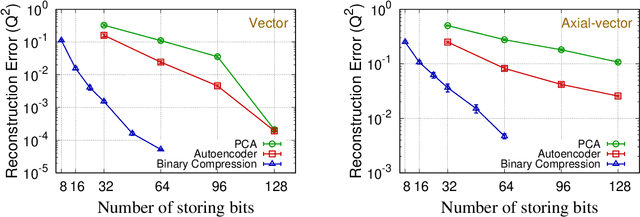
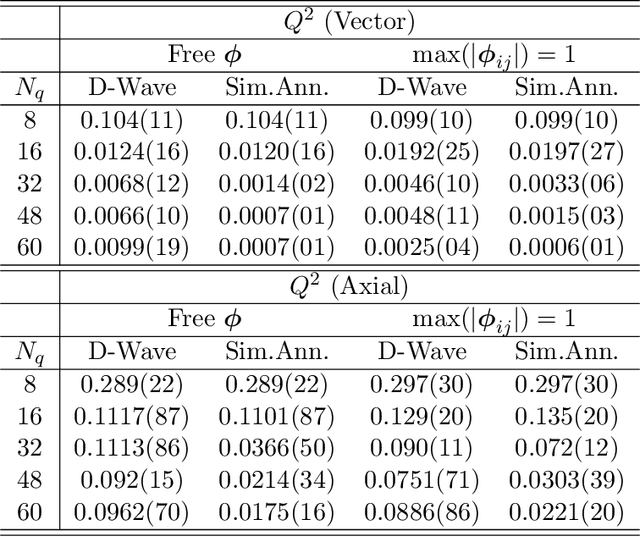
We present a new lossy compression algorithm for statistical floating-point data through a representation learning with binary variables. The algorithm finds a set of basis vectors and their binary coefficients that precisely reconstruct the original data. The optimization for the basis vectors is performed classically, while binary coefficients are retrieved through both simulated and quantum annealing for comparison. A bias correction procedure is also presented to estimate and eliminate the error and bias introduced from the inexact reconstruction of the lossy compression for statistical data analyses. The compression algorithm is demonstrated on two different datasets of lattice quantum chromodynamics simulations. The results obtained using simulated annealing show 3.5 times better compression performance than the algorithms based on a neural-network autoencoder and principal component analysis. Calculations using quantum annealing also show promising results, but performance is limited by the integrated control error of the quantum processing unit, which yields large uncertainties in the biases and coupling parameters. Hardware comparison is further studied between the previous generation D-Wave 2000Q and the current D-Wave Advantage system. Our study shows that the Advantage system is more likely to obtain low-energy solutions for the problems than the 2000Q.