 Add to Chrome
 Add to Firefox
 Add to Edge
Decoding Psychological States Through Movement: Inferring Human Kinesic Functions with Application to Built Environments
Jan 23, 2026
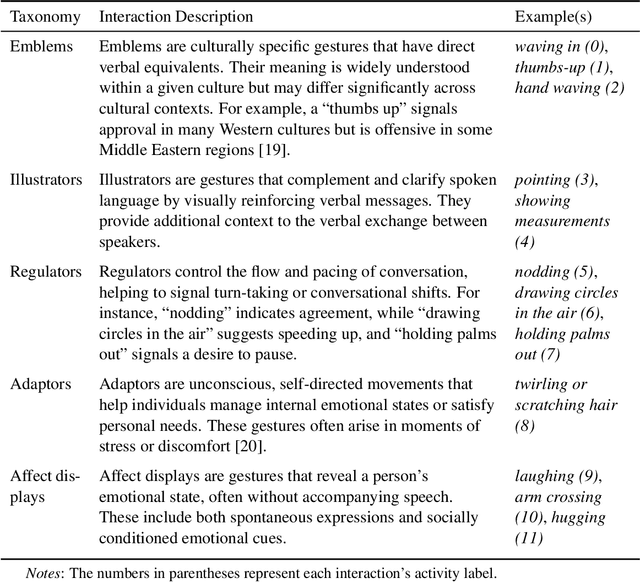
Social infrastructure and other built environments are increasingly expected to support well-being and community resilience by enabling social interaction. Yet in civil and built-environment research, there is no consistent and privacy-preserving way to represent and measure socially meaningful interaction in these spaces, leaving studies to operationalize "interaction" differently across contexts and limiting practitioners' ability to evaluate whether design interventions are changing the forms of interaction that social capital theory predicts should matter. To address this field-level and methodological gap, we introduce the Dyadic User Engagement DataseT (DUET) dataset and an embedded kinesics recognition framework that operationalize Ekman and Friesen's kinesics taxonomy as a function-level interaction vocabulary aligned with social capital-relevant behaviors (e.g., reciprocity and attention coordination). DUET captures 12 dyadic interactions spanning all five kinesic functions-emblems, illustrators, affect displays, adaptors, and regulators-across four sensing modalities and three built-environment contexts, enabling privacy-preserving analysis of communicative intent through movement. Benchmarking six open-source, state-of-the-art human activity recognition models quantifies the difficulty of communicative-function recognition on DUET and highlights the limitations of ubiquitous monadic, action-level recognition when extended to dyadic, socially grounded interaction measurement. Building on DUET, our recognition framework infers communicative function directly from privacy-preserving skeletal motion without handcrafted action-to-function dictionaries; using a transfer-learning architecture, it reveals structured clustering of kinesic functions and a strong association between representation quality and classification performance while generalizing across subjects and contexts.

Read the Room: Inferring Social Context Through Dyadic Interaction Recognition in Cyber-physical-social Infrastructure Systems
Oct 06, 2025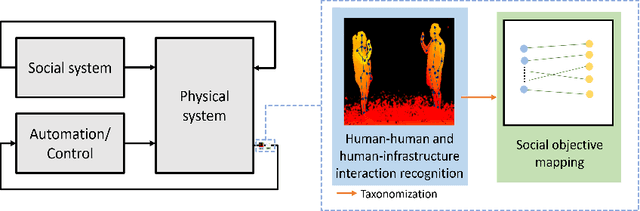
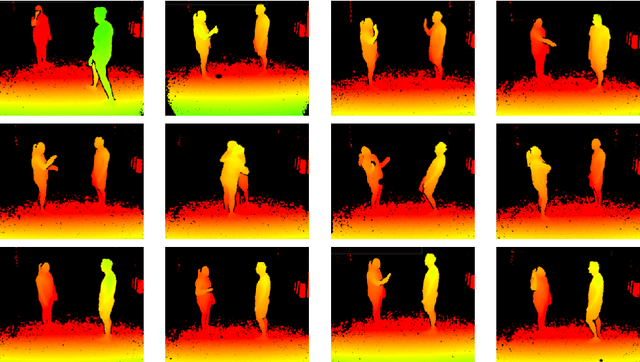
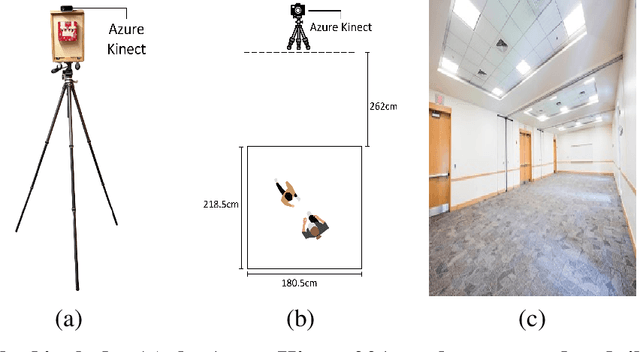
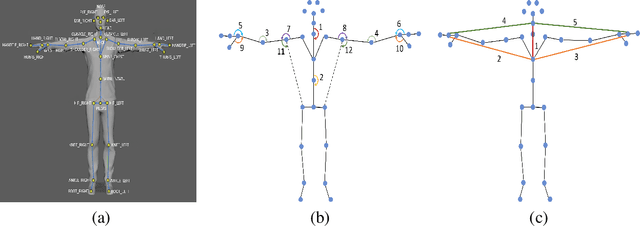
Cyber-physical systems (CPS) integrate sensing, computing, and control to improve infrastructure performance, focusing on economic goals like performance and safety. However, they often neglect potential human-centered (or ''social'') benefits. Cyber-physical-social infrastructure systems (CPSIS) aim to address this by aligning CPS with social objectives. This involves defining social benefits, understanding human interactions with each other and infrastructure, developing privacy-preserving measurement methods, modeling these interactions for prediction, linking them to social benefits, and actuating the physical environment to foster positive social outcomes. This paper delves into recognizing dyadic human interactions using real-world data, which is the backbone to measuring social behavior. This lays a foundation to address the need to enhance understanding of the deeper meanings and mutual responses inherent in human interactions. While RGB cameras are informative for interaction recognition, privacy concerns arise. Depth sensors offer a privacy-conscious alternative by analyzing skeletal movements. This study compares five skeleton-based interaction recognition algorithms on a dataset of 12 dyadic interactions. Unlike single-person datasets, these interactions, categorized into communication types like emblems and affect displays, offer insights into the cultural and emotional aspects of human interactions.
From Actions to Kinesics: Extracting Human Psychological States through Bodily Movements
Oct 06, 2025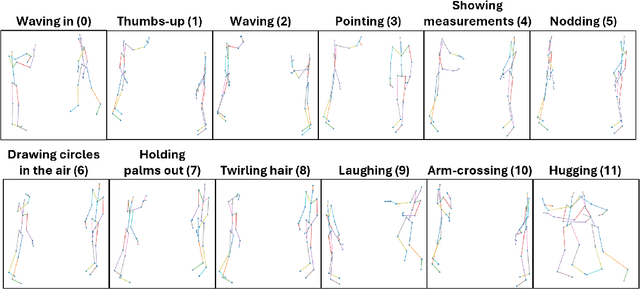
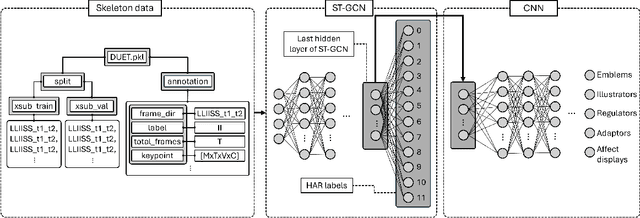
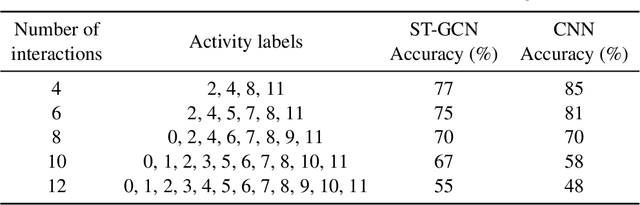
Understanding the dynamic relationship between humans and the built environment is a key challenge in disciplines ranging from environmental psychology to reinforcement learning (RL). A central obstacle in modeling these interactions is the inability to capture human psychological states in a way that is both generalizable and privacy preserving. Traditional methods rely on theoretical models or questionnaires, which are limited in scope, static, and labor intensive. We present a kinesics recognition framework that infers the communicative functions of human activity -- known as kinesics -- directly from 3D skeleton joint data. Combining a spatial-temporal graph convolutional network (ST-GCN) with a convolutional neural network (CNN), the framework leverages transfer learning to bypass the need for manually defined mappings between physical actions and psychological categories. The approach preserves user anonymity while uncovering latent structures in bodily movements that reflect cognitive and emotional states. Our results on the Dyadic User EngagemenT (DUET) dataset demonstrate that this method enables scalable, accurate, and human-centered modeling of behavior, offering a new pathway for enhancing RL-driven simulations of human-environment interaction.