 Add to Chrome
 Add to Firefox
 Add to Edge
Harmonic Beltrami Signature Network: a Shape Prior Module in Deep Learning Framework
Mar 03, 2026
This paper presents the Harmonic Beltrami Signature Network (HBSN), a novel deep learning architecture for computing the Harmonic Beltrami Signature (HBS) from binary-like images. HBS is a shape representation that provides a one-to-one correspondence with 2D simply connected shapes, with invariance to translation, scaling, and rotation. By exploiting the function approximation capacity of neural networks, HBSN enables efficient extraction and utilization of shape prior information. The proposed network architecture incorporates a pre-Spatial Transformer Network (pre-STN) for shape normalization, a UNet-based backbone for HBS prediction, and a post-STN for angle regularization. Experiments show that HBSN accurately computes HBS representations, even for complex shapes. Furthermore, we demonstrate how HBSN can be directly incorporated into existing deep learning segmentation models, improving their performance through the use of shape priors. The results confirm the utility of HBSN as a general-purpose module for embedding geometric shape information into computer vision pipelines.

Shape Prior Segmentation Guided by Harmonic Beltrami Signature
Jul 05, 2024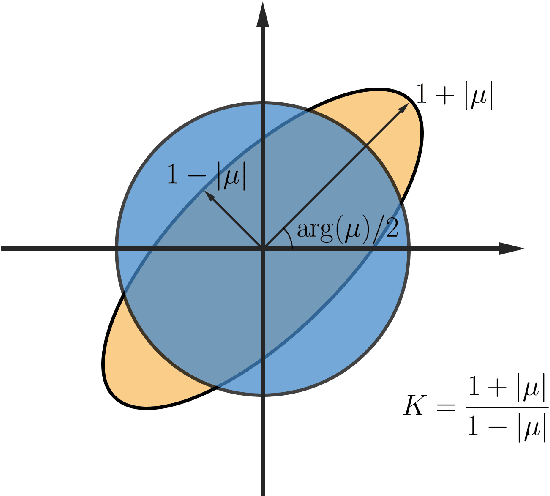
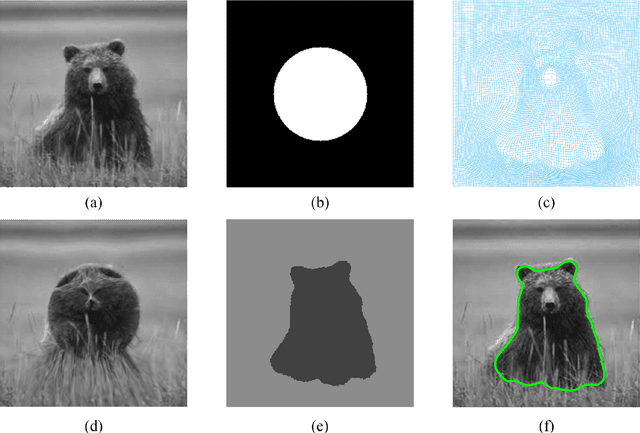
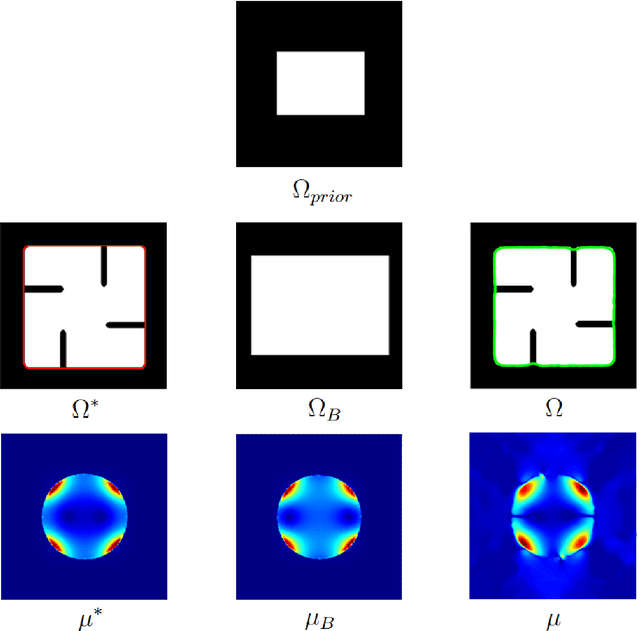
This paper presents a novel shape prior segmentation method guided by the Harmonic Beltrami Signature (HBS). The HBS is a shape representation fully capturing 2D simply connected shapes, exhibiting resilience against perturbations and invariance to translation, rotation, and scaling. The proposed method integrates the HBS within a quasi-conformal topology preserving segmentation framework, leveraging shape prior knowledge to significantly enhance segmentation performance, especially for low-quality or occluded images. The key innovation lies in the bifurcation of the optimization process into two iterative stages: 1) The computation of a quasi-conformal deformation map, which transforms the unit disk into the targeted segmentation area, driven by image data and other regularization terms; 2) The subsequent refinement of this map is contingent upon minimizing the $L_2$ distance between its Beltrami coefficient and the reference HBS. This shape-constrained refinement ensures that the segmentation adheres to the reference shape(s) by exploiting the inherent invariance, robustness, and discerning shape discriminative capabilities afforded by the HBS. Extensive experiments on synthetic and real-world images validate the method's ability to improve segmentation accuracy over baselines, eliminate preprocessing requirements, resist noise corruption, and flexibly acquire and apply shape priors. Overall, the HBS segmentation framework offers an efficient strategy to robustly incorporate the shape prior knowledge, thereby advancing critical low-level vision tasks.
Beltrami Signature: A Novel Invariant 2D Shape Representation for Object Classification
Mar 30, 2021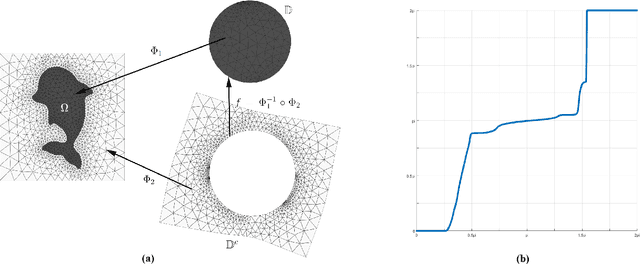
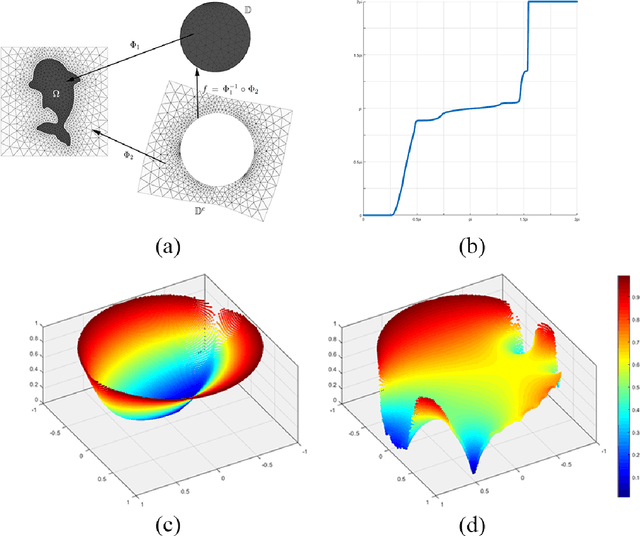
There is a growing interest in shape analysis in recent years and in this paper we present a novel contour-based shape representation named Beltrami signature for 2D bounded simple connected domain. The proposed representation is based on conformal welding. With suitable normalization, the uniqueness of welding is guaranteed up to a rotation. Then it can be extended to a harmonic function and finally quasi-conformal theory get rid of the only uncertainty by computing Beltrami coefficient of harmonic extension. The benifits of the proposed signature is it keeps invariant under simple transformations like sacling, transformation and rotation and is roubost under slight deformation and distortion. Experiments demonstrates the above properties and also shows the excellent classification performance.