 Add to Chrome
 Add to Firefox
 Add to Edge
Active noise cancellation on open-ear smart glasses
Apr 07, 2026
Smart glasses are becoming an increasingly prevalent wearable platform, with audio as a key interaction modality. However, hearing in noisy environments remains challenging because smart glasses are equipped with open-ear speakers that do not seal the ear canal. Furthermore, the open-ear design is incompatible with conventional active noise cancellation (ANC) techniques, which rely on an error microphone inside or at the entrance of the ear canal to measure the residual sound heard after cancellation. Here we present the first real-time ANC system for open-ear smart glasses that suppresses environmental noise using only microphones and miniaturized open-ear speakers embedded in the glasses frame. Our low-latency computational pipeline estimates the noise at the ear from an array of eight microphones distributed around the glasses frame and generates an anti-noise signal in real-time to cancel environmental noise. We develop a custom glasses prototype and evaluate it in a user study across 8 environments under mobility in the 100--1000 Hz frequency range, where environmental noise is concentrated. We achieve a mean noise reduction of 9.6 dB without any calibration, and 11.2 dB with a brief user-specific calibration.

SonicSieve: Bringing Directional Speech Extraction to Smartphones Using Acoustic Microstructures
Apr 15, 2025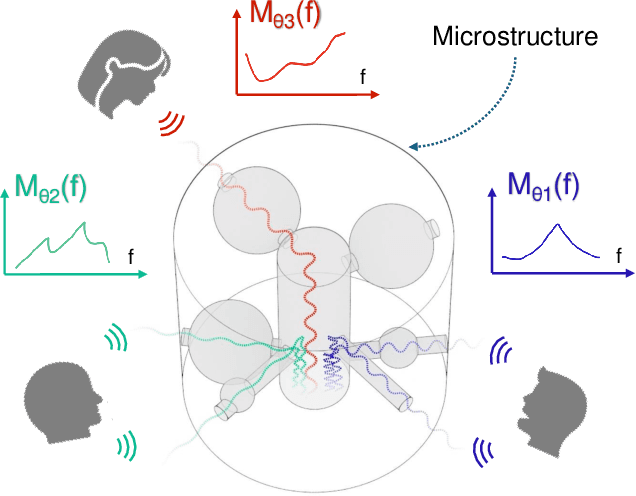
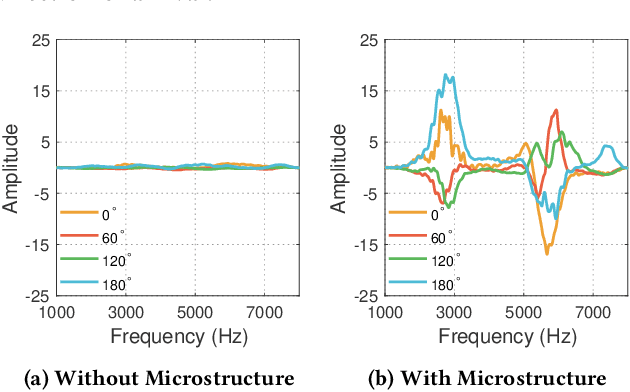
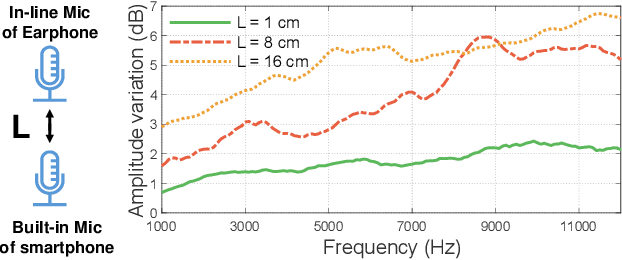
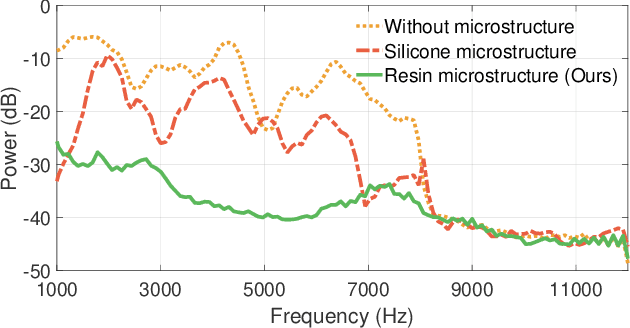
Imagine placing your smartphone on a table in a noisy restaurant and clearly capturing the voices of friends seated around you, or recording a lecturer's voice with clarity in a reverberant auditorium. We introduce SonicSieve, the first intelligent directional speech extraction system for smartphones using a bio-inspired acoustic microstructure. Our passive design embeds directional cues onto incoming speech without any additional electronics. It attaches to the in-line mic of low-cost wired earphones which can be attached to smartphones. We present an end-to-end neural network that processes the raw audio mixtures in real-time on mobile devices. Our results show that SonicSieve achieves a signal quality improvement of 5.0 dB when focusing on a 30{\deg} angular region. Additionally, the performance of our system based on only two microphones exceeds that of conventional 5-microphone arrays.