 Add to Chrome
 Add to Firefox
 Add to Edge
FedWiLoc: Federated Learning for Privacy-Preserving WiFi Indoor Localization
Dec 20, 2025
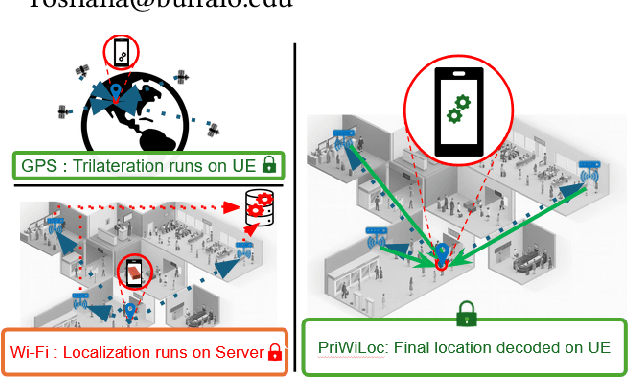
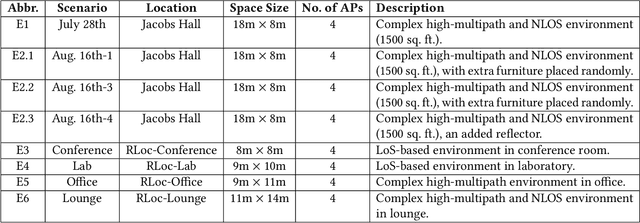

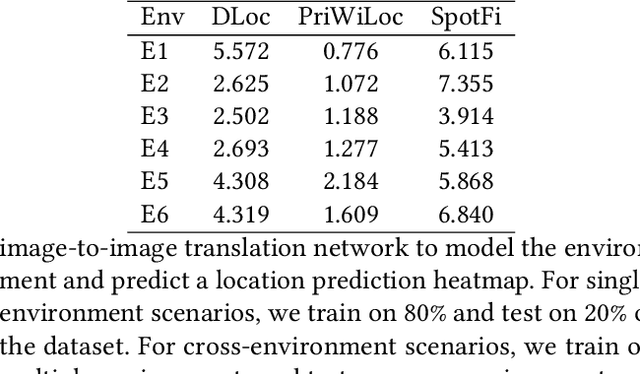
Current data-driven Wi-Fi-based indoor localization systems face three critical challenges: protecting user privacy, achieving accurate predictions in dynamic multipath environments, and generalizing across different deployments. Traditional Wi-Fi localization systems often compromise user privacy, particularly when facing compromised access points (APs) or man-in-the-middle attacks. As IoT devices proliferate in indoor environments, developing solutions that deliver accurate localization while robustly protecting privacy has become imperative. We introduce FedWiLoc, a privacy-preserving indoor localization system that addresses these challenges through three key innovations. First, FedWiLoc employs a split architecture where APs process Channel State Information (CSI) locally and transmit only privacy-preserving embedding vectors to user devices, preventing raw CSI exposure. Second, during training, FedWiLoc uses federated learning to collaboratively train the model across APs without centralizing sensitive user data. Third, we introduce a geometric loss function that jointly optimizes angle-of-arrival predictions and location estimates, enforcing geometric consistency to improve accuracy in challenging multipath conditions. Extensive evaluation across six diverse indoor environments spanning over 2,000 sq. ft. demonstrates that FedWiLoc outperforms state-of-the-art methods by up to 61.9% in median localization error while maintaining strong privacy guarantees throughout both training and inference.

A High-Dimensional Feature Selection Algorithm Based on Multiobjective Differential Evolution
May 09, 2025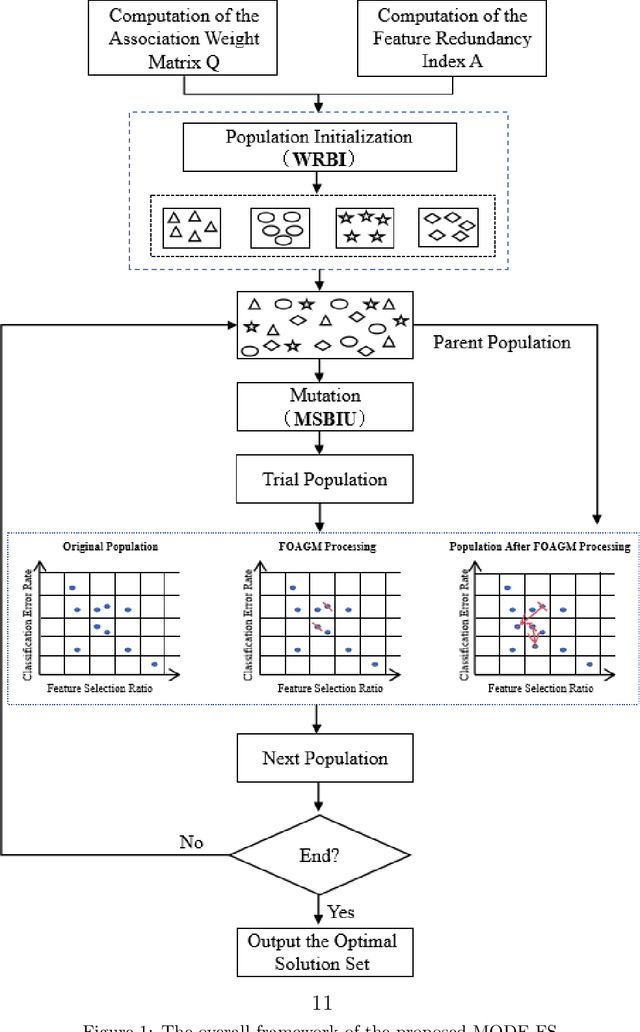
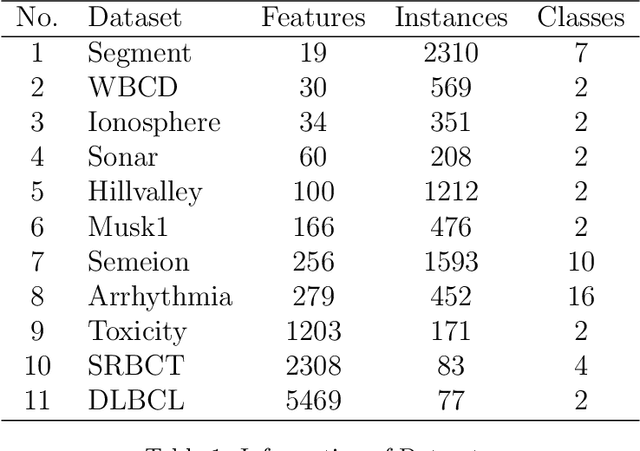
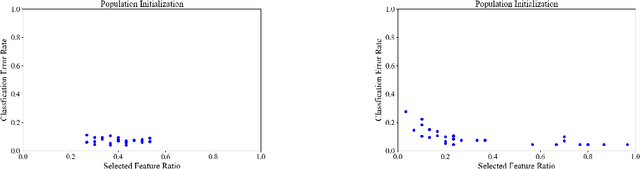
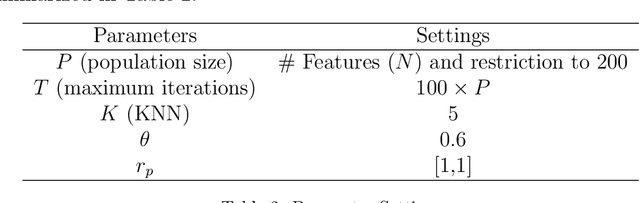
Multiobjective feature selection seeks to determine the most discriminative feature subset by simultaneously optimizing two conflicting objectives: minimizing the number of selected features and the classification error rate. The goal is to enhance the model's predictive performance and computational efficiency. However, feature redundancy and interdependence in high-dimensional data present considerable obstacles to the search efficiency of optimization algorithms and the quality of the resulting solutions. To tackle these issues, we propose a high-dimensional feature selection algorithm based on multiobjective differential evolution. First, a population initialization strategy is designed by integrating feature weights and redundancy indices, where the population is divided into four subpopulations to improve the diversity and uniformity of the initial population. Then, a multiobjective selection mechanism is developed, in which feature weights guide the mutation process. The solution quality is further enhanced through nondominated sorting, with preference given to solutions with lower classification error, effectively balancing global exploration and local exploitation. Finally, an adaptive grid mechanism is applied in the objective space to identify densely populated regions and detect duplicated solutions. Experimental results on 11 UCI datasets of varying difficulty demonstrate that the proposed method significantly outperforms several state-of-the-art multiobjective feature selection approaches regarding feature selection performance.