 Add to Chrome
 Add to Firefox
 Add to Edge
A Two-Stage Globally-Diverse Adversarial Attack for Vision-Language Pre-training Models
Jan 18, 2026
Vision-language pre-training (VLP) models are vulnerable to adversarial examples, particularly in black-box scenarios. Existing multimodal attacks often suffer from limited perturbation diversity and unstable multi-stage pipelines. To address these challenges, we propose 2S-GDA, a two-stage globally-diverse attack framework. The proposed method first introduces textual perturbations through a globally-diverse strategy by combining candidate text expansion with globally-aware replacement. To enhance visual diversity, image-level perturbations are generated using multi-scale resizing and block-shuffle rotation. Extensive experiments on VLP models demonstrate that 2S-GDA consistently improves attack success rates over state-of-the-art methods, with gains of up to 11.17\% in black-box settings. Our framework is modular and can be easily combined with existing methods to further enhance adversarial transferability.

Boosting Adversarial Transferability Against Defenses via Multi-Scale Transformation
Jul 02, 2025The transferability of adversarial examples poses a significant security challenge for deep neural networks, which can be attacked without knowing anything about them. In this paper, we propose a new Segmented Gaussian Pyramid (SGP) attack method to enhance the transferability, particularly against defense models. Unlike existing methods that generally focus on single-scale images, our approach employs Gaussian filtering and three types of downsampling to construct a series of multi-scale examples. Then, the gradients of the loss function with respect to each scale are computed, and their average is used to determine the adversarial perturbations. The proposed SGP can be considered an input transformation with high extensibility that is easily integrated into most existing adversarial attacks. Extensive experiments demonstrate that in contrast to the state-of-the-art methods, SGP significantly enhances attack success rates against black-box defense models, with average attack success rates increasing by 2.3% to 32.6%, based only on transferability.
Boosting Adversarial Transferability via High-Frequency Augmentation and Hierarchical-Gradient Fusion
May 27, 2025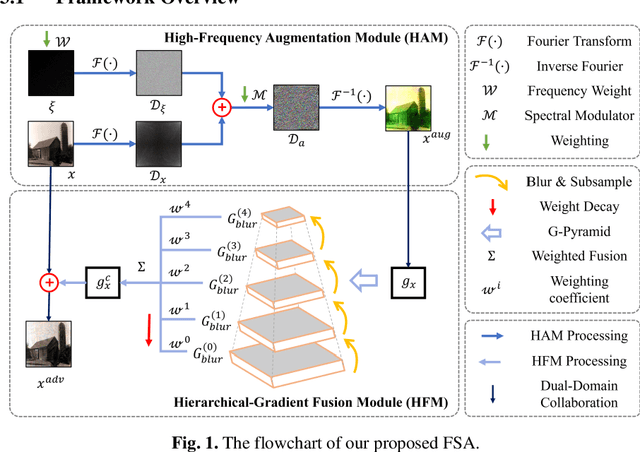
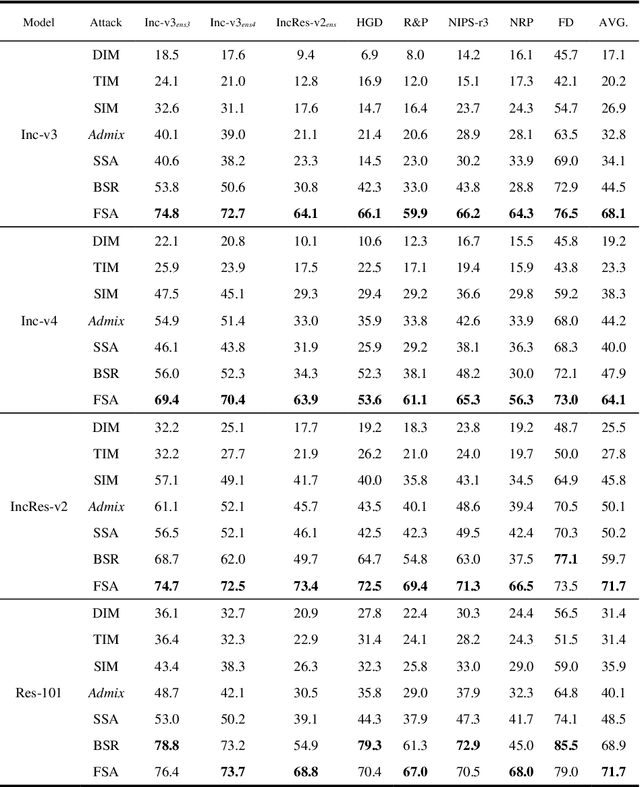
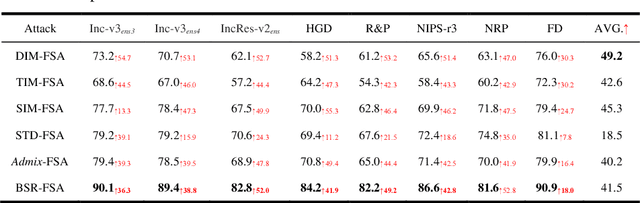
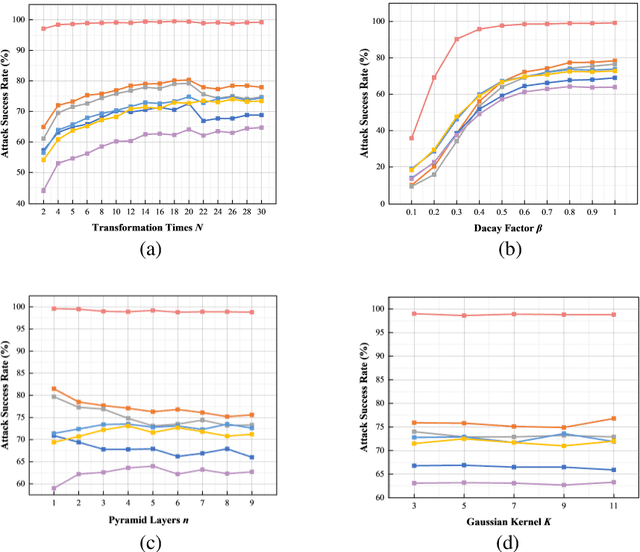
Adversarial attacks have become a significant challenge in the security of machine learning models, particularly in the context of black-box defense strategies. Existing methods for enhancing adversarial transferability primarily focus on the spatial domain. This paper presents Frequency-Space Attack (FSA), a new adversarial attack framework that effectively integrates frequency-domain and spatial-domain transformations. FSA combines two key techniques: (1) High-Frequency Augmentation, which applies Fourier transform with frequency-selective amplification to diversify inputs and emphasize the critical role of high-frequency components in adversarial attacks, and (2) Hierarchical-Gradient Fusion, which merges multi-scale gradient decomposition and fusion to capture both global structures and fine-grained details, resulting in smoother perturbations. Our experiment demonstrates that FSA consistently outperforms state-of-the-art methods across various black-box models. Notably, our proposed FSA achieves an average attack success rate increase of 23.6% compared with BSR (CVPR 2024) on eight black-box defense models.
Adversarial Attack Based on Prediction-Correction
Jun 02, 2023Deep neural networks (DNNs) are vulnerable to adversarial examples obtained by adding small perturbations to original examples. The added perturbations in existing attacks are mainly determined by the gradient of the loss function with respect to the inputs. In this paper, the close relationship between gradient-based attacks and the numerical methods for solving ordinary differential equation (ODE) is studied for the first time. Inspired by the numerical solution of ODE, a new prediction-correction (PC) based adversarial attack is proposed. In our proposed PC-based attack, some existing attack can be selected to produce a predicted example first, and then the predicted example and the current example are combined together to determine the added perturbations. The proposed method possesses good extensibility and can be applied to all available gradient-based attacks easily. Extensive experiments demonstrate that compared with the state-of-the-art gradient-based adversarial attacks, our proposed PC-based attacks have higher attack success rates, and exhibit better transferability.