 Add to Chrome
 Add to Firefox
 Add to Edge
Conjecture and Inquiry: Quantifying Software Performance Requirements via Interactive Retrieval-Augmented Preference Elicitation
Apr 23, 2026
Since software performance requirements are documented in natural language, quantifying them into mathematical forms is essential for software engineering. Yet, the vagueness in performance requirements and uncertainty of human cognition have caused highly uncertain ambiguity in the interpretations, rendering their automated quantification an unaddressed and challenging problem. In this paper, we formalize the problem and propose IRAP, an approach that quantifies performance requirements into mathematical functions via interactive retrieval-augmented preference elicitation. IRAP differs from the others in that it explicitly derives from problem-specific knowledge to retrieve and reason the preferences, which also guides the progressive interaction with stakeholders, while reducing the cognitive overhead. Experiment results against 10 state-of-the-art methods on four real-world datasets demonstrate the superiority of IRAP on all cases with up to 40x improvements under as few as five rounds of interactions.

Meta-TTT: A Meta-learning Minimax Framework For Test-Time Training
Oct 02, 2024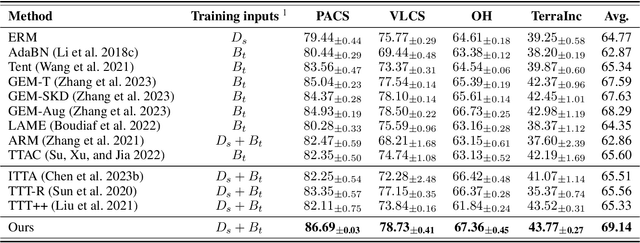
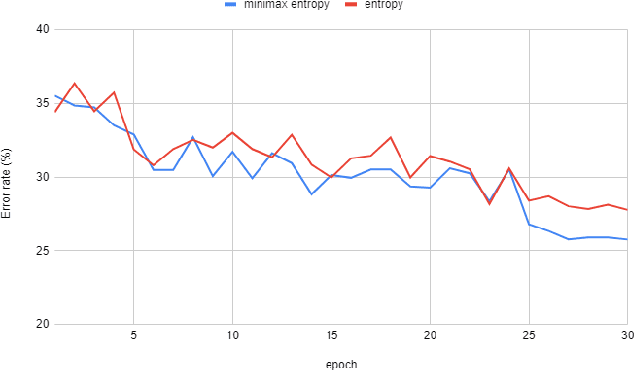
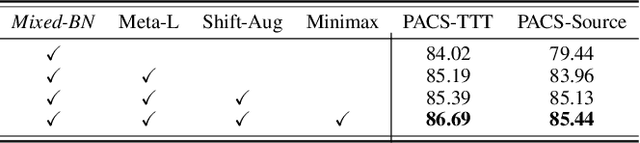
Test-time domain adaptation is a challenging task that aims to adapt a pre-trained model to limited, unlabeled target data during inference. Current methods that rely on self-supervision and entropy minimization underperform when the self-supervised learning (SSL) task does not align well with the primary objective. Additionally, minimizing entropy can lead to suboptimal solutions when there is limited diversity within minibatches. This paper introduces a meta-learning minimax framework for test-time training on batch normalization (BN) layers, ensuring that the SSL task aligns with the primary task while addressing minibatch overfitting. We adopt a mixed-BN approach that interpolates current test batch statistics with the statistics from source domains and propose a stochastic domain synthesizing method to improve model generalization and robustness to domain shifts. Extensive experiments demonstrate that our method surpasses state-of-the-art techniques across various domain adaptation and generalization benchmarks, significantly enhancing the pre-trained model's robustness on unseen domains.