 Add to Chrome
 Add to Firefox
 Add to Edge
Hardware-Aware YOLO Compression for Low-Power Edge AI on STM32U5 for Weeds Detection in Digital Agriculture
Nov 11, 2025
Weeds significantly reduce crop yields worldwide and pose major challenges to sustainable agriculture. Traditional weed management methods, primarily relying on chemical herbicides, risk environmental contamination and lead to the emergence of herbicide-resistant species. Precision weeding, leveraging computer vision and machine learning methods, offers a promising eco-friendly alternative but is often limited by reliance on high-power computational platforms. This work presents an optimized, low-power edge AI system for weeds detection based on the YOLOv8n object detector deployed on the STM32U575ZI microcontroller. Several compression techniques are applied to the detection model, including structured pruning, integer quantization and input image resolution scaling in order to meet strict hardware constraints. The model is trained and evaluated on the CropAndWeed dataset with 74 plant species, achieving a balanced trade-off between detection accuracy and efficiency. Our system supports real-time, in-situ weeds detection with a minimal energy consumption of 51.8mJ per inference, enabling scalable deployment in power-constrained agricultural environments.

Adaptively Pruned Spiking Neural Networks for Energy-Efficient Intracortical Neural Decoding
Apr 15, 2025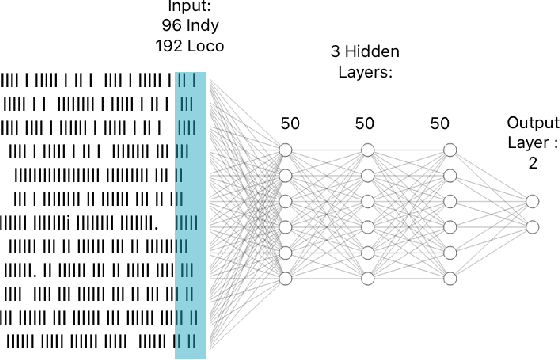
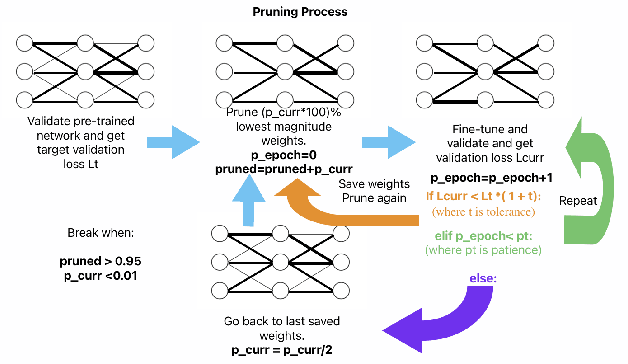
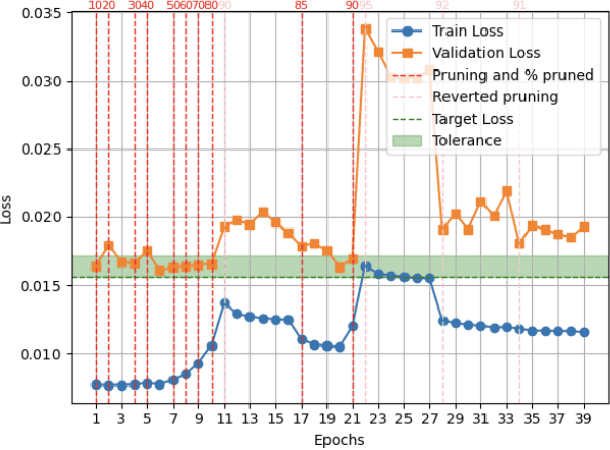
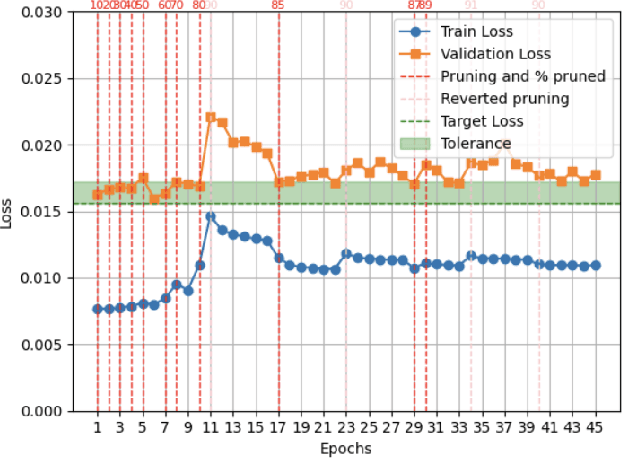
Intracortical brain-machine interfaces demand low-latency, energy-efficient solutions for neural decoding. Spiking Neural Networks (SNNs) deployed on neuromorphic hardware have demonstrated remarkable efficiency in neural decoding by leveraging sparse binary activations and efficient spatiotemporal processing. However, reducing the computational cost of SNNs remains a critical challenge for developing ultra-efficient intracortical neural implants. In this work, we introduce a novel adaptive pruning algorithm specifically designed for SNNs with high activation sparsity, targeting intracortical neural decoding. Our method dynamically adjusts pruning decisions and employs a rollback mechanism to selectively eliminate redundant synaptic connections without compromising decoding accuracy. Experimental evaluation on the NeuroBench Non-Human Primate (NHP) Motor Prediction benchmark shows that our pruned network achieves performance comparable to dense networks, with a maximum tenfold improvement in efficiency. Moreover, hardware simulation on the neuromorphic processor reveals that the pruned network operates at sub-$\mu$W power levels, underscoring its potential for energy-constrained neural implants. These results underscore the promise of our approach for advancing energy-efficient intracortical brain-machine interfaces with low-overhead on-device intelligence.