 Add to Chrome
 Add to Firefox
 Add to Edge
Graph Feedback Controls Consensus and Clique Formation in Open-Weight Language-Model Populations
Jul 13, 2026
Multi-agent language-model systems increasingly route local interactions, yet the runtime interaction graph is often treated as an implementation detail. We study convention formation in open-weight LM populations spanning 1.1B-32B parameters with a naming-game protocol. Restricted first-token scores over tokenizer-safe labels let us measure prompt-conditioned score-state distributions, construct state-similarity graphs, and separate sampled-label agreement from latent state-space consensus. Across controlled interventions, in the main open-weight repair grids, retained partner-label evidence is necessary but not sufficient: homophilous threshold-similarity routing deletes cross-basin exposure and amplifies fragmentation, while bridge-seeking routing often repairs fragmentation when memory is available. In a three-seed mixed four-model grid, threshold-similarity produces no final behavioral or state consensus in 189 setting-seed runs, whereas state-component and label-disagreement bridges recover final behavioral consensus in 14/18 retained-memory runs. Across homogeneous model populations, retained history generally shifts fragmented dynamics toward consensus; the clearest case is Qwen2.5-32B, which reaches stable behavioral and final state consensus in all 18 retained-history well-mixed settings, while threshold-similarity reaches neither form of consensus in 189 settings. Robustness over state thresholds, population size, and vocabulary size preserves the qualitative ordering, and early-window graph-energy features provide useful within-grid diagnostics.

The Effect of Training Parameters and Mechanisms on Decentralized Federated Learning based on MNIST Dataset
Aug 07, 2021

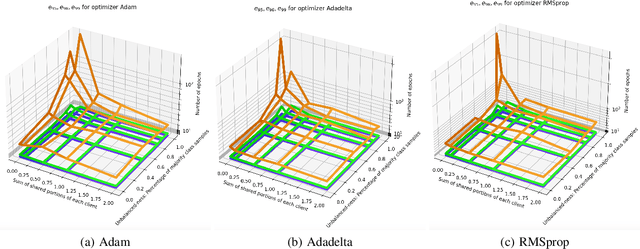

Federated Learning is an algorithm suited for training models on decentralized data, but the requirement of a central "server" node is a bottleneck. In this document, we first introduce the notion of Decentralized Federated Learning (DFL). We then perform various experiments on different setups, such as changing model aggregation frequency, switching from independent and identically distributed (IID) dataset partitioning to non-IID partitioning with partial global sharing, using different optimization methods across clients, and breaking models into segments with partial sharing. All experiments are run on the MNIST handwritten digits dataset. We observe that those altered training procedures are generally robust, albeit non-optimal. We also observe failures in training when the variance between model weights is too large. The open-source experiment code is accessible through GitHub\footnote{Code was uploaded at \url{https://github.com/zhzhang2018/DecentralizedFL}}.