 Add to Chrome
 Add to Firefox
 Add to Edge
FUGC: Benchmarking Semi-Supervised Learning Methods for Cervical Segmentation
Jan 22, 2026
Accurate segmentation of cervical structures in transvaginal ultrasound (TVS) is critical for assessing the risk of spontaneous preterm birth (PTB), yet the scarcity of labeled data limits the performance of supervised learning approaches. This paper introduces the Fetal Ultrasound Grand Challenge (FUGC), the first benchmark for semi-supervised learning in cervical segmentation, hosted at ISBI 2025. FUGC provides a dataset of 890 TVS images, including 500 training images, 90 validation images, and 300 test images. Methods were evaluated using the Dice Similarity Coefficient (DSC), Hausdorff Distance (HD), and runtime (RT), with a weighted combination of 0.4/0.4/0.2. The challenge attracted 10 teams with 82 participants submitting innovative solutions. The best-performing methods for each individual metric achieved 90.26\% mDSC, 38.88 mHD, and 32.85 ms RT, respectively. FUGC establishes a standardized benchmark for cervical segmentation, demonstrates the efficacy of semi-supervised methods with limited labeled data, and provides a foundation for AI-assisted clinical PTB risk assessment.

IEOPF: An Active Contour Model for Image Segmentation with Inhomogeneities Estimated by Orthogonal Primary Functions
Mar 08, 2018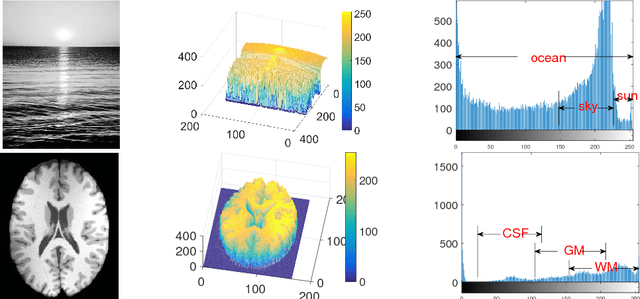
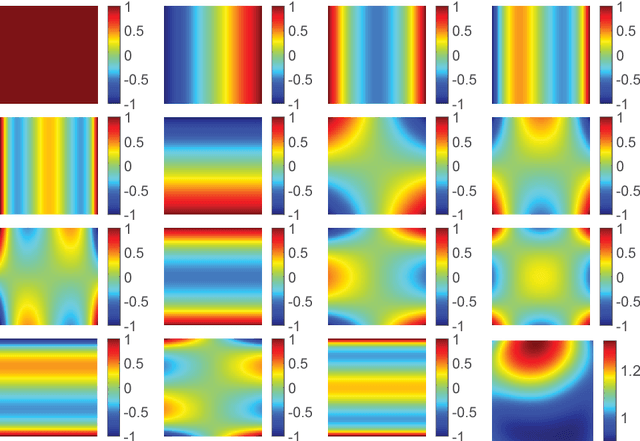
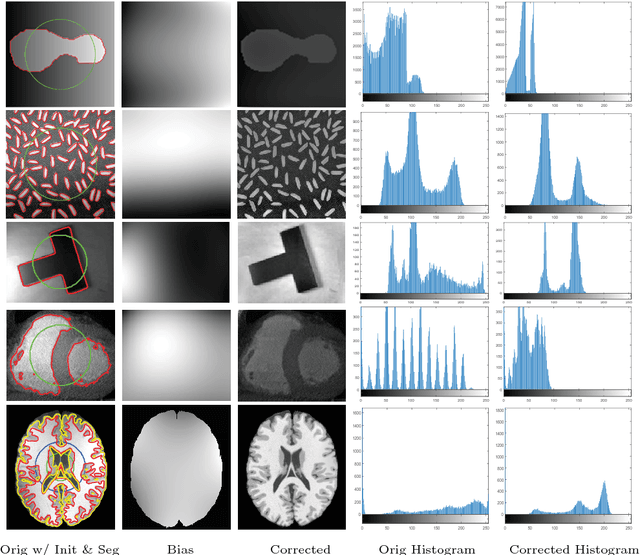
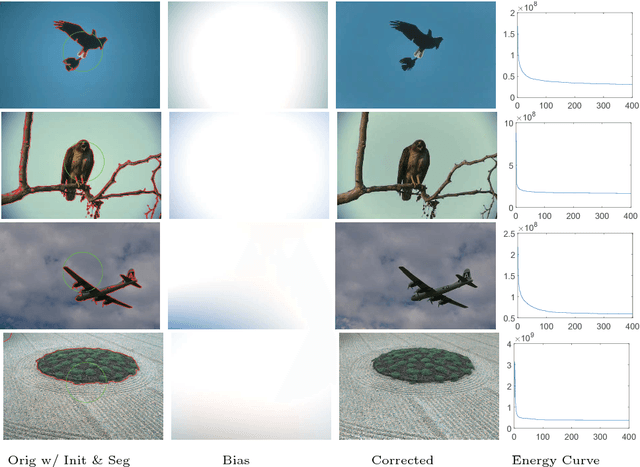
Image segmentation is still an open problem especially when intensities of the interested objects are overlapped due to the presence of intensity inhomogeneity (also known as bias field). To segment images with intensity inhomogeneities, a bias correction embedded level set model is proposed where Inhomogeneities are Estimated by Orthogonal Primary Functions (IEOPF). In the proposed model, the smoothly varying bias is estimated by a linear combination of a given set of orthogonal primary functions. An inhomogeneous intensity clustering energy is then defined and membership functions of the clusters described by the level set function are introduced to rewrite the energy as a data term of the proposed model. Similar to popular level set methods, a regularization term and an arc length term are also included to regularize and smooth the level set function, respectively. The proposed model is then extended to multichannel and multiphase patterns to segment colourful images and images with multiple objects, respectively. It has been extensively tested on both synthetic and real images that are widely used in the literature and public BrainWeb and IBSR datasets. Experimental results and comparison with state-of-the-art methods demonstrate that advantages of the proposed model in terms of bias correction and segmentation accuracy.