 Add to Chrome
 Add to Firefox
 Add to Edge
Distance-aware Soft Prompt Learning for Multimodal Valence-Arousal Estimation
Mar 12, 2026
Valence-arousal (VA) estimation is crucial for capturing the nuanced nature of human emotions in naturalistic environments. While pre-trained Vision-Language models like CLIP have shown remarkable semantic alignment capabilities, their application in continuous regression tasks is often limited by the discrete nature of text prompts. In this paper, we propose a novel multimodal framework for VA estimation that introduces Distance-aware Soft Prompt Learning to bridge the gap between semantic space and continuous dimensions. Specifically, we partition the VA space into a 3X3 grid, defining nine emotional regions, each associated with distinct textual descriptions. Rather than a hard categorization, we employ a Gaussian kernel to compute soft labels based on the Euclidean distance between the ground truth coordinates and the region centers, allowing the model to learn fine-grained emotional transitions. For multimodal integration, our architecture utilizes a CLIP image encoder and an Audio Spectrogram Transformer (AST) to extract robust spatial and acoustic features. These features are temporally modeled via Gated Recurrent Units (GRUs) and integrated through a hierarchical fusion scheme that sequentially combines cross-modal attention for alignment and gated fusion for adaptive refinement. Experimental results on the Aff-Wild2 dataset demonstrate that our proposed semantic-guided approach significantly enhances the accuracy of VA estimation, achieving competitive performance in unconstrained ``in-the-wild'' scenarios.

LEAP:D -- A Novel Prompt-based Approach for Domain-Generalized Aerial Object Detection
Nov 14, 2024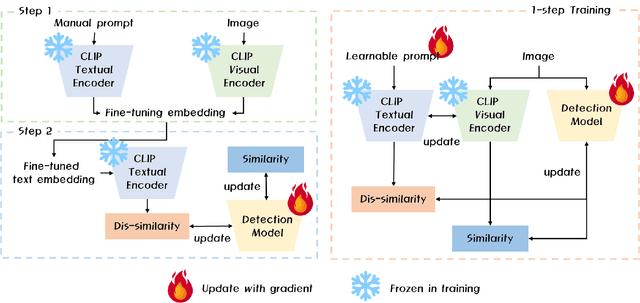
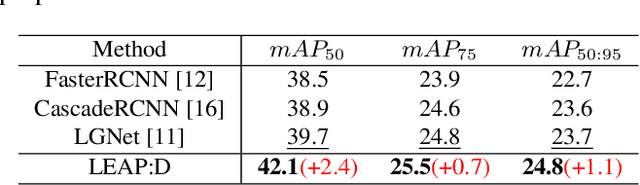
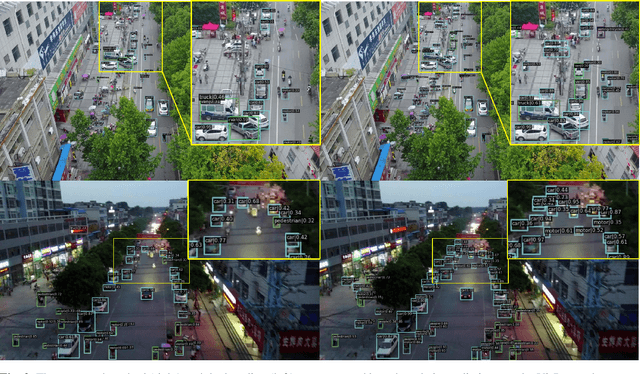
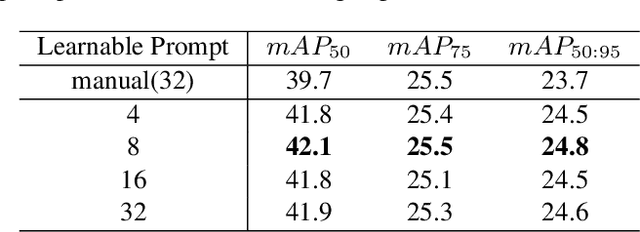
Drone-captured images present significant challenges in object detection due to varying shooting conditions, which can alter object appearance and shape. Factors such as drone altitude, angle, and weather cause these variations, influencing the performance of object detection algorithms. To tackle these challenges, we introduce an innovative vision-language approach using learnable prompts. This shift from conventional manual prompts aims to reduce domain-specific knowledge interference, ultimately improving object detection capabilities. Furthermore, we streamline the training process with a one-step approach, updating the learnable prompt concurrently with model training, enhancing efficiency without compromising performance. Our study contributes to domain-generalized object detection by leveraging learnable prompts and optimizing training processes. This enhances model robustness and adaptability across diverse environments, leading to more effective aerial object detection.