 Add to Chrome
 Add to Firefox
 Add to Edge
Understanding Cross Task Generalization in Handwriting-Based Alzheimer's Screening via Vision Language Adaptation
Nov 08, 2025
Alzheimer's disease is a prevalent neurodegenerative disorder for which early detection is critical. Handwriting-often disrupted in prodromal AD-provides a non-invasive and cost-effective window into subtle motor and cognitive decline. Existing handwriting-based AD studies, mostly relying on online trajectories and hand-crafted features, have not systematically examined how task type influences diagnostic performance and cross-task generalization. Meanwhile, large-scale vision language models have demonstrated remarkable zero or few-shot anomaly detection in natural images and strong adaptability across medical modalities such as chest X-ray and brain MRI. However, handwriting-based disease detection remains largely unexplored within this paradigm. To close this gap, we introduce a lightweight Cross-Layer Fusion Adapter framework that repurposes CLIP for handwriting-based AD screening. CLFA implants multi-level fusion adapters within the visual encoder to progressively align representations toward handwriting-specific medical cues, enabling prompt-free and efficient zero-shot inference. Using this framework, we systematically investigate cross-task generalization-training on a specific handwriting task and evaluating on unseen ones-to reveal which task types and writing patterns most effectively discriminate AD. Extensive analyses further highlight characteristic stroke patterns and task-level factors that contribute to early AD identification, offering both diagnostic insights and a benchmark for handwriting-based cognitive assessment.

Hybrid Transformer for Early Alzheimer's Detection: Integration of Handwriting-Based 2D Images and 1D Signal Features
Oct 14, 2024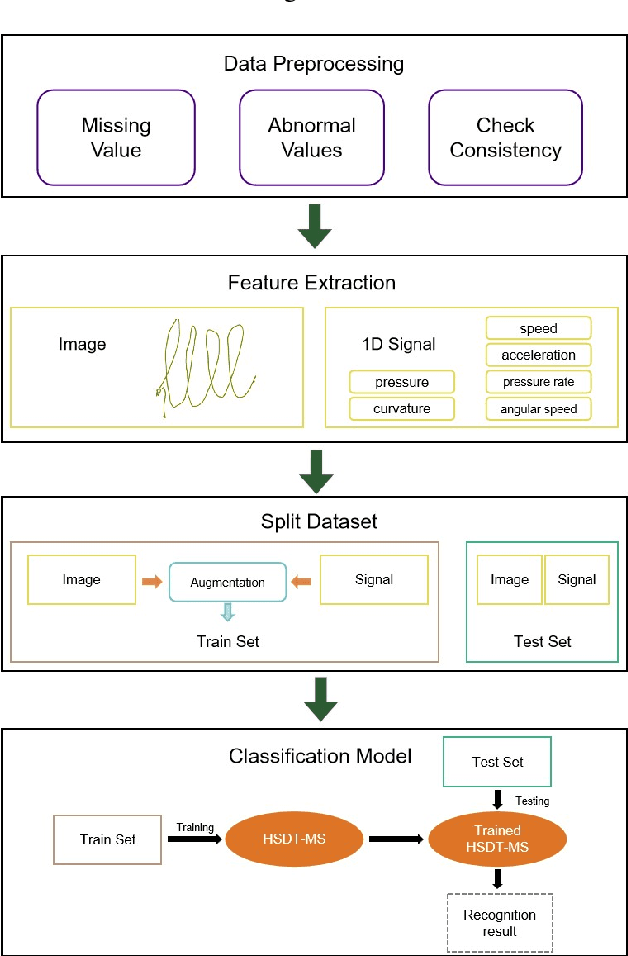
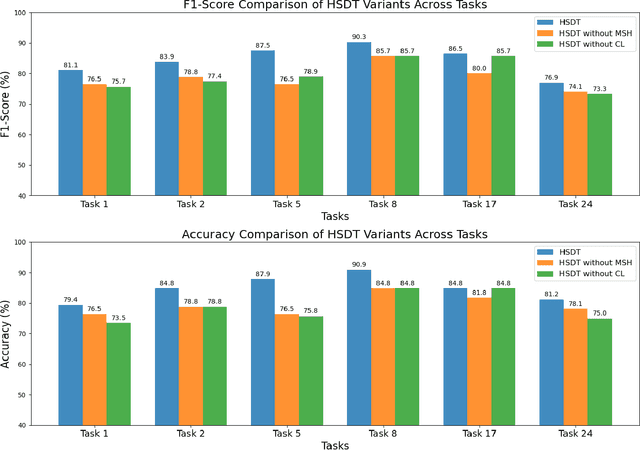
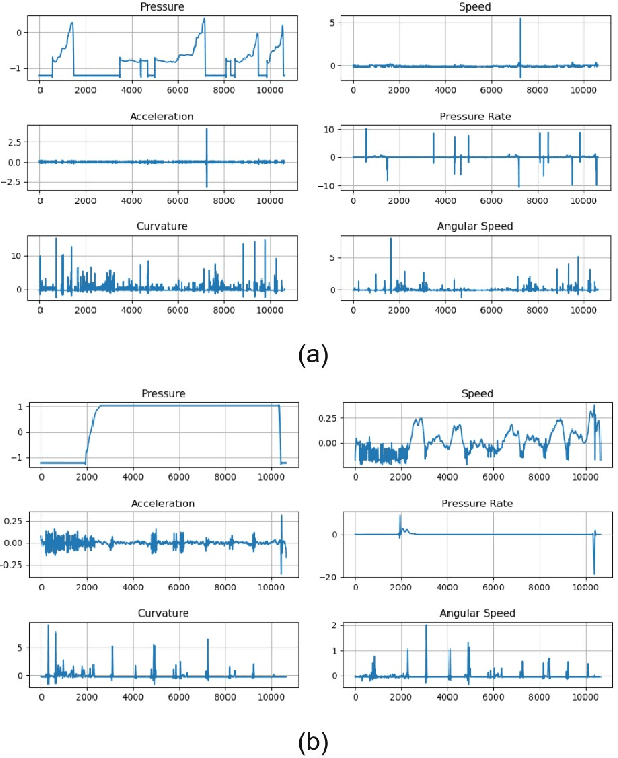
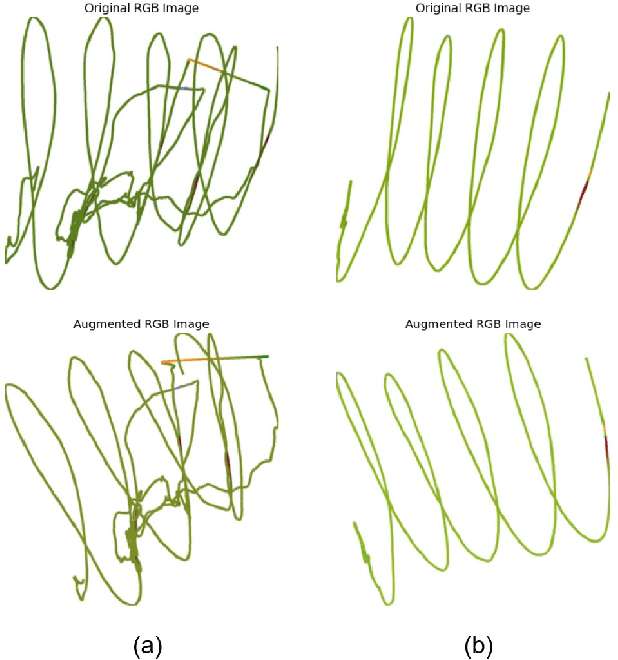
Alzheimer's Disease (AD) is a prevalent neurodegenerative condition where early detection is vital. Handwriting, often affected early in AD, offers a non-invasive and cost-effective way to capture subtle motor changes. State-of-the-art research on handwriting, mostly online, based AD detection has predominantly relied on manually extracted features, fed as input to shallow machine learning models. Some recent works have proposed deep learning (DL)-based models, either 1D-CNN or 2D-CNN architectures, with performance comparing favorably to handcrafted schemes. These approaches, however, overlook the intrinsic relationship between the 2D spatial patterns of handwriting strokes and their 1D dynamic characteristics, thus limiting their capacity to capture the multimodal nature of handwriting data. Moreover, the application of Transformer models remains basically unexplored. To address these limitations, we propose a novel approach for AD detection, consisting of a learnable multimodal hybrid attention model that integrates simultaneously 2D handwriting images with 1D dynamic handwriting signals. Our model leverages a gated mechanism to combine similarity and difference attention, blending the two modalities and learning robust features by incorporating information at different scales. Our model achieved state-of-the-art performance on the DARWIN dataset, with an F1-score of 90.32\% and accuracy of 90.91\% in Task 8 ('L' writing), surpassing the previous best by 4.61% and 6.06% respectively.