 Add to Chrome
 Add to Firefox
 Add to Edge
EAGLE-Pangu: Accelerator-Safe Tree Speculative Decoding on Ascend NPUs
Mar 09, 2026
Autoregressive decoding remains a primary bottleneck in large language model (LLM) serving, motivating speculative decoding methods that reduce expensive teacher-model invocations by verifying multiple candidate tokens per step. Tree-structured speculation further increases parallelism, but is often brittle when ported across heterogeneous backends and accelerator stacks, where attention masking, KV-cache layouts, and indexing semantics are not interchangeable. We present EAGLE-Pangu, a reproducible system that ports EAGLE-3-style tree speculative decoding to a Pangu teacher backend on Ascend NPUs. EAGLE-Pangu contributes (i) an explicit branch/commit cache manager built on the Cache API, (ii) accelerator-safe tree tensorization that removes undefined negative indices by construction and validates structural invariants, and (iii) a fused-kernel-compatible teacher verification path with a debuggable eager fallback. On 240 turns from MT-Bench and HumanEval-style prompts, EAGLE-Pangu improves end-to-end decoding throughput by 1.27x on average, up to 2.46x at p99, over teacher-only greedy decoding in the fused-kernel performance path. We also provide a fused-kernel-free reference path with structured traces and invariant checks to support reproducible debugging and ablation across execution modes and tree budgets.

Exploring the Interactions between Target Positive and Negative Information for Acoustic Echo Cancellation
Jul 26, 2023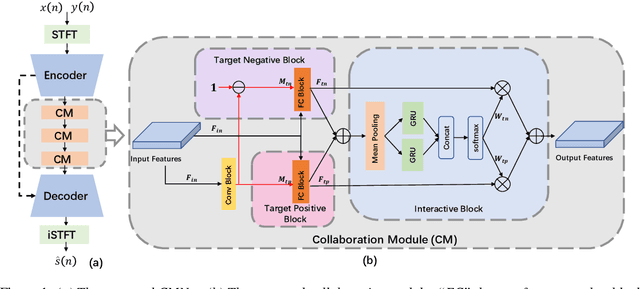

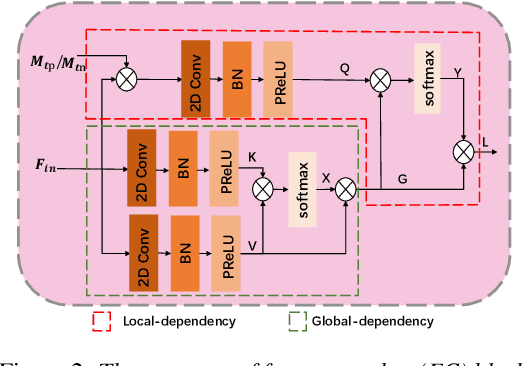

Acoustic echo cancellation (AEC) aims to remove interference signals while leaving near-end speech least distorted. As the indistinguishable patterns between near-end speech and interference signals, near-end speech can't be separated completely, causing speech distortion and interference signals residual. We observe that besides target positive information, e.g., ground-truth speech and features, the target negative information, such as interference signals and features, helps make pattern of target speech and interference signals more discriminative. Therefore, we present a novel AEC model encoder-decoder architecture with the guidance of negative information termed as CMNet. A collaboration module (CM) is designed to establish the correlation between the target positive and negative information in a learnable manner via three blocks: target positive, target negative, and interactive block. Experimental results demonstrate our CMNet achieves superior performance than recent methods.
All Information is Necessary: Integrating Speech Positive and Negative Information by Contrastive Learning for Speech Enhancement
Apr 26, 2023Monaural speech enhancement (SE) is an ill-posed problem due to the irreversible degradation process. Recent methods to achieve SE tasks rely solely on positive information, e.g., ground-truth speech and speech-relevant features. Different from the above, we observe that the negative information, such as original speech mixture and speech-irrelevant features, are valuable to guide the SE model training procedure. In this study, we propose a SE model that integrates both speech positive and negative information for improving SE performance by adopting contrastive learning, in which two innovations have consisted. (1) We design a collaboration module (CM), which contains two parts, contrastive attention for separating relevant and irrelevant features via contrastive learning and interactive attention for establishing the correlation between both speech features in a learnable and self-adaptive manner. (2) We propose a contrastive regularization (CR) built upon contrastive learning to ensure that the estimated speech is pulled closer to the clean speech and pushed far away from the noisy speech in the representation space by integrating self-supervised models. We term the proposed SE network with CM and CR as CMCR-Net. Experimental results demonstrate that our CMCR-Net achieves comparable and superior performance to recent approaches.