 Add to Chrome
 Add to Firefox
 Add to Edge
D-NOVA: In-Storage Retrieval Accelerator via Dual-Bound 3D NAND-Optimized Similarity Search with Vector Adaptation
Jul 20, 2026
Retrieval-Augmented Generation (RAG) enhances the factual grounding of large language model (LLM) inference by retrieving relevant information from external knowledge bases. However, its dense vector retrieval introduces significant latency and energy overhead, becoming the primary performance bottleneck. Although recent in-storage accelerators aim to reduce data movement, they still rely on host or embedded processors outside the memory, where nearly 70% of the total retrieval time is spent. As a result, they cannot fully overcome the bandwidth limitations, leading to yet another memory bottleneck. To tackle these limitations, we present D-NOVA, a hardware-software co-designed in-storage retrieval accelerator. D-NOVA executes an inverted file (IVF)-based hierarchical retrieval pipeline by deeply embedding the search functionality directly into the NAND memory array. This is achieved by incorporating a new distance metric, Dual-Bound Tight Similarity Sensing (DTS), which is specifically tailored for searching within the NAND string. In addition, we introduce a lightweight contrastive adapter that maps embedding vectors into a DTS-friendly domain, recovering near-software recall while improving performance and energy efficiency. D-NOVA is up to 41.7x faster and 71x more energy-efficient than a CPU baseline, and achieves 12.13x higher throughput while being up to 1.26x more energy-efficient than state-of-the-art in-storage RAG accelerators, demonstrating the potential of fully in-storage vector search for scalable RAG acceleration.

Clo-HDnn: A 4.66 TFLOPS/W and 3.78 TOPS/W Continual On-Device Learning Accelerator with Energy-efficient Hyperdimensional Computing via Progressive Search
Jul 23, 2025Clo-HDnn is an on-device learning (ODL) accelerator designed for emerging continual learning (CL) tasks. Clo-HDnn integrates hyperdimensional computing (HDC) along with low-cost Kronecker HD Encoder and weight clustering feature extraction (WCFE) to optimize accuracy and efficiency. Clo-HDnn adopts gradient-free CL to efficiently update and store the learned knowledge in the form of class hypervectors. Its dual-mode operation enables bypassing costly feature extraction for simpler datasets, while progressive search reduces complexity by up to 61% by encoding and comparing only partial query hypervectors. Achieving 4.66 TFLOPS/W (FE) and 3.78 TOPS/W (classifier), Clo-HDnn delivers 7.77x and 4.85x higher energy efficiency compared to SOTA ODL accelerators.
FSL-HDnn: A 5.7 TOPS/W End-to-end Few-shot Learning Classifier Accelerator with Feature Extraction and Hyperdimensional Computing
Sep 17, 2024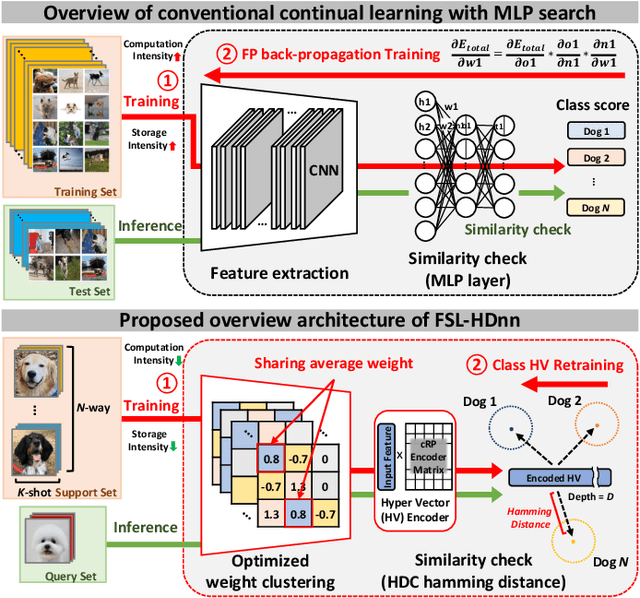
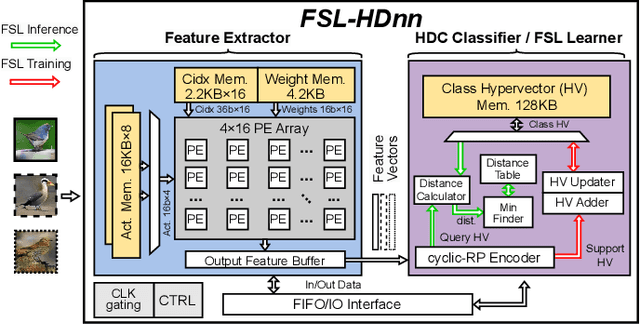
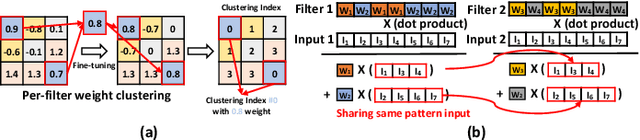
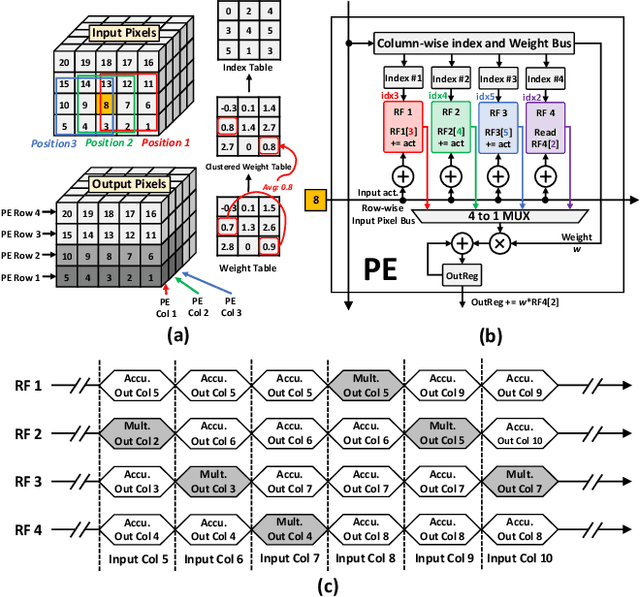
This paper introduces FSL-HDnn, an energy-efficient accelerator that implements the end-to-end pipeline of feature extraction, classification, and on-chip few-shot learning (FSL) through gradient-free learning techniques in a 40 nm CMOS process. At its core, FSL-HDnn integrates two low-power modules: Weight clustering feature extractor and Hyperdimensional Computing (HDC). Feature extractor utilizes advanced weight clustering and pattern reuse strategies for optimized CNN-based feature extraction. Meanwhile, HDC emerges as a novel approach for lightweight FSL classifier, employing hyperdimensional vectors to improve training accuracy significantly compared to traditional distance-based approaches. This dual-module synergy not only simplifies the learning process by eliminating the need for complex gradients but also dramatically enhances energy efficiency and performance. Specifically, FSL-HDnn achieves an Intensity unprecedented energy efficiency of 5.7 TOPS/W for feature 1 extraction and 0.78 TOPS/W for classification and learning Training Intensity phases, achieving improvements of 2.6X and 6.6X, respectively, Storage over current state-of-the-art CNN and FSL processors.