 Add to Chrome
 Add to Firefox
 Add to Edge
Towards Sustainable Universal Deepfake Detection with Frequency-Domain Masking
Dec 08, 2025
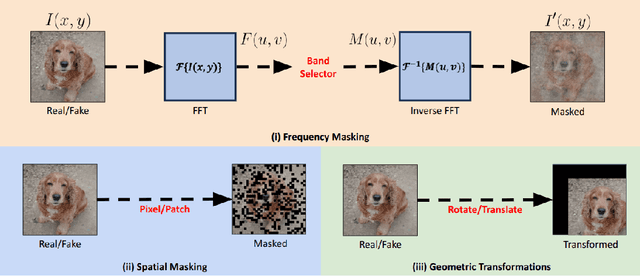
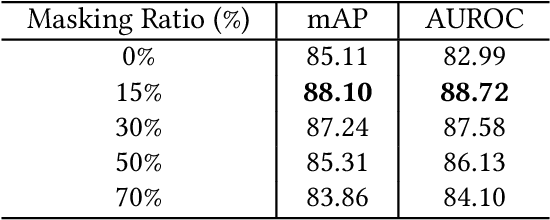
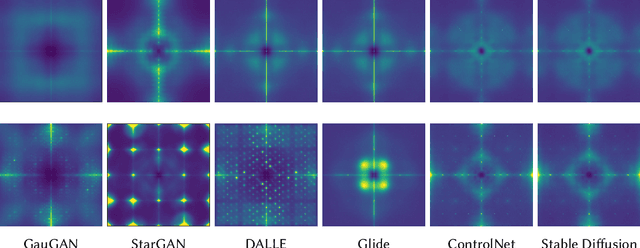
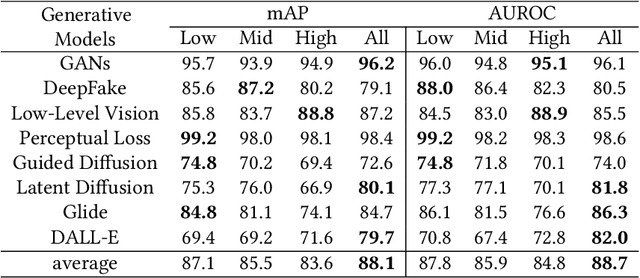
Universal deepfake detection aims to identify AI-generated images across a broad range of generative models, including unseen ones. This requires robust generalization to new and unseen deepfakes, which emerge frequently, while minimizing computational overhead to enable large-scale deepfake screening, a critical objective in the era of Green AI. In this work, we explore frequency-domain masking as a training strategy for deepfake detectors. Unlike traditional methods that rely heavily on spatial features or large-scale pretrained models, our approach introduces random masking and geometric transformations, with a focus on frequency masking due to its superior generalization properties. We demonstrate that frequency masking not only enhances detection accuracy across diverse generators but also maintains performance under significant model pruning, offering a scalable and resource-conscious solution. Our method achieves state-of-the-art generalization on GAN- and diffusion-generated image datasets and exhibits consistent robustness under structured pruning. These results highlight the potential of frequency-based masking as a practical step toward sustainable and generalizable deepfake detection. Code and models are available at: [https://github.com/chandlerbing65nm/FakeImageDetection](https://github.com/chandlerbing65nm/FakeImageDetection).

Mask to Adapt: Simple Random Masking Enables Robust Continual Test-Time Learning
Dec 08, 2025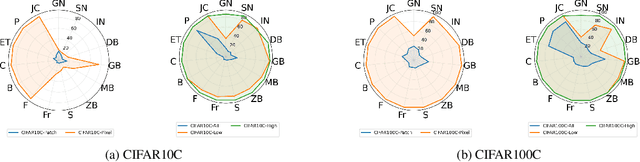
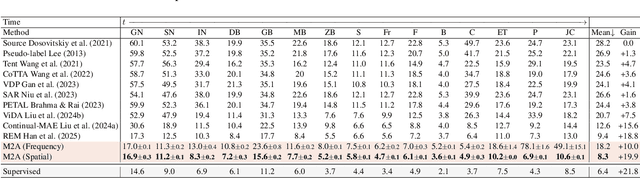
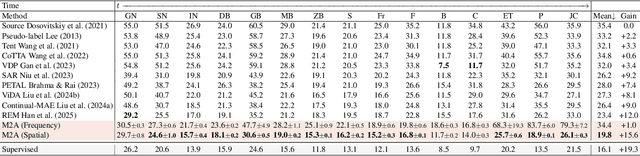
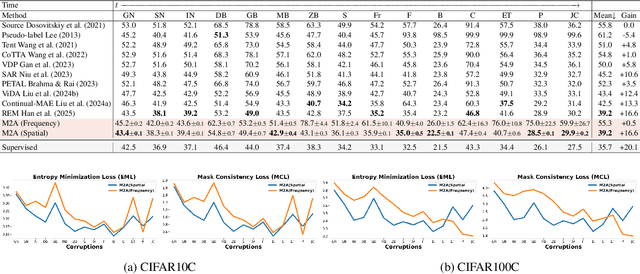
Distribution shifts at test time degrade image classifiers. Recent continual test-time adaptation (CTTA) methods use masking to regulate learning, but often depend on calibrated uncertainty or stable attention scores and introduce added complexity. We ask: do we need custom-made masking designs, or can a simple random masking schedule suffice under strong corruption? We introduce Mask to Adapt (M2A), a simple CTTA approach that generates a short sequence of masked views (spatial or frequency) and adapts with two objectives: a mask consistency loss that aligns predictions across different views and an entropy minimization loss that encourages confident outputs. Motivated by masked image modeling, we study two common masking families -- spatial masking and frequency masking -- and further compare subtypes within each (spatial: patch vs.\ pixel; frequency: all vs.\ low vs.\ high). On CIFAR10C/CIFAR100C/ImageNetC (severity~5), M2A (Spatial) attains 8.3\%/19.8\%/39.2\% mean error, outperforming or matching strong CTTA baselines, while M2A (Frequency) lags behind. Ablations further show that simple random masking is effective and robust. These results indicate that a simple random masking schedule, coupled with consistency and entropy objectives, is sufficient to drive effective test-time adaptation without relying on uncertainty or attention signals.
Improving the Detection of Small Oriented Objects in Aerial Images
Jan 12, 2024Small oriented objects that represent tiny pixel-area in large-scale aerial images are difficult to detect due to their size and orientation. Existing oriented aerial detectors have shown promising results but are mainly focused on orientation modeling with less regard to the size of the objects. In this work, we proposed a method to accurately detect small oriented objects in aerial images by enhancing the classification and regression tasks of the oriented object detection model. We designed the Attention-Points Network consisting of two losses: Guided-Attention Loss (GALoss) and Box-Points Loss (BPLoss). GALoss uses an instance segmentation mask as ground-truth to learn the attention features needed to improve the detection of small objects. These attention features are then used to predict box points for BPLoss, which determines the points' position relative to the target oriented bounding box. Experimental results show the effectiveness of our Attention-Points Network on a standard oriented aerial dataset with small object instances (DOTA-v1.5) and on a maritime-related dataset (HRSC2016). The code is publicly available.