 Add to Chrome
 Add to Firefox
 Add to Edge
Topological summaries of fingerprint ridge patterns carry identity information
Jun 20, 2026
Fingerprints are the most widely deployed biometric. Verifying whether two impressions come from the same finger typically relies on minutiae, small landmarks such as skin ridge endings and bifurcations. These landmarks are extracted through a multi-stage pipeline of image enhancement, skeletonization, minutiae detection, and alignment. We investigate an alternative: using topological data analysis to represent the full pattern of skin ridges and valleys directly, bypassing minutiae detection and the downstream matching pipeline. We apply persistent homology, a topological tool that tracks how loops in the ridge pattern form and fill in across spatial scales, producing multi-scale summaries of ridge geometry. We develop and compare a range of verification methods on a standard benchmark dataset, FVC2000 DB1. Even the simplest topological summaries, with no trained parameters, substantially outperform geometry-only baselines. A trained method achieves an AUC of 0.91, while an optimal-transport method excels at the strictest false-accept thresholds, suggesting they capture different aspects of the ridge pattern. Fusing these two approaches yields the best performance at every low false-accept threshold we examine. Our results establish that these topological summaries capture substantial fingerprint identity information, far more effective for verification than raw pixel-level geometry. Because the entire pipeline is openly specified, it offers a transparent complement to minutiae-based systems, and we provide a modular framework for constructing, evaluating, and combining topological verification methods.

Capturing Dynamics of Time-Varying Data via Topology
Oct 07, 2020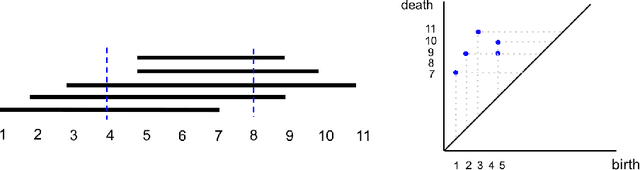
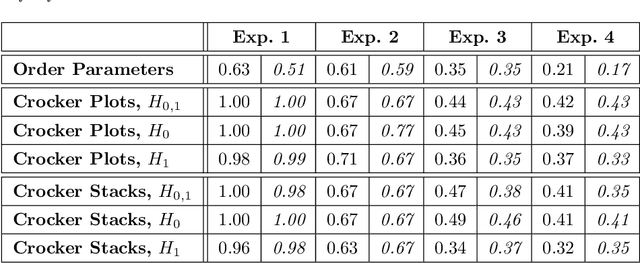
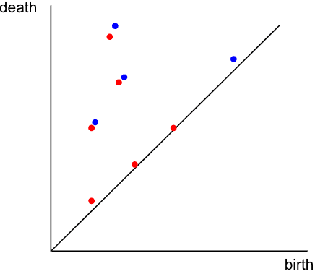
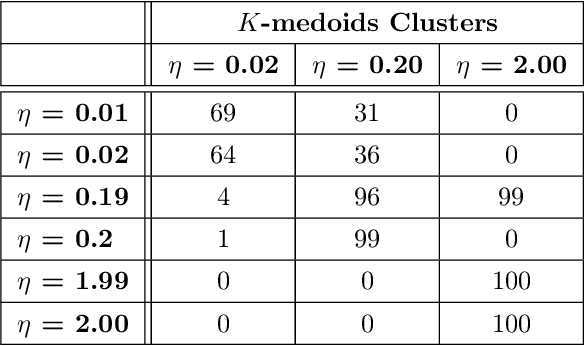
One approach to understanding complex data is to study its shape through the lens of algebraic topology. While the early development of topological data analysis focused primarily on static data, in recent years, theoretical and applied studies have turned to data that varies in time. A time-varying collection of metric spaces as formed, for example, by a moving school of fish or flock of birds, can contain a vast amount of information. There is often a need to simplify or summarize the dynamic behavior. We provide an introduction to topological summaries of time-varying metric spaces including vineyards [17], crocker plots [52], and multiparameter rank functions [34]. We then introduce a new tool to summarize time-varying metric spaces: a crocker stack. Crocker stacks are convenient for visualization, amenable to machine learning, and satisfy a desirable stability property which we prove. We demonstrate the utility of crocker stacks for a parameter identification task involving an influential model of biological aggregations [54]. Altogether, we aim to bring the broader applied mathematics community up-to-date on topological summaries of time-varying metric spaces.