 Add to Chrome
 Add to Firefox
 Add to Edge
Embedding ISO 10218 Safety Compliance in Robots via Control Barrier Functions for Human-Robot Collaboration
Jun 11, 2026
Human-Robot Collaboration (HRC) requires strict adherence to safety standards, such as ISO 10218, to prevent harmful interactions. Standard Speed and Separation Monitoring (SSM) filters calculate safe robotic speeds based on conservative assumptions, such as constant human velocity, which prevents accurate predictions of minimum separation distances and causes unnecessary operational halts. This paper proposes a Control Barrier Function (CBF) that explicitly incorporates human acceleration data to analytically forward-predict the minimum human-robot separation distance during a worst-case robotic stopping trajectory. To guarantee safety at the control level, this predictive CBF is integrated as an inequality constraint within a Sequential Quadratic Programming (SQP) framework. Specifically, two methods are proposed: Method I, a CBF-constrained PD safety filter; and Method II, a task-scaling SQP controller that enforces a spatial tube constraint. Simulated and real-world experiments on a UR10e robot evaluate the two proposed methods against a standard industrial SSM module baseline. Results demonstrate that Method II dynamically modulates execution speed and confines spatial deviations. Compared to Method I, Method II achieves a 63\% reduction in mean trajectory error and avoids excessive evasive manoeuvres, ensuring high task throughput while complying with ISO 10218 SSM guidelines.

Reactive and Safety-Aware Path Replanning for Collaborative Applications
Mar 10, 2025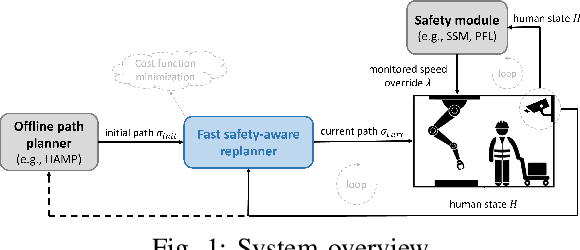
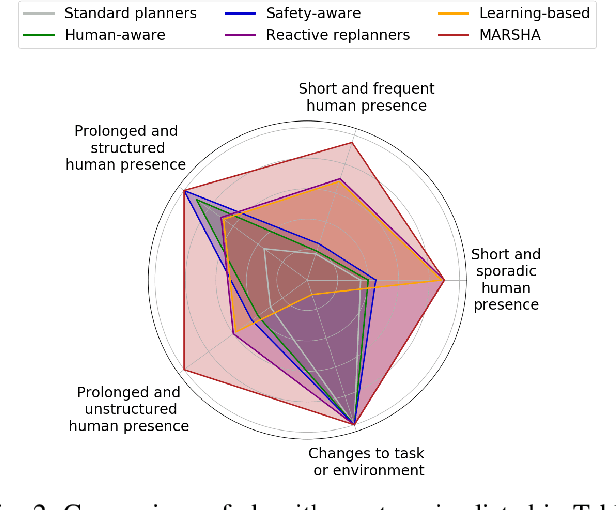
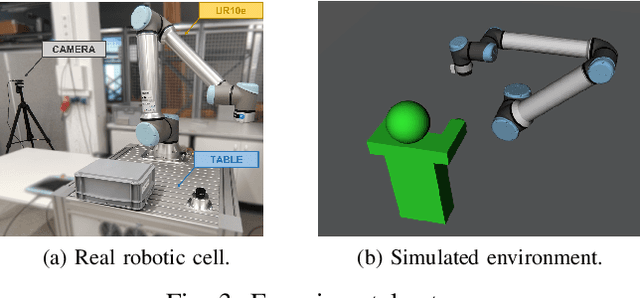

This paper addresses motion replanning in human-robot collaborative scenarios, emphasizing reactivity and safety-compliant efficiency. While existing human-aware motion planners are effective in structured environments, they often struggle with unpredictable human behavior, leading to safety measures that limit robot performance and throughput. In this study, we combine reactive path replanning and a safety-aware cost function, allowing the robot to adjust its path to changes in the human state. This solution reduces the execution time and the need for trajectory slowdowns without sacrificing safety. Simulations and real-world experiments show the method's effectiveness compared to standard human-robot cooperation approaches, with efficiency enhancements of up to 60\%.
OpenMORE: an open-source tool for sampling-based path replanning in ROS
Nov 30, 2023With the spread of robots in unstructured, dynamic environments, the topic of path replanning has gained importance in the robotics community. Although the number of replanning strategies has significantly increased, there is a lack of agreed-upon libraries and tools, making the use, development, and benchmarking of new algorithms arduous. This paper introduces OpenMORE, a new open-source ROS-based C++ library for sampling-based path replanning algorithms. The library builds a framework that allows for continuous replanning and collision checking of the traversed path during the execution of the robot trajectory. Users can solve replanning tasks exploiting the already available algorithms and can easily integrate new ones, leveraging the library to manage the entire execution.
* Accepted at IEEE ETFA 2023
Anytime informed path re-planning and optimization for robots in changing environments
Mar 24, 2021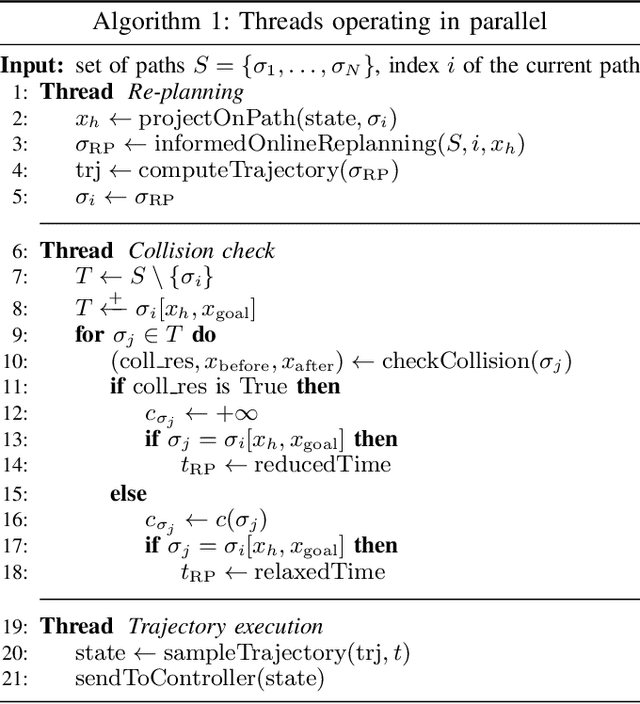
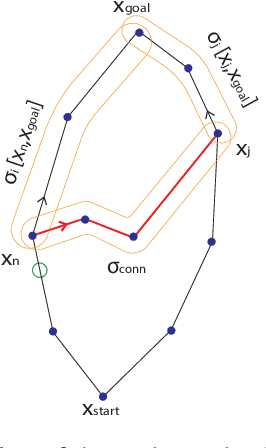
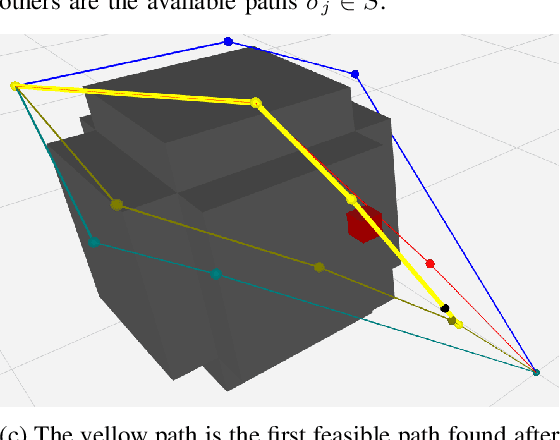
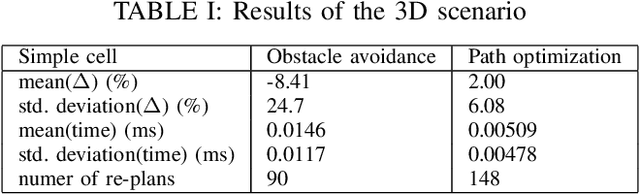
In this paper, we propose a path re-planning algorithm that makes robots able to work in scenarios with moving obstacles. The algorithm switches between a set of pre-computed paths to avoid collisions with moving obstacles. It also improves the current path in an anytime fashion. The use of informed sampling enhances the search speed. Numerical results show the effectiveness of the strategy in different simulation scenarios.