 Add to Chrome
 Add to Firefox
 Add to Edge
Optimizing Multidimensional Scaling in Gini Metric Spaces
May 24, 2026
The Gini Multidimensional Scaling (Gini MDS) framework extends the Euclidean multidimensional scaling. We introduce a Gini pseudo-distance based on values and their ranks that depends on a fine-tunable hyperparameter. This pseudo-distance allows flexible exploration of latent configurations, enabling embeddings that best match observed dissimilarities. The Gini MDS is shown to be robust to noise and outliers, making it well-suited for real-world applications. We provide experiments on 16 UCI datasets with outliers and on MNIST images with noise to show that the Gini MDS outperforms the Euclidean MDS on noisy data. Finally, a tensor-based implementation in \texttt{PyTorch} provides GPU acceleration and efficient computation compared to the standard MDS of the \texttt{sklearn} library.

KNN and K-means in Gini Prametric Spaces
Jan 29, 2025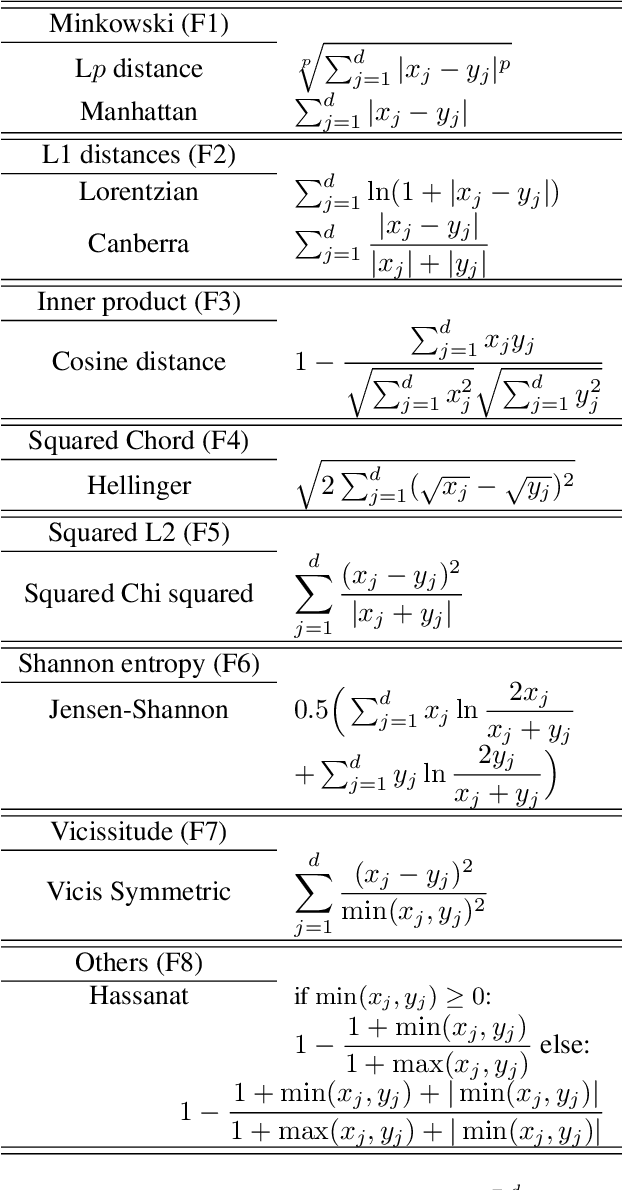
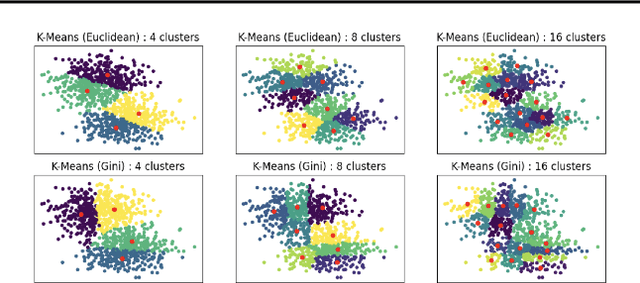
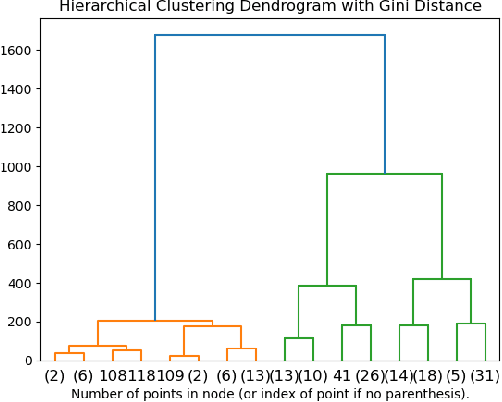
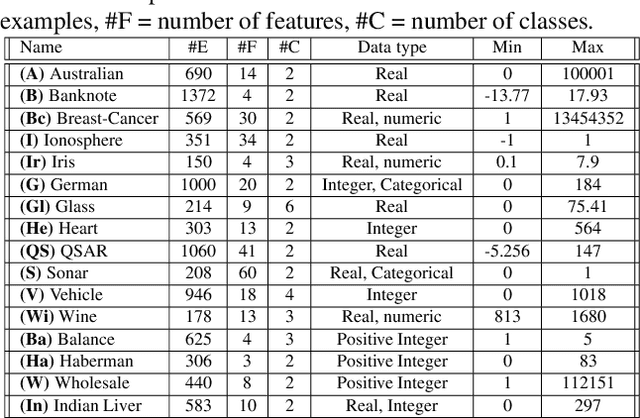
This paper introduces innovative enhancements to the K-means and K-nearest neighbors (KNN) algorithms based on the concept of Gini prametric spaces. Unlike traditional distance metrics, Gini-based measures incorporate both value-based and rank-based information, improving robustness to noise and outliers. The main contributions of this work include: proposing a Gini-based measure that captures both rank information and value distances; presenting a Gini K-means algorithm that is proven to converge and demonstrates resilience to noisy data; and introducing a Gini KNN method that performs competitively with state-of-the-art approaches such as Hassanat's distance in noisy environments. Experimental evaluations on 14 datasets from the UCI repository demonstrate the superior performance and efficiency of Gini-based algorithms in clustering and classification tasks. This work opens new avenues for leveraging rank-based measures in machine learning and statistical analysis.