 Add to Chrome
 Add to Firefox
 Add to Edge
Rethinking Reinforcement Fine-Tuning in LVLM: Convergence, Reward Decomposition, and Generalization
Apr 21, 2026
Reinforcement fine-tuning with verifiable rewards (RLVR) has emerged as a powerful paradigm for equipping large vision-language models (LVLMs) with agentic capabilities such as tool use and multi-step reasoning. Despite striking empirical successes, most notably Visual Agentic Reinforcement Fine-Tuning (Visual-ARFT), the theoretical underpinnings of this paradigm remain poorly understood. In particular, two critical questions lack rigorous answers: (i)~how does the composite structure of verifiable rewards (format compliance, answer accuracy, tool executability) affect the convergence of Group Relative Policy Optimization (GRPO), and (ii)~why does training on a small set of tool-augmented tasks transfer to out-of-distribution domains? We address these gaps by introducing the \emph{Tool-Augmented Markov Decision Process} (TA-MDP), a formal framework that models multimodal agentic decision-making with bounded-depth tool calls. Within this framework, we establish three main results. First, we prove that GRPO under composite verifiable rewards converges to a first-order stationary point at rate $O(1/\sqrt{T})$ with explicit dependence on the number of reward components and group size (\textbf{Theorem~1}). Second, we derive a \emph{Reward Decomposition Theorem} that bounds the sub-optimality gap between decomposed per-component optimization and joint optimization, providing a precise characterization of when reward decomposition is beneficial (\textbf{Theorem~2}). Third, we establish a PAC-Bayes generalization bound for tool-augmented policies that explains the strong out-of-distribution transfer observed in Visual-ARFT (\textbf{Theorem~3}).

Evidence-Driven Marker Extraction for Social Media Suicide Risk Detection
Feb 26, 2025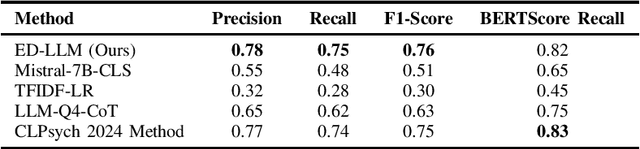
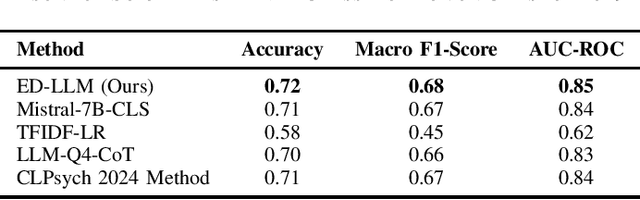

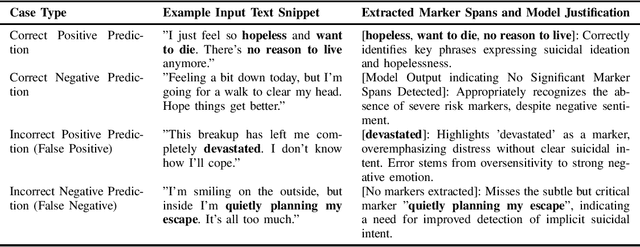
Early detection of suicide risk from social media text is crucial for timely intervention. While Large Language Models (LLMs) offer promising capabilities in this domain, challenges remain in terms of interpretability and computational efficiency. This paper introduces Evidence-Driven LLM (ED-LLM), a novel approach for clinical marker extraction and suicide risk classification. ED-LLM employs a multi-task learning framework, jointly training a Mistral-7B based model to identify clinical marker spans and classify suicide risk levels. This evidence-driven strategy enhances interpretability by explicitly highlighting textual evidence supporting risk assessments. Evaluated on the CLPsych datasets, ED-LLM demonstrates competitive performance in risk classification and superior capability in clinical marker span identification compared to baselines including fine-tuned LLMs, traditional machine learning, and prompt-based methods. The results highlight the effectiveness of multi-task learning for interpretable and efficient LLM-based suicide risk assessment, paving the way for clinically relevant applications.