 Add to Chrome
 Add to Firefox
 Add to Edge
Model in Distress: Sentiment Analysis on French Synthetic Social Media
Apr 20, 2026
Automated analysis of customer feedback on social media is hindered by three challenges: the high cost of annotated training data, the scarcity of evaluation sets, especially in multilingual settings, and privacy concerns that prevent data sharing and reproducibility. We address these issues by developing a generalizable synthetic data generation pipeline applied to a case study on customer distress detection in French public transportation. Our approach utilizes backtranslation with fine-tuned models to generate 1.7 million synthetic tweets from a small seed corpus, complemented by synthetic reasoning traces. We train 600M-parameter reasoners with English and French reasoning that achieve 77-79% accuracy on human-annotated evaluation data, matching or exceeding SOTA proprietary LLMs and specialized encoders. Beyond reducing annotation costs, our pipeline preserves privacy by eliminating the exposure of sensitive user data. Our methodology can be adopted for other use cases and languages.

Even Small Reasoners Should Quote Their Sources: Introducing the Pleias-RAG Model Family
Apr 25, 2025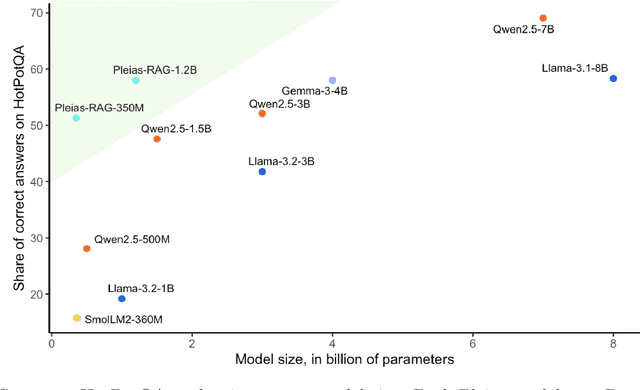
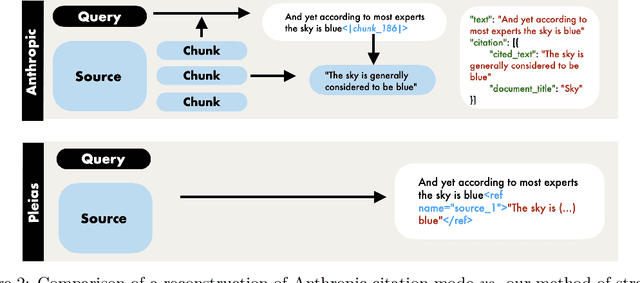
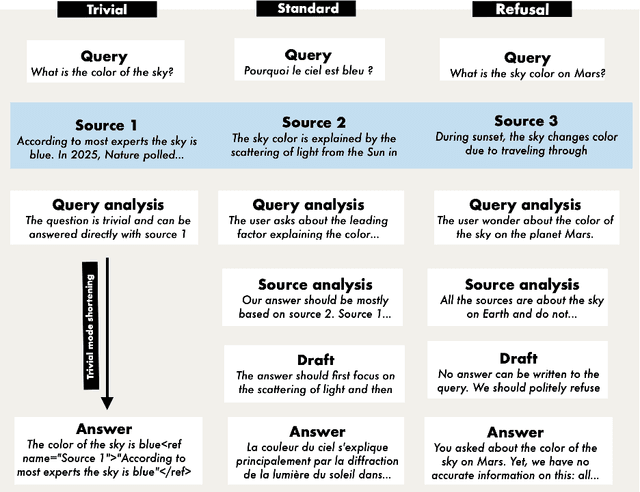
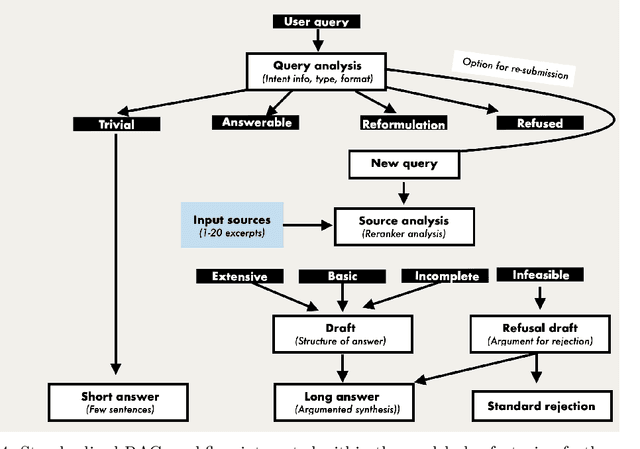
We introduce a new generation of small reasoning models for RAG, search, and source summarization. Pleias-RAG-350m and Pleias-RAG-1B are mid-trained on a large synthetic dataset emulating the retrieval of a wide variety of multilingual open sources from the Common Corpus. They provide native support for citation and grounding with literal quotes and reintegrate multiple features associated with RAG workflows, such as query routing, query reformulation, and source reranking. Pleias-RAG-350m and Pleias-RAG-1B outperform SLMs below 4 billion parameters on standardized RAG benchmarks (HotPotQA, 2wiki) and are competitive with popular larger models, including Qwen-2.5-7B, Llama-3.1-8B, and Gemma-3-4B. They are the only SLMs to date maintaining consistent RAG performance across leading European languages and ensuring systematic reference grounding for statements. Due to their size and ease of deployment on constrained infrastructure and higher factuality by design, the models unlock a range of new use cases for generative AI.