 Add to Chrome
 Add to Firefox
 Add to Edge
The geometry of online conversations and the causal antecedents of conflictual discourse
Feb 17, 2026
This article investigates the causal antecedents of conflictual language and the geometry of interaction in online threaded conversations related to climate change. We employ three annotation dimensions, inferred through LLM prompting and averaging, to capture complementary aspects of discursive conflict (such as stance: agreement vs disagreement; tone: attacking vs respectful; and emotional versus factual framing) and use data from a threaded online forum to examine how these dimensions respond to temporal, conversational, and arborescent structural features of discussions. We show that, as suggested by the literature, longer delays between successive posts in a thread are associated with replies that are, on average, more respectful, whereas longer delays relative to the parent post are associated with slightly less disagreement but more emotional (less factual) language. Second, we characterize alignment with the local conversational environment and find strong convergence both toward the average stance, tone and emotional framing of older sibling posts replying to the same parent and toward those of the parent post itself, with parent post effects generally stronger than sibling effects. We further show that early branch-level responses condition these alignment dynamics, such that parent-child stance alignment is amplified or attenuated depending on whether a branch is initiated in agreement or disagreement with the discussion's root message. These influences are largely additive for civility-related dimensions (attacking vs respectful, disagree vs agree), whereas for emotional versus factual framing there is a significant interaction: alignment with the parent's emotionality is amplified when older siblings are similarly aligned.

The Unfolding Structure of Arguments in Online Debates: The case of a No-Deal Brexit
Mar 09, 2021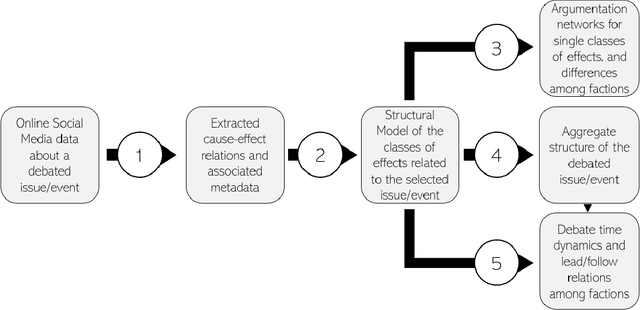
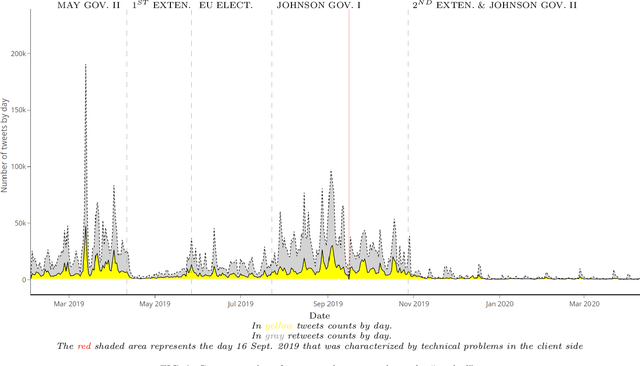
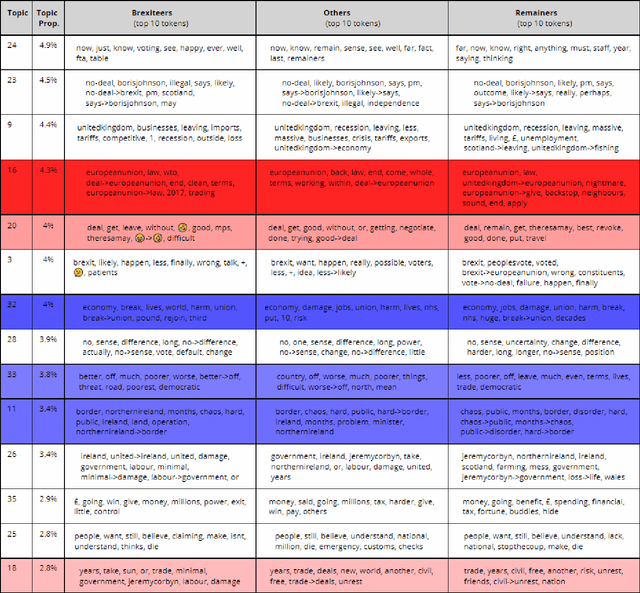
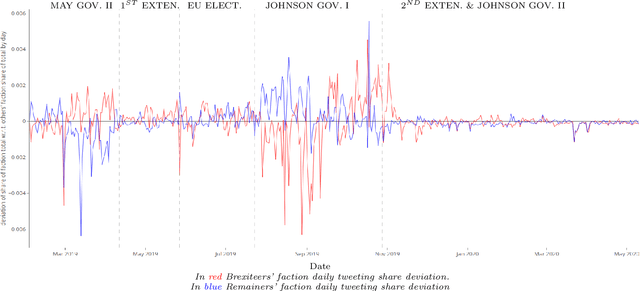
In the last decade, political debates have progressively shifted to social media. Rhetorical devices employed by online actors and factions that operate in these debating arenas can be captured and analysed to conduct a statistical reading of societal controversies and their argumentation dynamics. In this paper, we propose a five-step methodology, to extract, categorize and explore the latent argumentation structures of online debates. Using Twitter data about a "no-deal" Brexit, we focus on the expected effects in case of materialisation of this event. First, we extract cause-effect claims contained in tweets using RegEx that exploit verbs related to Creation, Destruction and Causation. Second, we categorise extracted "no-deal" effects using a Structural Topic Model estimated on unigrams and bigrams. Third, we select controversial effect topics and explore within-topic argumentation differences between self-declared partisan user factions. We hence type topics using estimated covariate effects on topic propensities, then, using the topics correlation network, we study the topological structure of the debate to identify coherent topical constellations. Finally, we analyse the debate time dynamics and infer lead/follow relations among factions. Results show that the proposed methodology can be employed to perform a statistical rhetorics analysis of debates, and map the architecture of controversies across time. In particular, the "no-deal" Brexit debate is shown to have an assortative argumentation structure heavily characterized by factional constellations of arguments, as well as by polarized narrative frames invoked through verbs related to Creation and Destruction. Our findings highlight the benefits of implementing a systemic approach to the analysis of debates, which allows the unveiling of topical and factional dependencies between arguments employed in online debates.