 Add to Chrome
 Add to Firefox
 Add to Edge
Hierarchical Pooling for Sheaf Neural Networks
Jun 18, 2026
Sheaf Neural Networks (SNNs) generalize Graph Neural Networks (GNNs) by replacing scalar node signals with stalk-valued signals and by using restriction maps to measure compatibility across edges. Unlike standard graph diffusion, which encourages neighboring node features to become similar, sheaf diffusion promotes consistency through the restriction maps and can therefore model more general relationships between neighboring nodes. However, existing sheaf neural architectures mainly operate at a fixed graph resolution and do not provide a principled pooling mechanism for building hierarchical representations. In this paper, we introduce Hierarchical Sheaf Pool (HiSP), a sheaf-aware pooling framework based on local spectral coarsening. Given a partition of the graph, HiSP constructs each coarse stalk by projecting fine stalk-valued features onto the low-frequency eigenmodes of the cluster-internal sheaf Laplacian. These local modes define a cochain-level prolongation map, which allows the fine sheaf energy to be represented on the coarse space through a Galerkin operator. We further analyze the approximation induced by coarsening by separating truncation loss, due to discarded local modes, from realization loss, due to representing the projected operator as a coarse sheaf. Finally, we implement HiSP as a GNN pooling layer compatible with SNNs and provide a PyG implementation supporting batching, lifted sheaf Laplacians, and hierarchical architectures.

Torch Geometric Pool: the Pytorch library for pooling in Graph Neural Networks
Dec 14, 2025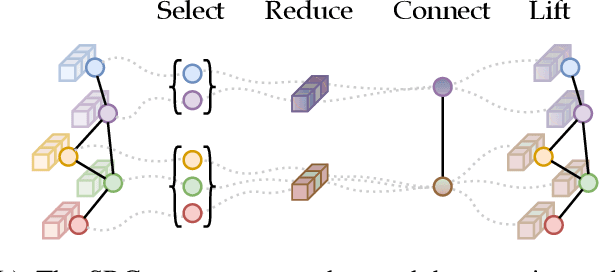
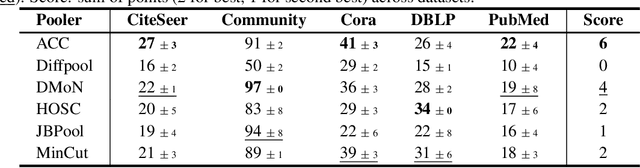
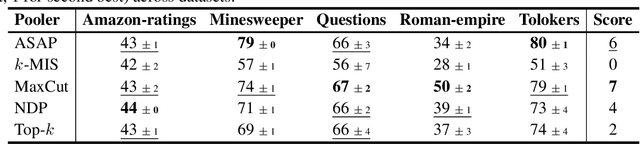
We introduce Torch Geometric Pool (tgp), a library for hierarchical pooling in Graph Neural Networks. Built upon Pytorch Geometric, Torch Geometric Pool (tgp) provides a wide variety of pooling operators, unified under a consistent API and a modular design. The library emphasizes usability and extensibility, and includes features like precomputed pooling, which significantly accelerate training for a class of operators. In this paper, we present tgp's structure and present an extensive benchmark. The latter showcases the library's features and systematically compares the performance of the implemented graph-pooling methods in different downstream tasks. The results, showing that the choice of the optimal pooling operator depends on tasks and data at hand, support the need for a library that enables fast prototyping.
MaxCutPool: differentiable feature-aware Maxcut for pooling in graph neural networks
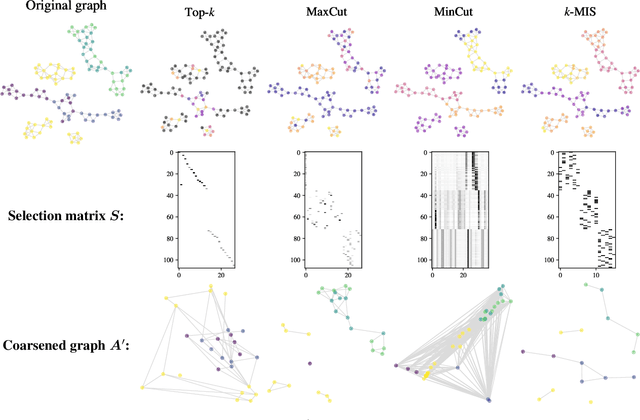
Sep 10, 2024We propose a novel approach to compute the MAXCUT in attributed graphs, i.e., graphs with features associated with nodes and edges. Our approach is robust to the underlying graph topology and is fully differentiable, making it possible to find solutions that jointly optimize the MAXCUT along with other objectives. Based on the obtained MAXCUT partition, we implement a hierarchical graph pooling layer for Graph Neural Networks, which is sparse, differentiable, and particularly suitable for downstream tasks on heterophilic graphs.