 Add to Chrome
 Add to Firefox
 Add to Edge
Solomonoff-Inspired Hypothesis Ranking with LLMs for Prediction Under Uncertainty
Dec 22, 2025
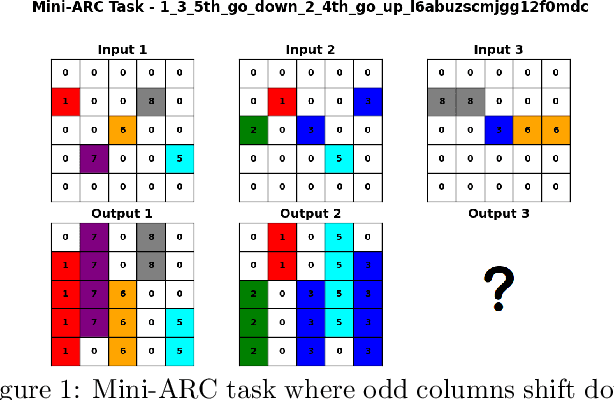
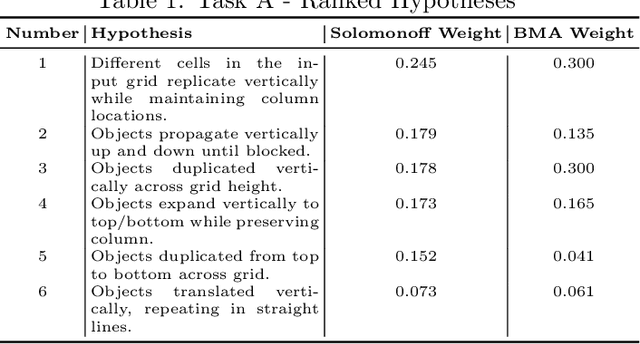

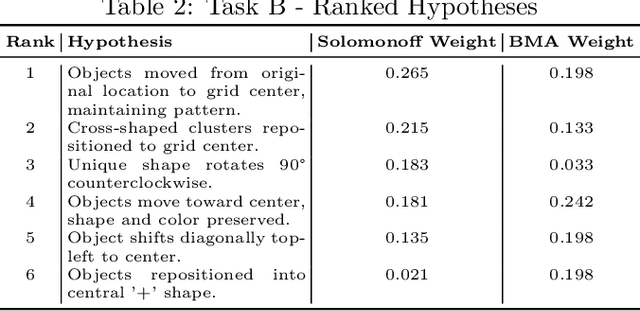
Reasoning under uncertainty is a key challenge in AI, especially for real-world tasks, where problems with sparse data demands systematic generalisation. Existing approaches struggle to balance accuracy and simplicity when evaluating multiple candidate solutions. We propose a Solomonoff-inspired method that weights LLM-generated hypotheses by simplicity and predictive fit. Applied to benchmark (Mini-ARC) tasks, our method produces Solomonoff-weighted mixtures for per-cell predictions, yielding conservative, uncertainty-aware outputs even when hypotheses are noisy or partially incorrect. Compared to Bayesian Model Averaging (BMA), Solomonoff scoring spreads probability more evenly across competing hypotheses, while BMA concentrates weight on the most likely but potentially flawed candidates. Across tasks, this highlights the value of algorithmic information-theoretic priors for interpretable, reliable multi-hypothesis reasoning under uncertainty.

Active Vibration Fluidization for Granular Jamming Grippers
Dec 13, 2022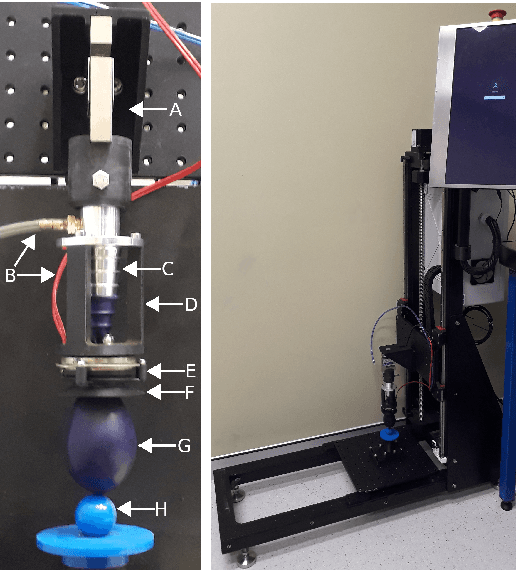


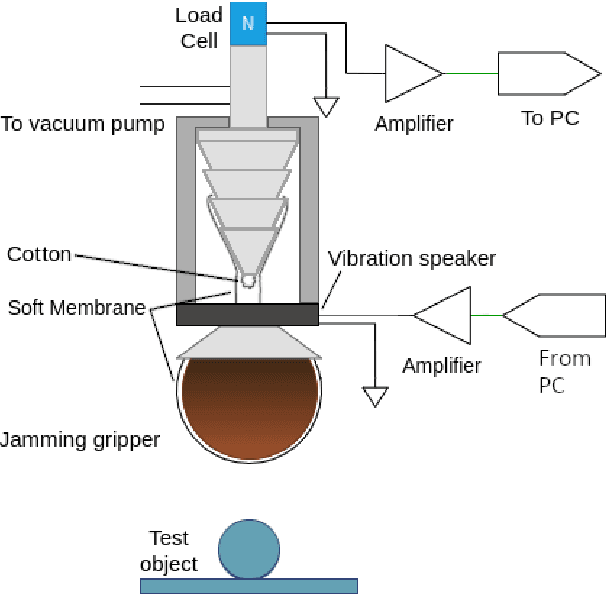
Granular jamming has recently become popular in soft robotics with widespread applications including industrial gripping, surgical robotics and haptics. Previous work has investigated the use of various techniques that exploit the nature of granular physics to improve jamming performance, however this is generally underrepresented in the literature compared to its potential impact. We present the first research that exploits vibration-based fluidisation actively (e.g., during a grip) to elicit bespoke performance from granular jamming grippers. We augment a conventional universal gripper with a computer-controllled audio exciter, which is attached to the gripper via a 3D printed mount, and build an automated test rig to allow large-scale data collection to explore the effects of active vibration. We show that vibration in soft jamming grippers can improve holding strength. In a series of studies, we show that frequency and amplitude of the waveforms are key determinants to performance, and that jamming performance is also dependent on temporal properties of the induced waveform. We hope to encourage further study focused on active vibrational control of jamming in soft robotics to improve performance and increase diversity of potential applications.