 Add to Chrome
 Add to Firefox
 Add to Edge
Can we trust AI to detect healthy multilingual English speakers among the cognitively impaired cohort in the UK? An investigation using real-world conversational speech
Feb 13, 2026
Conversational speech often reveals early signs of cognitive decline, such as dementia and MCI. In the UK, one in four people belongs to an ethnic minority, and dementia prevalence is expected to rise most rapidly among Black and Asian communities. This study examines the trustworthiness of AI models, specifically the presence of bias, in detecting healthy multilingual English speakers among the cognitively impaired cohort, to make these tools clinically beneficial. For experiments, monolingual participants were recruited nationally (UK), and multilingual speakers were enrolled from four community centres in Sheffield and Bradford. In addition to a non-native English accent, multilinguals spoke Somali, Chinese, or South Asian languages, who were further divided into two Yorkshire accents (West and South) to challenge the efficiency of the AI tools thoroughly. Although ASR systems showed no significant bias across groups, classification and regression models using acoustic and linguistic features exhibited bias against multilingual speakers, particularly in memory, fluency, and reading tasks. This bias was more pronounced when models were trained on the publicly available DementiaBank dataset. Moreover, multilinguals were more likely to be misclassified as having cognitive decline. This study is the first of its kind to discover that, despite their strong overall performance, current AI models show bias against multilingual individuals from ethnic minority backgrounds in the UK, and they are also more likely to misclassify speakers with a certain accent (South Yorkshire) as living with a more severe cognitive decline. In this pilot study, we conclude that the existing AI tools are therefore not yet reliable for diagnostic use in these populations, and we aim to address this in future work by developing more generalisable, bias-mitigated models.

CognoSpeak: an automatic, remote assessment of early cognitive decline in real-world conversational speech
Jan 10, 2025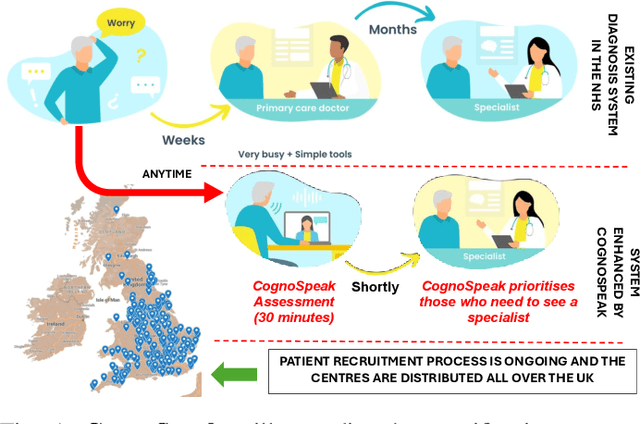
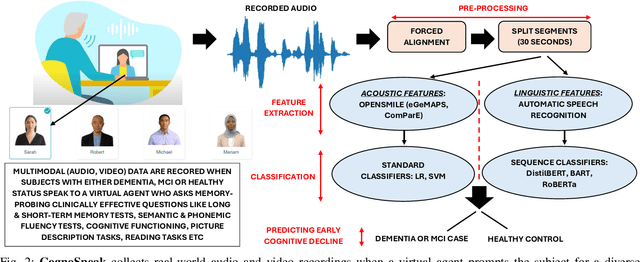
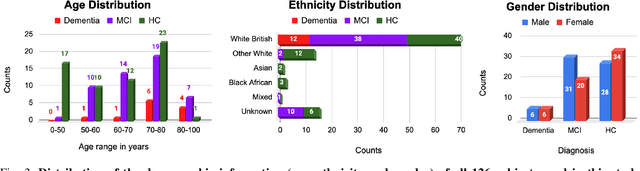
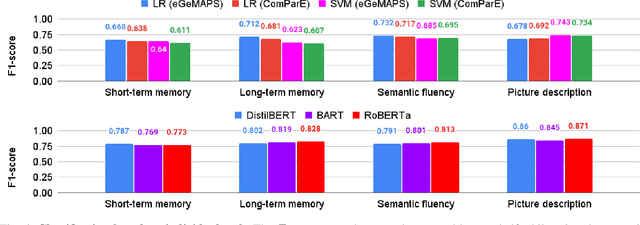
The early signs of cognitive decline are often noticeable in conversational speech, and identifying those signs is crucial in dealing with later and more serious stages of neurodegenerative diseases. Clinical detection is costly and time-consuming and although there has been recent progress in the automatic detection of speech-based cues, those systems are trained on relatively small databases, lacking detailed metadata and demographic information. This paper presents CognoSpeak and its associated data collection efforts. CognoSpeak asks memory-probing long and short-term questions and administers standard cognitive tasks such as verbal and semantic fluency and picture description using a virtual agent on a mobile or web platform. In addition, it collects multimodal data such as audio and video along with a rich set of metadata from primary and secondary care, memory clinics and remote settings like people's homes. Here, we present results from 126 subjects whose audio was manually transcribed. Several classic classifiers, as well as large language model-based classifiers, have been investigated and evaluated across the different types of prompts. We demonstrate a high level of performance; in particular, we achieved an F1-score of 0.873 using a DistilBERT model to discriminate people with cognitive impairment (dementia and people with mild cognitive impairment (MCI)) from healthy volunteers using the memory responses, fluency tasks and cookie theft picture description. CognoSpeak is an automatic, remote, low-cost, repeatable, non-invasive and less stressful alternative to existing clinical cognitive assessments.