 Add to Chrome
 Add to Firefox
 Add to Edge
ScaLe-INR: Scale and Learn Implicit Neural Representations
Jun 26, 2026
Implicit Neural Representations (INRs) parameterized by multilayer perceptrons excel at modeling continuous signals. However, a key challenge persists as INRs fundamentally suffer from spectral bias and information cross-talk. When a single network attempts to capture multi-scale phenomena, high-frequency weight updates destructively interfere with the underlying low-frequency structural approximation. We introduce Scale and Learn INR (ScaLe-INR), a novel multi-branch architecture that resolves these limitations by explicitly matching the signal's frequency spectrum with the optimal operating region of the INR. Drawing upon the Fourier inverse scaling theorem we demonstrate that applying directional coordinate scaling expands a network's representational bandwidth along specific spatial axes. To mathematically enforce functional disentanglement and minimize task-specific information leakage between branches, we propose a Directional Edge Guidance Loss, a spatially-conditioned sparsity prior derived from ground-truth gradients. By constraining the high-frequency branches to act as strict, localized edge-filters, ScaLe-INR eliminates spectral cross-talk, accelerates convergence, and achieves high-fidelity signal reconstruction on complex multi-scale topologies. We evaluate ScaLe-INR across diverse reconstruction and inverse tasks, demonstrating substantial performance gains over existing state-of-the-art (SOTA) methods. The proposed architecture improves upon the nearest baselines by +5.16 dB in image reconstruction and +0.65 dB in image denoising. Furthermore, it achieve an impressive figure of 50.02 dB on audio reconstruction and 0.999 IOU(Intersection Over Union) on 3D reconstruction which beats the all SOTA models.

BandRC: Band Shifted Raised Cosine Activated Implicit Neural Representations
May 16, 2025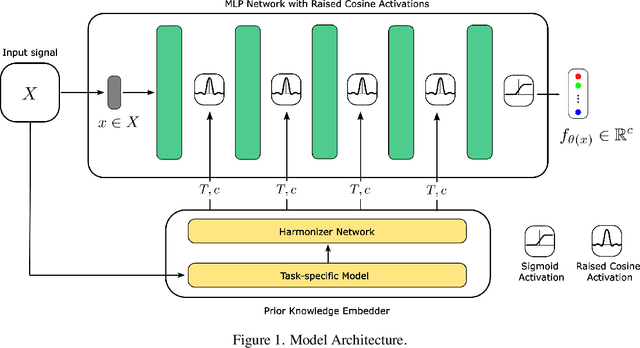
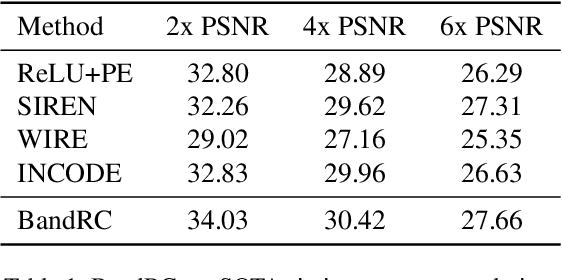
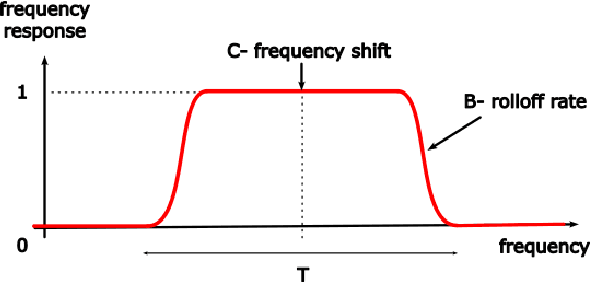
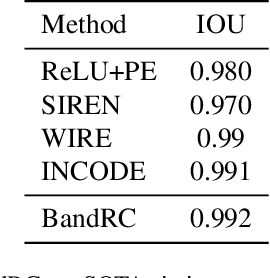
In recent years, implicit neural representations(INRs) have gained popularity in the computer vision community. This is mainly due to the strong performance of INRs in many computer vision tasks. These networks can extract a continuous signal representation given a discrete signal representation. In previous studies, it has been repeatedly shown that INR performance has a strong correlation with the activation functions used in its multilayer perceptrons. Although numerous activation functions have been proposed that are competitive with one another, they share some common set of challenges such as spectral bias(Lack of sensitivity to high-frequency content in signals), limited robustness to signal noise and difficulties in simultaneous capturing both local and global features. and furthermore, the requirement for manual parameter tuning. To address these issues, we introduce a novel activation function, Band Shifted Raised Cosine Activated Implicit Neural Networks \textbf{(BandRC)} tailored to enhance signal representation capacity further. We also incorporate deep prior knowledge extracted from the signal to adjust the activation functions through a task-specific model. Through a mathematical analysis and a series of experiments which include image reconstruction (with a +8.93 dB PSNR improvement over the nearest counterpart), denoising (with a +0.46 dB increase in PSNR), super-resolution (with a +1.03 dB improvement over the nearest State-Of-The-Art (SOTA) method for 6X super-resolution), inpainting, and 3D shape reconstruction we demonstrate the dominance of BandRC over existing state of the art activation functions.