 Add to Chrome
 Add to Firefox
 Add to Edge
CSI Feedback Under Basis Mismatch: Rate-Splitting Transform Coding for FDD Massive MIMO
Apr 22, 2026
In frequency division duplex massive multiple-input multiple-output systems, downlink channel state information must be fed back within a limited uplink budget. While transform coding with Karhunen-Loeve transform and reverse water-filling is rate-distortion optimal for Gaussian channels, its performance is limited by basis mismatch between the user and base station. We analyze this mismatch and propose a practical architecture separating long-term basis feedback from short-term coefficient quantization. Using a random vector quantization, we derive a closed-form end-to-end mean square error expression. This allows us to characterize the optimal rate split and identify a phase transition threshold for basis updates. Simulations on correlated Gaussian and COST2100 channels demonstrate near-optimal performance, robustness to update overhead, and significant complexity reduction compared to deep-learning-based autoencoders.

Fundamental Limits of CSI Compression in FDD Massive MIMO
Mar 15, 2026Channel state information (CSI) feedback in frequency-division duplex (FDD) massive multiple-input multiple-output (MIMO) systems is fundamentally limited by the high dimensionality of wideband channels. In this paper, we model the stacked wideband CSI vector as a Gaussian-mixture source with a latent geometry state that represents different propagation environments. Each component corresponds to a locally stationary regime characterized by a correlated proper complex Gaussian distribution with its own covariance matrix. This representation captures the multimodal nature of practical CSI datasets while preserving the analytical tractability of Gaussian models. Motivated by this structure, we propose Gaussian-mixture transform coding (GMTC), a practical CSI feedback architecture that combines state inference with state-adaptive TC. The mixture parameters are learned offline from channel samples and stored as a shared statistical dictionary at both the user equipment (UE) and the base station. For each CSI realization, the UE identifies the most likely geometry state, encodes the corresponding label using a lossless source code, and compresses the CSI using the Karhunen-Loeve transform matched to that state. We further characterize the fundamental limits of CSI compression under this model by deriving analytical converse and achievability bounds on the rate-distortion (RD) function. A key structural result is that the optimal bit allocation across all mixture components is governed by a single global reverse-waterfilling level. Simulations on the COST2100 dataset show that GMTC significantly improves the RD tradeoff relative to neural transform coding approaches while requiring substantially smaller model memory and lower inference complexity. These results indicate that near-optimal CSI compression can be achieved through state-adaptive TC without relying on large neural encoders.
Transformer-Based Nonlinear Transform Coding for Multi-Rate CSI Compression in MIMO-OFDM Systems
Feb 27, 2025
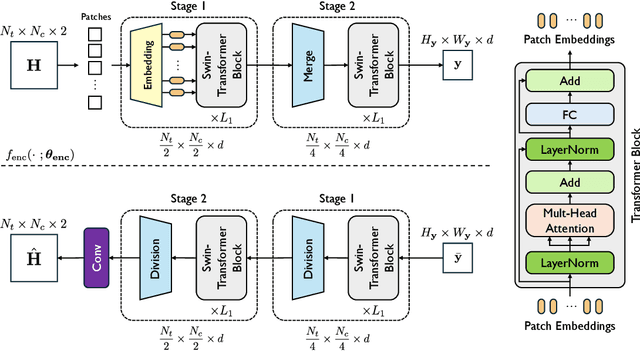
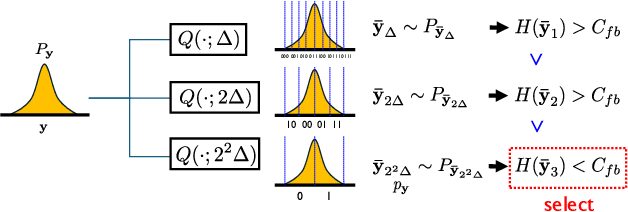
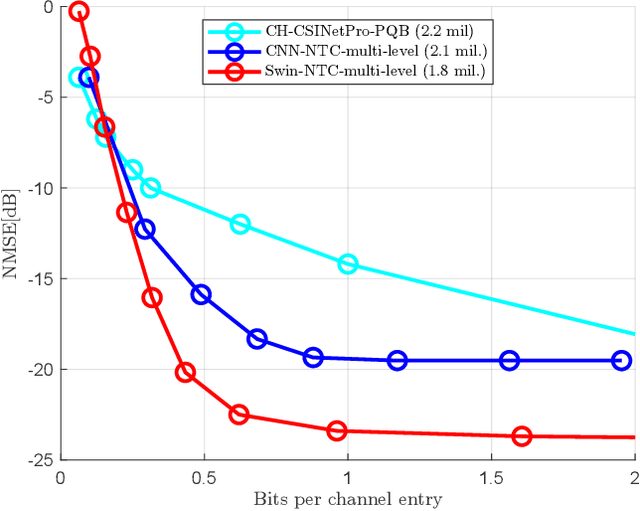
We propose a novel approach for channel state information (CSI) compression in multiple-input multiple-output orthogonal frequency division multiplexing (MIMO-OFDM) systems, where the frequency-domain channel matrix is treated as a high-dimensional complex-valued image. Our method leverages transformer-based nonlinear transform coding (NTC), an advanced deep-learning-driven image compression technique that generates a highly compact binary representation of the CSI. Unlike conventional autoencoder-based CSI compression, NTC optimizes a nonlinear mapping to produce a latent vector while simultaneously estimating its probability distribution for efficient entropy coding. By exploiting the statistical independence of latent vector entries, we integrate a transformer-based deep neural network with a scalar nested-lattice uniform quantization scheme, enabling low-complexity, multi-rate CSI feedback that dynamically adapts to varying feedback channel conditions. The proposed multi-rate CSI compression scheme achieves state-of-the-art rate-distortion performance, outperforming existing techniques with the same number of neural network parameters. Simulation results further demonstrate that our approach provides a superior rate-distortion trade-off, requiring only 6% of the neural network parameters compared to existing methods, making it highly efficient for practical deployment.
Multi-Rate Variable-Length CSI Compression for FDD Massive MIMO
Nov 30, 2023For frequency-division-duplexing (FDD) systems, channel state information (CSI) should be fed back from the user terminal to the base station. This feedback overhead becomes problematic as the number of antennas grows. To alleviate this issue, we propose a flexible CSI compression method using variational autoencoder (VAE) with an entropy bottleneck structure, which can support multi-rate and variable-length operation. Numerical study confirms that the proposed method outperforms the existing CSI compression techniques in terms of normalized mean squared error.