 Add to Chrome
 Add to Firefox
 Add to Edge
VIBE: Visual Instruction Based Editor
Jan 05, 2026
Instruction-based image editing is among the fastest developing areas in generative AI. Over the past year, the field has reached a new level, with dozens of open-source models released alongside highly capable commercial systems. However, only a limited number of open-source approaches currently achieve real-world quality. In addition, diffusion backbones, the dominant choice for these pipelines, are often large and computationally expensive for many deployments and research settings, with widely used variants typically containing 6B to 20B parameters. This paper presents a compact, high-throughput instruction-based image editing pipeline that uses a modern 2B-parameter Qwen3-VL model to guide the editing process and the 1.6B-parameter diffusion model Sana1.5 for image generation. Our design decisions across architecture, data processing, training configuration, and evaluation target low-cost inference and strict source consistency while maintaining high quality across the major edit categories feasible at this scale. Evaluated on the ImgEdit and GEdit benchmarks, the proposed method matches or exceeds the performance of substantially heavier baselines, including models with several times as many parameters and higher inference cost, and is particularly strong on edits that require preserving the input image, such as an attribute adjustment, object removal, background edits, and targeted replacement. The model fits within 24 GB of GPU memory and generates edited images at up to 2K resolution in approximately 4 seconds on an NVIDIA H100 in BF16, without additional inference optimizations or distillation.

NoHumansRequired: Autonomous High-Quality Image Editing Triplet Mining
Jul 18, 2025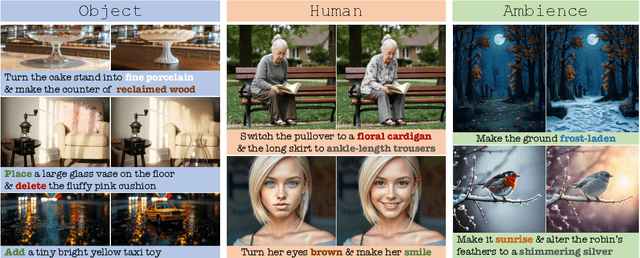
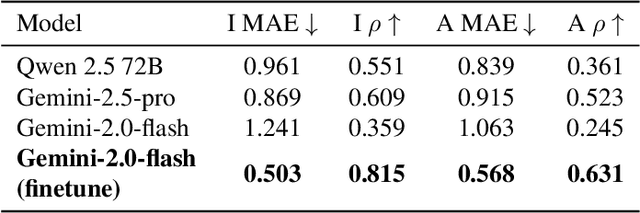
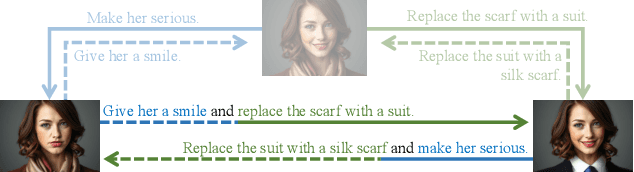

Recent advances in generative modeling enable image editing assistants that follow natural language instructions without additional user input. Their supervised training requires millions of triplets: original image, instruction, edited image. Yet mining pixel-accurate examples is hard. Each edit must affect only prompt-specified regions, preserve stylistic coherence, respect physical plausibility, and retain visual appeal. The lack of robust automated edit-quality metrics hinders reliable automation at scale. We present an automated, modular pipeline that mines high-fidelity triplets across domains, resolutions, instruction complexities, and styles. Built on public generative models and running without human intervention, our system uses a task-tuned Gemini validator to score instruction adherence and aesthetics directly, removing any need for segmentation or grounding models. Inversion and compositional bootstrapping enlarge the mined set by approximately 2.2x, enabling large-scale high-fidelity training data. By automating the most repetitive annotation steps, the approach allows a new scale of training without human labeling effort. To democratize research in this resource-intensive area, we release NHR-Edit: an open dataset of 358k high-quality triplets. In the largest cross-dataset evaluation, it surpasses all public alternatives. We also release Bagel-NHR-Edit, an open-source fine-tuned Bagel model, which achieves state-of-the-art metrics in our experiments.