 Add to Chrome
 Add to Firefox
 Add to Edge
Stability and Robustness via Regularization: Bandit Inference via Regularized Stochastic Mirror Descent
Mar 10, 2026
Statistical inference with bandit data presents fundamental challenges due to adaptive sampling, which violates the independence assumptions underlying classical asymptotic theory. Recent work has identified stability as a sufficient condition for valid inference under adaptivity. This paper develops a systematic theory of stability for bandit algorithms based on stochastic mirror descent, a broad algorithmic framework that includes the widely-used EXP3 algorithm as a special case. Our contributions are threefold. First, we establish a general stability criterion: if the average iterates of a stochastic mirror descent algorithm converge in ratio to a non-random probability vector, then the induced bandit algorithm is stable. This result provides a unified lens for analyzing stability across diverse algorithmic instantiations. Second, we introduce a family of regularized-EXP3 algorithms employing a log-barrier regularizer with appropriately tuned parameters. We prove that these algorithms satisfy our stability criterion and, as an immediate corollary, that Wald-type confidence intervals for linear functionals of the mean parameter achieve nominal coverage. Notably, we show that the same algorithms attain minimax-optimal regret guarantees up to logarithmic factors, demonstrating that inference-enabling stability and learning efficiency are compatible objectives within the mirror descent framework. Third, we establish robustness to corruption: a modified variant of regularized-EXP3 maintains asymptotic normality of empirical arm means even in the presence of $o(T^{1/2})$ adversarial corruptions. This stands in sharp contrast to other stable algorithms such as UCB, which suffer linear regret even under logarithmic levels of corruption.

Stable Thompson Sampling: Valid Inference via Variance Inflation
May 29, 2025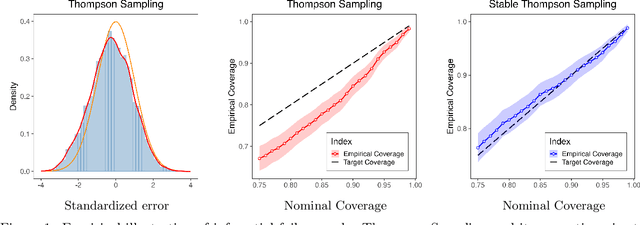
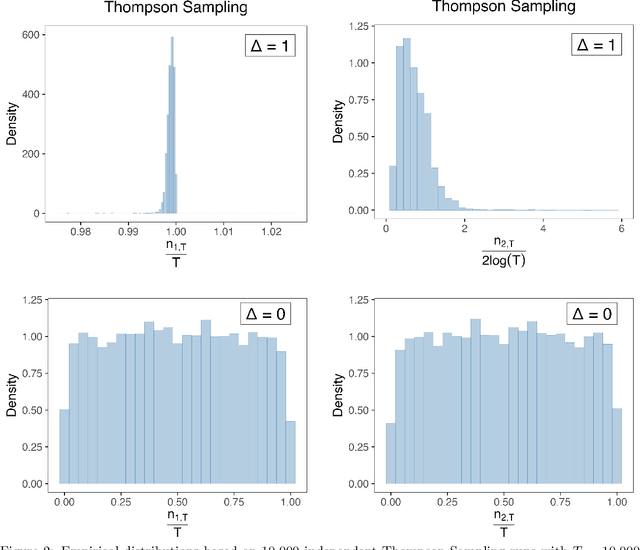
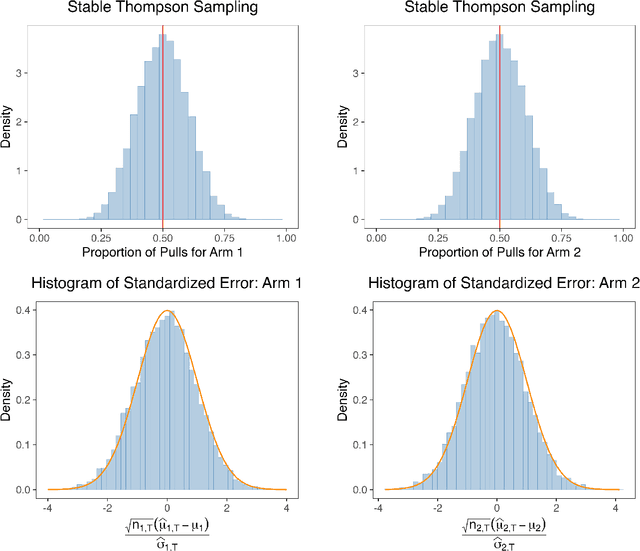
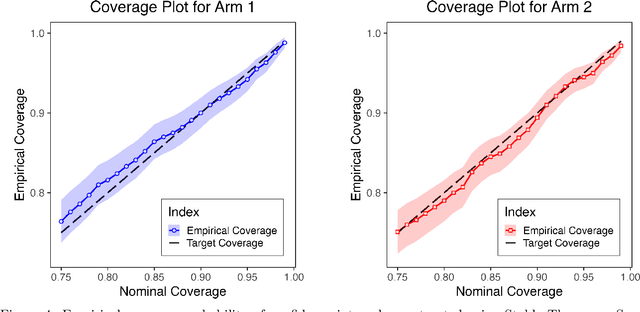
We consider the problem of statistical inference when the data is collected via a Thompson Sampling-type algorithm. While Thompson Sampling (TS) is known to be both asymptotically optimal and empirically effective, its adaptive sampling scheme poses challenges for constructing confidence intervals for model parameters. We propose and analyze a variant of TS, called Stable Thompson Sampling, in which the posterior variance is inflated by a logarithmic factor. We show that this modification leads to asymptotically normal estimates of the arm means, despite the non-i.i.d. nature of the data. Importantly, this statistical benefit comes at a modest cost: the variance inflation increases regret by only a logarithmic factor compared to standard TS. Our results reveal a principled trade-off: by paying a small price in regret, one can enable valid statistical inference for adaptive decision-making algorithms.