 Add to Chrome
 Add to Firefox
 Add to Edge
Combining Statistical Features and Deep Encodings for Rehearsal-Based Class-Incremental Time Series Classification
Jun 02, 2026
Many systems used in real-world environments require adding new categories and incorporating new information without forgetting what was previously learnt by the classification model. This is known as class-incremental continual learning, and in the case of multivariate time-series, is further complicated by the temporal structure of the data. In this paper, we present a novel approach for performing class incremental continual learning for the classification of multivariate time series data based upon the construction of a dual-stream feature extraction pipeline (using both deep temporal embedding features generated via a pre-trained frozen foundation model and application of statistical features). Evaluated on five benchmark datasets, the proposed system achieves competitive average accuracy across all datasets while maintaining low forgetting rates across all experimental configurations.

Continual Learning for non-stationary regression via Memory-Efficient Replay
Feb 10, 2026Data streams are rarely static in dynamic environments like Industry 4.0. Instead, they constantly change, making traditional offline models outdated unless they can quickly adjust to the new data. This need can be adequately addressed by continual learning (CL), which allows systems to gradually acquire knowledge without incurring the prohibitive costs of retraining them from scratch. Most research on continual learning focuses on classification problems, while very few studies address regression tasks. We propose the first prototype-based generative replay framework designed for online task-free continual regression. Our approach defines an adaptive output-space discretization model, enabling prototype-based generative replay for continual regression without storing raw data. Evidence obtained from several benchmark datasets shows that our framework reduces forgetting and provides more stable performance than other state-of-the-art solutions.
Continual Learning at the Edge: An Agnostic IIoT Architecture
Dec 16, 2025The exponential growth of Internet-connected devices has presented challenges to traditional centralized computing systems due to latency and bandwidth limitations. Edge computing has evolved to address these difficulties by bringing computations closer to the data source. Additionally, traditional machine learning algorithms are not suitable for edge-computing systems, where data usually arrives in a dynamic and continual way. However, incremental learning offers a good solution for these settings. We introduce a new approach that applies the incremental learning philosophy within an edge-computing scenario for the industrial sector with a specific purpose: real time quality control in a manufacturing system. Applying continual learning we reduce the impact of catastrophic forgetting and provide an efficient and effective solution.
Overcoming Catastrophic Forgetting in Tabular Data Classification: A Pseudorehearsal-based approach
Jul 12, 2024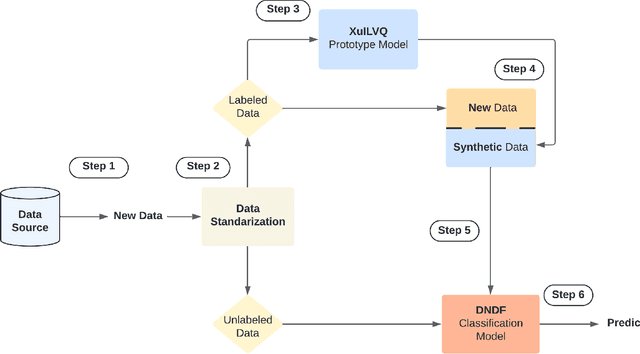
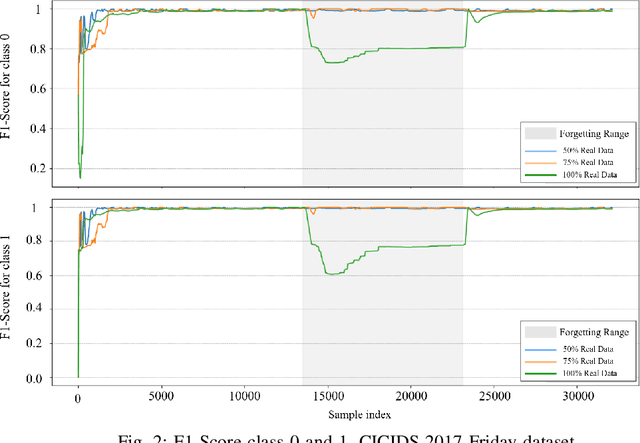
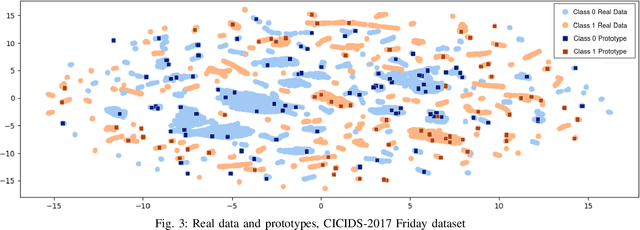
Continual learning (CL) poses the important challenge of adapting to evolving data distributions without forgetting previously acquired knowledge while consolidating new knowledge. In this paper, we introduce a new methodology, coined as Tabular-data Rehearsal-based Incremental Lifelong Learning framework (TRIL3), designed to address the phenomenon of catastrophic forgetting in tabular data classification problems. TRIL3 uses the prototype-based incremental generative model XuILVQ to generate synthetic data to preserve old knowledge and the DNDF algorithm, which was modified to run in an incremental way, to learn classification tasks for tabular data, without storing old samples. After different tests to obtain the adequate percentage of synthetic data and to compare TRIL3 with other CL available proposals, we can conclude that the performance of TRIL3 outstands other options in the literature using only 50% of synthetic data.