 Add to Chrome
 Add to Firefox
 Add to Edge
DraftFM: A FoundationModel for Day-Zero Drafting in Magic: The Gathering
Aug 20, 2026
Drafting a new Magic: The Gathering expansion begins before any pick from it has been observed: the complete card list is public, but the draft logs that supervised pick models train on do not yet exist. We study this day-zero regime directly. DraftFM is a discrete-choice policy that scores exactly the cards available in the current pack, conditioned on the drafted pool and the state of the draft. Every card enters as a frozen 775-dimensional function of its public card record, structured features and a fixed text embedding, with no card identities, set identities, or usage statistics anywhere in the model, so an unseen card is scored by the same machinery as a familiar one. A 1.6-million-parameter network fitted on 149 million human picks from 29 expansions predicts held-out picks in three expansions withheld in their entirety, reaching 50.8%, 60.4%, and 56.7% top-1 agreement, where uniform chance at the opening pick is about 7%. Refitted on all 32 observed expansions, the same architecture produced a card ranking for the then-unreleased set The Hobbit, sealed with its complete cryptographic provenance and published roughly 36 hours before the set became draftable on MTG Arena. The sealed ranking agrees with six independent expert reviewers roughly as much as those reviewers agree with one another. Evaluation against realized outcomes is committed to a follow-on note, whatever it shows.

Understanding Model Drift in a Large Cellular Network
Sep 07, 2021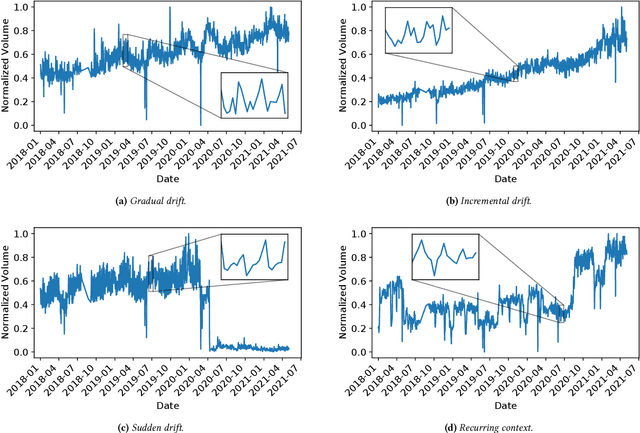
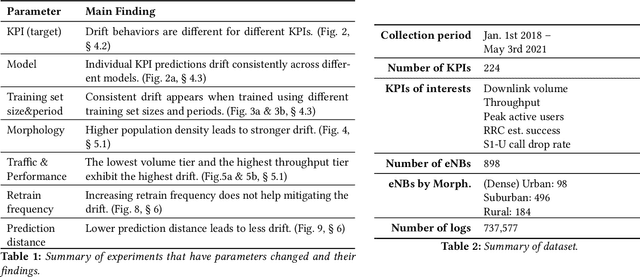
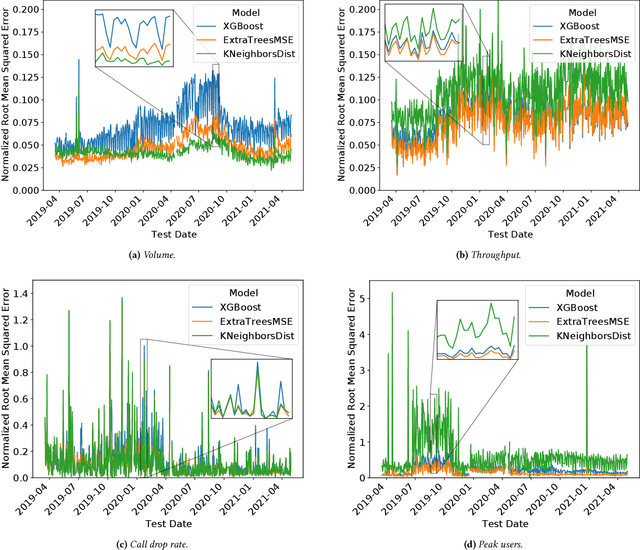
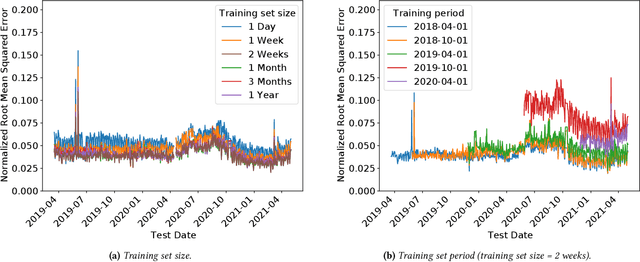
Operational networks are increasingly using machine learning models for a variety of tasks, including detecting anomalies, inferring application performance, and forecasting demand. Accurate models are important, yet accuracy can degrade over time due to concept drift, whereby either the characteristics of the data change over time (data drift) or the relationship between the features and the target predictor change over time (model drift). Drift is important to detect because changes in properties of the underlying data or relationships to the target prediction can require model retraining, which can be time-consuming and expensive. Concept drift occurs in operational networks for a variety of reasons, ranging from software upgrades to seasonality to changes in user behavior. Yet, despite the prevalence of drift in networks, its extent and effects on prediction accuracy have not been extensively studied. This paper presents an initial exploration into concept drift in a large cellular network in the United States for a major metropolitan area in the context of demand forecasting. We find that concept drift arises largely due to data drift, and it appears across different key performance indicators (KPIs), models, training set sizes, and time intervals. We identify the sources of concept drift for the particular problem of forecasting downlink volume. Weekly and seasonal patterns introduce both high and low-frequency model drift, while disasters and upgrades result in sudden drift due to exogenous shocks. Regions with high population density, lower traffic volumes, and higher speeds also tend to correlate with more concept drift. The features that contribute most significantly to concept drift are User Equipment (UE) downlink packets, UE uplink packets, and Real-time Transport Protocol (RTP) total received packets.