 Add to Chrome
 Add to Firefox
 Add to Edge
Cohort-Scale Neural Atlases of Ultrasound Video
May 30, 2026
Ultrasound is the most widely used real-time imaging modality in clinical practice, yet per-frame video annotation remains a major bottleneck: expert labels are scarce and costly, and image appearance varies with speckle, shadowing, attenuation, and operator-dependent probe pose. This is especially limiting because clinically relevant information is often dynamic, from left-ventricular motion in echocardiography to muscle and bone kinematics in musculoskeletal imaging. Population atlases can amortize annotation cost by registering observations to a shared canonical coordinate system, but existing neural atlas methods mainly target single videos, small test-time image sets, or object-centric image collections. We introduce a cohort-scale neural atlas for ultrasound video: a single canonical chart with per-video Generative Latent Optimization embeddings, trained jointly over thousands of frames in DINOv3 feature space. Across five cardiac and musculoskeletal datasets with point landmarks and segmentation masks, our method learns coherent canonical templates and enables accurate atlas-space annotation transfer. On EchoNet-Dynamic and MSK-Bone, it supports single- and few-shot transfer with accuracy competitive with strong dense-correspondence baselines, while training in minutes on a single consumer GPU. The learned embeddings are interpretable: linear projections reveal structured cohort variation, image-decoder interpolation produces anatomically plausible intermediate frames, and test-time latent inversion reconstructs held-out frames through the atlas. These results suggest that cohort-scale neural atlases offer a practical, interpretable representation for reducing expert annotation burden in ultrasound video analysis.

Detecting muscle activation using ultrasound speed of sound inversion with deep learning
Oct 22, 2019


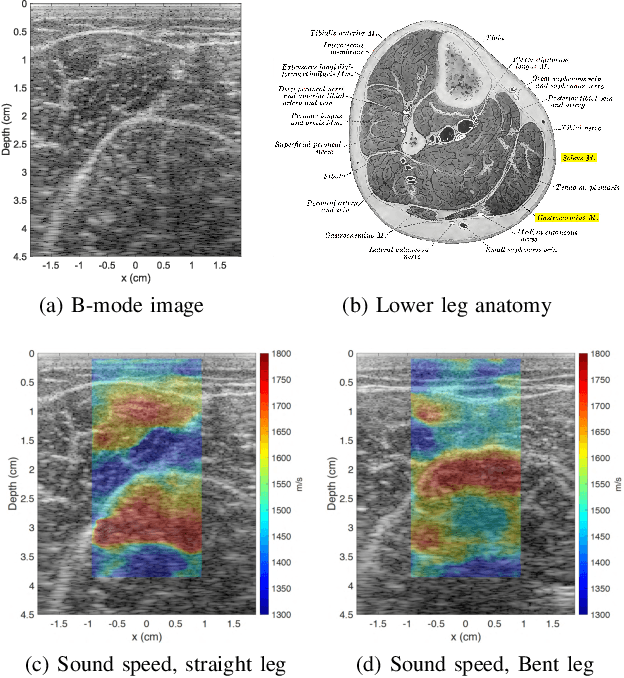
Functional muscle imaging is essential for diagnostics of a multitude of musculoskeletal afflictions such as degenerative muscle diseases, muscle injuries, muscle atrophy, and neurological related issues such as spasticity. However, there is currently no solution, imaging or otherwise, capable of providing a map of active muscles over a large field of view in dynamic scenarios. In this work, we look at the feasibility of longitudinal sound speed measurements to the task of dynamic muscle imaging of contraction or activation. We perform the assessment using a deep learning network applied to pre-beamformed ultrasound channel data for sound speed inversion. Preliminary results show that dynamic muscle contraction can be detected in the calf and that this contraction can be positively assigned to the operating muscles. Potential frame rates in the hundreds to thousands of frames per second are necessary to accomplish this.
A Deep Learning Framework for Single-Sided Sound Speed Inversion in Medical Ultrasound
Nov 02, 2018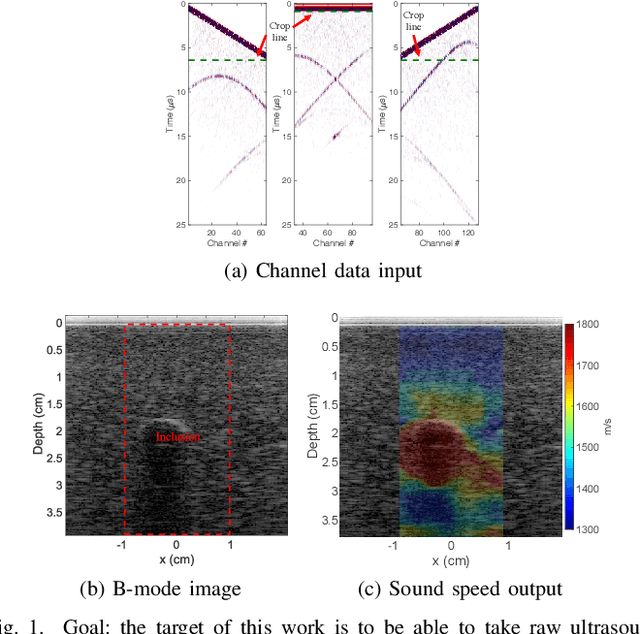
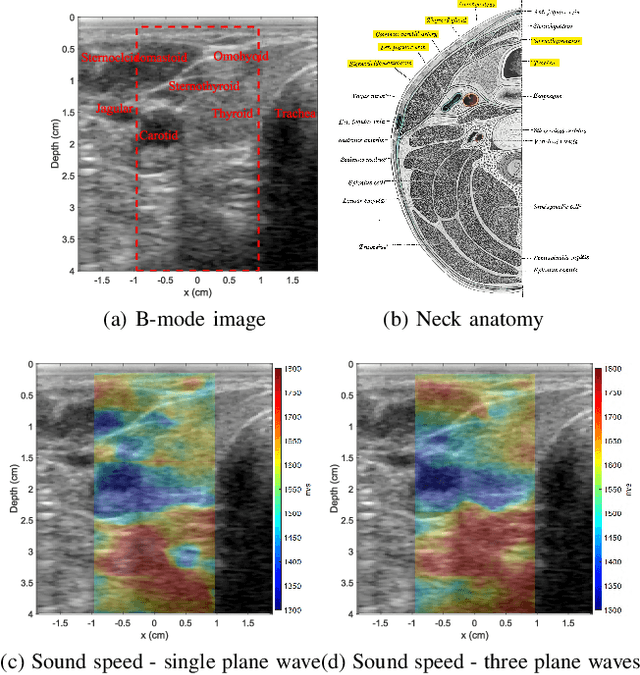
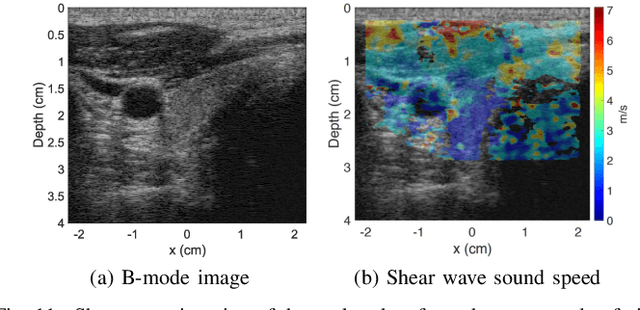
Ultrasound elastography is gaining traction as an accessible and useful diagnostic tool for such things as cancer detection and differentiation as well as liver and thyroid disease diagnostics. Unfortunately, state of the art acoustic radiation force techniques, essential to promote this goal, are limited to high end ultrasound hardware due to high power requirements; are extremely sensitive to patient and sonographer motion; and generally suffer from low frame rates. Researchers have shown that pressure wave velocity possesses similar diagnostic abilities to shear wave velocity. Using pressure waves removes the need for generating shear waves, which in turn enables elasticity based diagnostic techniques on portable and low cost devices. However, current travel time tomography and full waveform inversion techniques for recovering pressure wave velocities require a full circumferential field of view. Focus based techniques, on the other hand, provide only localized measurements, are sensitive to the intermediate medium and require capturing multiple frames. In this paper, we present a single sided sound speed inversion solution using a fully convolutional deep neural network. We show that it is possible to invert for longitudinal sound speed in soft tissue at real time frame rates. For the computation, analysis is performed on channel data information from three diagonal plane waves. This is the first step towards a full waveform solver using a Deep Learning framework for the elastic and viscoelastic inverse problem.