 Add to Chrome
 Add to Firefox
 Add to Edge
Packet Detection in a Filter Bank-Based Ultra-Wideband Communication System
Dec 18, 2025
Recently, filter bank multi-carrier spread spectrum (FBMC-SS) technology has been proposed for use in ultra-wideband (UWB) communication systems. It has been noted that, due to the spectral partitioning properties of the filter banks, a UWB signal can be synthesized and processed using a parallel set of signal processors operating at a moderate rate. This transceiver architecture can be used to generate UWB signals, without requiring a high-rate analog-to-digital and/or digital-to-analog converter. In this paper, beginning with a design operating on a single signal processor, we explore the development of a packet detector using the Rao score test. Taking advantage of the FBMC-SS signal structure, an effective detector design based on a cascade channelizer is proposed. We refer to this design as singe-radio band (SRB) detector. Given the typical bandwidth of UWB systems ($\bf 500$~MHz or wider), the SRB detector has to operate at a fast sampling rate of greater than $\bf 500$~MHz. This may be undesirable, as low cost analog-to-digital (ADC) and digital-to-analog (DAC) converters are often limited to a sampling rate of $\bf 200$~MHz or lower. Taking note of this point, the proposed SRB detector is extended to a multi-radio band (MRB) detector, where a set of parallel signal processors operating at a moderate sampling rate are used for a more practical implementation of the detector. Through computer simulations, we show that SRB and MRB detectors have the same performance in typical UWB channels. Finally, we provide results from an over-the-air demonstration of a UWB design occupying $\bf 1.28$~GHz of bandwidth. We find that reliable detection performance is possible in the harshest environments, at signal-to-noise ratios as low as $\bf -40$~dB with a preamble length of approximately half the duration of longest preamble length recommended in the IEEE802.15.4 standard.

Filtered Multi-Tone Spread Spectrum with Overlapping Subbands
Mar 26, 2025A new form of the filter bank multi-carrier spread spectrum (FBMC-SS) waveform is presented. This new waveform modifies the filtered multi-tone spread spectrum (FMT-SS) system, and is intended to whiten the power spectral density (PSD) of the transmit signal. In the conventional FMT-SS, subcarrier bands are non-overlapping, leaving a spectral null between the adjacent subcarrier bands. To make FMT-SS more appealing for a broader set of applications than those studied in the past, we propose adding additional subcarriers centered at these nulls and thoroughly explore the impact of the added subcarriers on the system performance. This modified form of FMT-SS is referred to as overlapped FMT-SS (OFMT-SS). We explore the conditions required for maximally flattening the PSD of the synthesized OFMT-SS signal and for cancelling the interference caused by overlapping subbands. We also explore the choices of spreading gains that result in a low peak-to-average power ratio (PAPR) for a number of different scenarios. Further reduction of the PAPR of the synthesized signal through clipping methods is also explored. Additionally, we propose methods of multi-coding for increasing the data rate of the OFMT-SS waveform, while minimally impacting its PAPR.
Theoretical Analysis of Multi-coding with Non-orthogonal Signaling
Mar 10, 2025Even though orthogonal multi-code signaling and its derivative, simplex signaling, are well known and widely used in different communication systems, certain applications may choose to adopt non-orthogonal signaling to benefit from other advantages that such signaling methods can offer. Motivated by a class of multi-carrier spread spectrum systems, this paper presents a thorough symbol error rate analysis of the broad class of multi-code signaling methods when they make use of codes which are not necessarily orthogonal. Our analysis is also extended to the case where the code set includes the negative of each code vector, i.e., an extension to biorthogonal signaling. Moreover, it is shown that the symbol error rate results derived in this paper reduce to those available in the literature when the multi-codes are orthogonal or satisfy the correlation property of simplex multi-codes.
UWB Narrowband Interference Survey and Design Considerations
Nov 11, 2024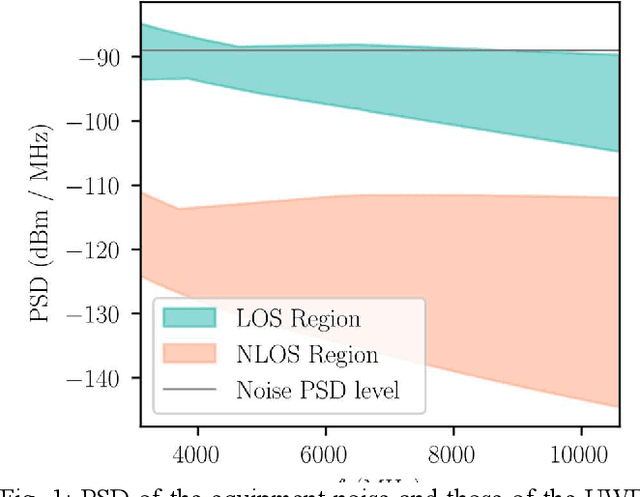
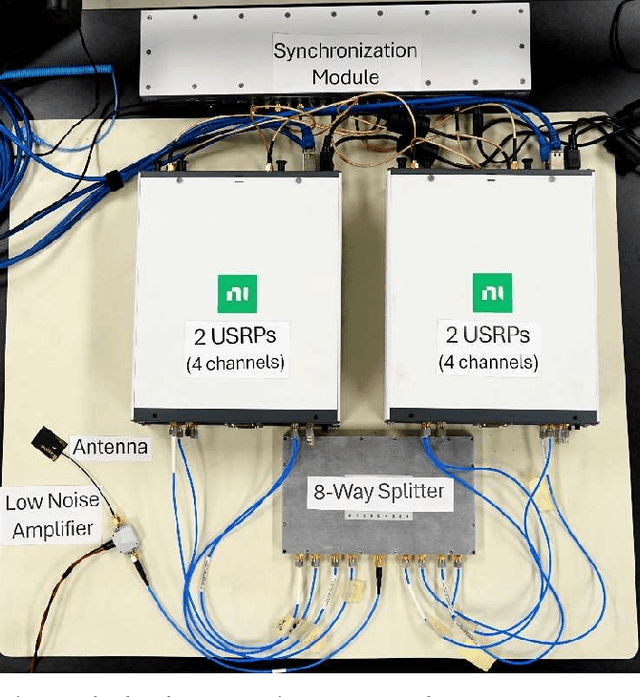
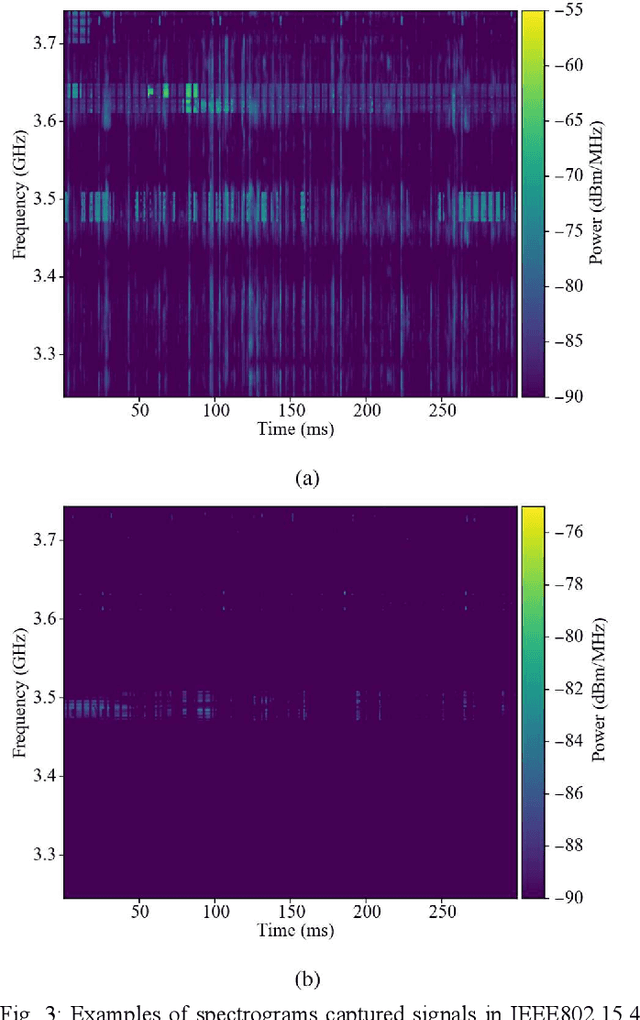
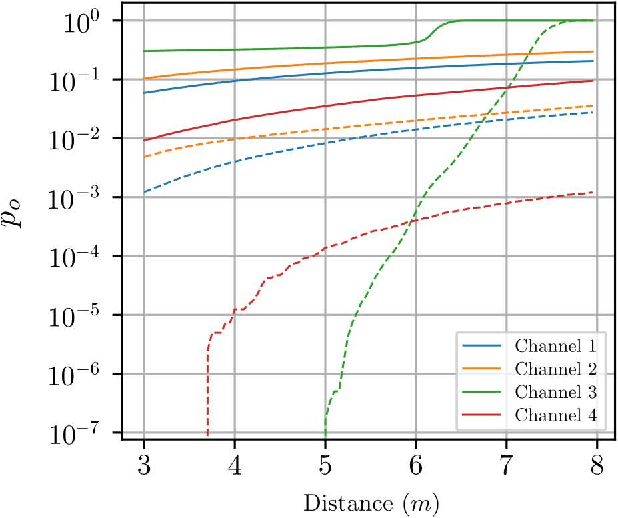
A study of interference caused by incumbent radios to UWB devices is presented. Through an extensive set of measured spectral activities in the low-band IEEE802.15.4 UWB operating channels, we explore the outage probabilities of a UWB system when it is equipped with an intelligent detector for combating interferers and compare them against those of a naive system that has no interference avoidance capability. Our results reveal that a UWB system with an effective interference avoidance capability may lead to a few orders of magnitude improvement in its outage probabilities. The measured outage probabilities are confirmed through measuring the frame error rate of a simulated filter-bank UWB transceiver system when impacted by the interferences obtained through our experiments.
Filter-Banks for Ultra-Wideband Communications: Advantages and Design Challenges
Nov 08, 2024Recently, filter-bank multicarrier spread spectrum (FBMC-SS) has been proposed as a candidate waveform for ultra-wideband (UWB) communications. It has been noted that FBMC-SS is a perfect match to this application, leading to a trivial method of matching to the required spectral mask at different regions of the world. FBMC-SS also allows easy rejection of high-power interfering signals that may appear over different parts of the UWB spectral band. In this paper, we concentrate on the use of staggered multitone spread spectrum (SMT-SS) for UWB communications. SMT makes use of offset quadrature amplitude modulation (OQAM) to transmit data symbols over narrowband, overlapping subcarrier bands. This form of FBMC-SS is well-suited to UWB communications because it has good spectral efficiency and a flat power spectral density (PSD), resulting in good utilization of the UWB spectral mask. Additionally, we explore new methods for multi-coding that result in higher bit rates than previous FBMC-SS systems. Moreover, we study methods for equalizing the UWB multipath channel and cancelling narrowband interference. Excellent performance of the proposed methods are substantiated by presenting simulation results.