 Add to Chrome
 Add to Firefox
 Add to Edge
Hybrid A*-Based Reverse Path-Planning of a Vehicle with Trailer System
Apr 27, 2026
Reverse parking maneuvering of a vehicle with trailer system is a difficult task to complete for human drivers due to the multi-body nature of the system and the unintuitive controls required to orientate the trailer properly. The problem is complicated with the presence of other vehicles that the trailer and its connected vehicle must avoid during the reverse parking maneuver. While path planning methods in reverse motion for vehicles with trailers exist, there is a lack of results that also offer collision avoidance as part of the algorithm. This paper hence proposes a modified Hybrid A*-based algorithm that can accommodate the vehicle-trailer system as well as collision avoidance considerations with the other vehicles and obstacles in the parking environment. One of the novelties of this proposed approach is its adaptability to the vehicle with trailer system, where limits of usable steering input that prevent the occurrence of jackknife incidents vary with respect to system configuration. The other contribution is the addition of the collision avoidance functionality which the standard Hybrid A* algorithm lacks. The method is developed and presented first, followed by simulation case studies to demonstrate the efficacy of the proposed approach.

Development of an Advisory System for Parking of a Car and Trailer
Jan 10, 2025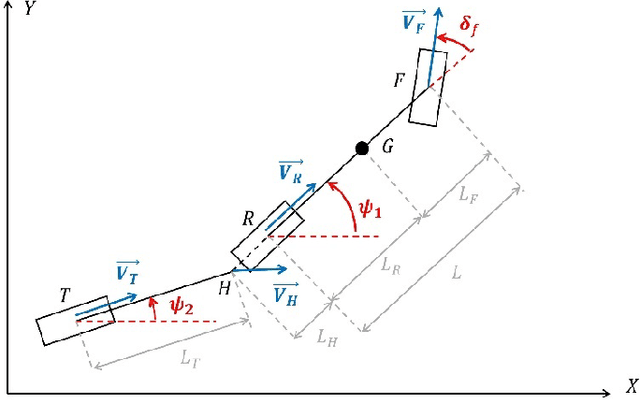
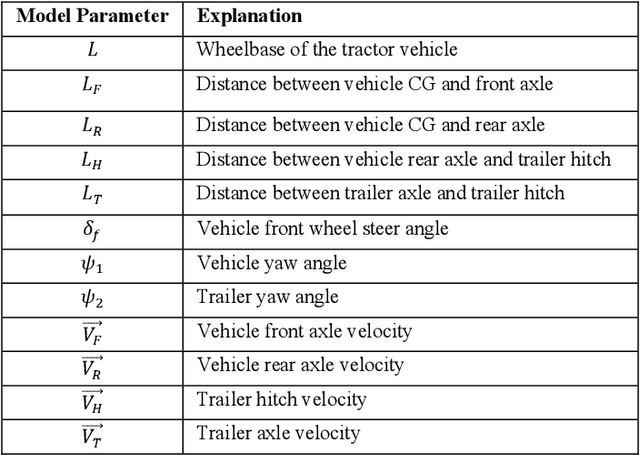
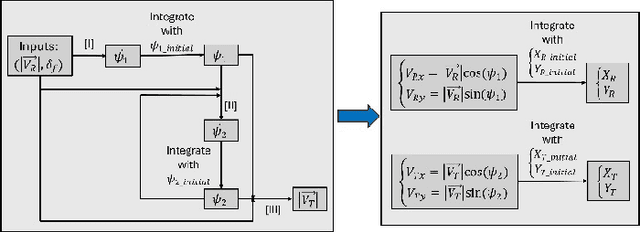

Trailer parking is a challenging task due to the unstable nature of the vehicle-trailer system in reverse motion and the unintuitive steering actions required at the vehicle to accomplish the parking maneuver. This paper presents a strategy to tackle this kind of maneuver with an advisory graphic aid to help the human driver with the task of manually backing up the vehicle-trailer system. A kinematic vehicle-trailer model is derived to describe the low-speed motion of the vehicle-trailer system, and its inverse kinematics is established by generating an equivalent virtual trailer axle steering command. The advisory system graphics is generated based on the inverse kinematics and displays the expected trailer orientation given the current vehicle steer angle and configuration (hitch angle). Simulation study and animation are set up to test the efficacy of the approach, where the user can select both vehicle speed and vehicle steering angle freely, which allows the user to stop the vehicle-trailer system and experiment with different steering inputs to see their effect on the predicted trailer motion before proceeding with the best one according to the advisory graphics, hence creating a series of piecewise continuous control actions similar to how manual trailer reverse parking is usually carried out. The advisory graphics proves to provide the driver with an intuitive understanding of the trailer motion at any given configuration (hitch angle).