 Add to Chrome
 Add to Firefox
 Add to Edge
Multimodal Higher-Order Brain Networks: A Topological Signal Processing Perspective
Mar 31, 2026
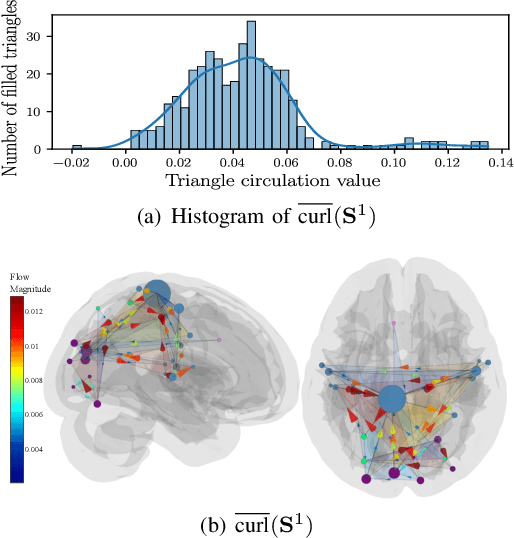
Brain connectomics is still largely dominated by pairwise-based models, such as graphs, which cannot represent circulatory or higher-order functional interactions. In this paper, we propose a multimodal framework based on Topological Signal Processing (TSP) that models the brain as a higher-order topological domain and treats functional interactions as discrete vector fields. We integrate diffusion MRI and resting-state fMRI to learn subject-specific brain cell complexes, where statistically validated structural connectivity defines a sparse scaffold and phase-coupling functional edge signals drive the inference of higher-order interactions (HOIs). Using Hodge-theoretic tools, spectral filtering, and sparse signal representations, our framework disentangles brain connectivity into divergence (source-sink organization), gradient (potential-driven coordination), and curl (circulatory HOIs), enabling the characterization of temporal dynamics through the lens of discrete vector calculus. Across 100 healthy young adults from Human Connectome Project, node-based HOIs are highly individualized, yet robust mesoscale structure emerges under functional-system aggregation. We identify a distributed default mode network-centered gradient backbone and limbic-centered rotational flows; divergence polarization and curl profiles defining circulation regimes with insightful occupancy and dwell-time statistics. These topological signatures yield significant brain-behavior associations, revealing a relevant higher-order organization intrinsic to edge-based models. By making divergence, circulation, and recurrent mesoscale coordination directly measurable, this work enables a principled and interpretable topological phenotyping of brain function.

Cross-Laplacians Based Topological Signal Processing over Cell MultiComplexes
Apr 10, 2025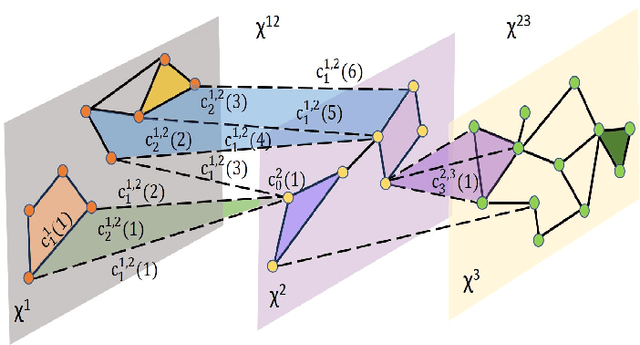
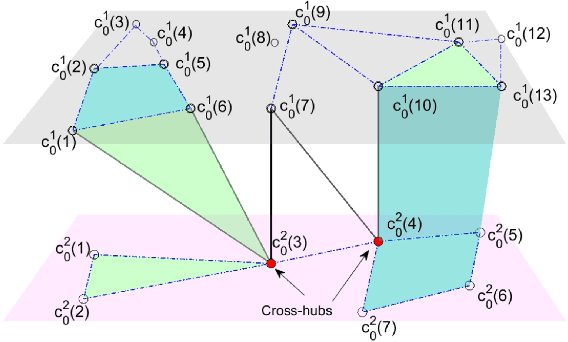
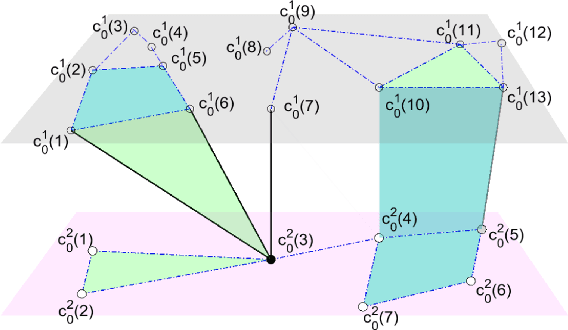
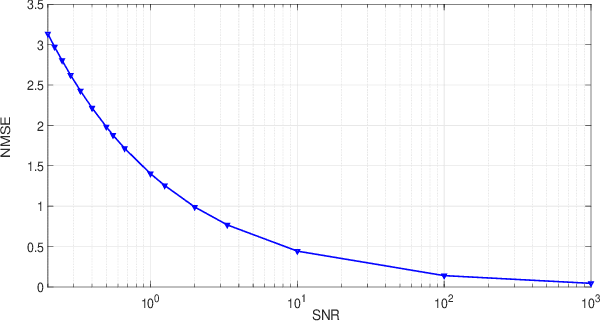
The study of the interactions among different types of interconnected systems in complex networks has attracted significant interest across many research fields. However, effective signal processing over layered networks requires topological descriptors of the intra- and cross-layers relationships that are able to disentangle the homologies of different domains, at different scales, according to the specific learning task. In this paper, we present Cell MultiComplex (CMC) spaces, which are novel topological domains for representing multiple higher-order relationships among interconnected complexes. We introduce cross-Laplacians matrices, which are algebraic descriptors of CMCs enabling the extraction of topological invariants at different scales, whether global or local, inter-layer or intra-layer. Using the eigenvectors of these cross-Laplacians as signal bases, we develop topological signal processing tools for CMC spaces. In this first study, we focus on the representation and filtering of noisy flows observed over cross-edges between different layers of CMCs to identify cross-layer hubs, i.e., key nodes on one layer controlling the others.
Learning Higher-Order Interactions in Brain Networks via Topological Signal Processing
Apr 10, 2025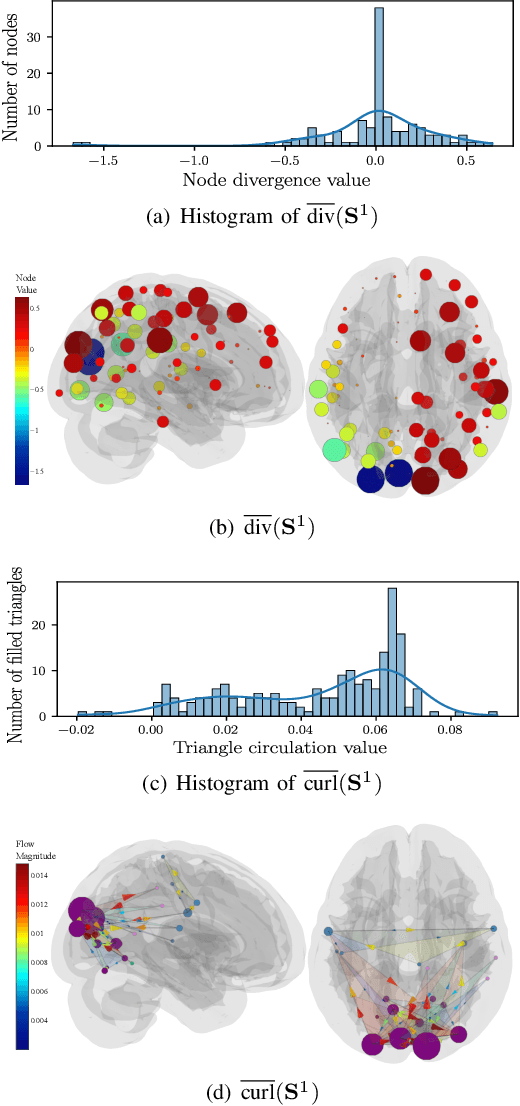
Our goal in this paper is to leverage the potential of the topological signal processing (TSP) framework for analyzing brain networks. Representing brain data as signals over simplicial complexes allows us to capture higher-order relationships within brain regions of interest (ROIs). Here, we focus on learning the underlying brain topology from observed neural signals using two distinct inference strategies. The first method relies on higher-order statistical metrics to infer multiway relationships among ROIs. The second method jointly learns the brain topology and sparse signal representations, of both the solenoidal and harmonic components of the signals, by minimizing the total variation along triangles and the data-fitting errors. Leveraging the properties of solenoidal and irrotational signals, and their physical interpretations, we extract functional connectivity features from brain topologies and uncover new insights into functional organization patterns. This allows us to associate brain functional connectivity (FC) patterns of conservative signals with well-known functional segregation and integration properties. Our findings align with recent neuroscience research, suggesting that our approach may offer a promising pathway for characterizing the higher-order brain functional connectivities.