 Add to Chrome
 Add to Firefox
 Add to Edge
Microstructure-based Variational Neural Networks for Robust Uncertainty Quantification in Materials Digital Twins
Dec 19, 2025
Aleatoric uncertainties - irremovable variability in microstructure morphology, constituent behavior, and processing conditions - pose a major challenge to developing uncertainty-robust digital twins. We introduce the Variational Deep Material Network (VDMN), a physics-informed surrogate model that enables efficient and probabilistic forward and inverse predictions of material behavior. The VDMN captures microstructure-induced variability by embedding variational distributions within its hierarchical, mechanistic architecture. Using an analytic propagation scheme based on Taylor-series expansion and automatic differentiation, the VDMN efficiently propagates uncertainty through the network during training and prediction. We demonstrate its capabilities in two digital-twin-driven applications: (1) as an uncertainty-aware materials digital twin, it predicts and experimentally validates the nonlinear mechanical variability in additively manufactured polymer composites; and (2) as an inverse calibration engine, it disentangles and quantitatively identifies overlapping sources of uncertainty in constituent properties. Together, these results establish the VDMN as a foundation for uncertainty-robust materials digital twins.

Unsupervised Multimodal Fusion of In-process Sensor Data for Advanced Manufacturing Process Monitoring
Oct 29, 2024


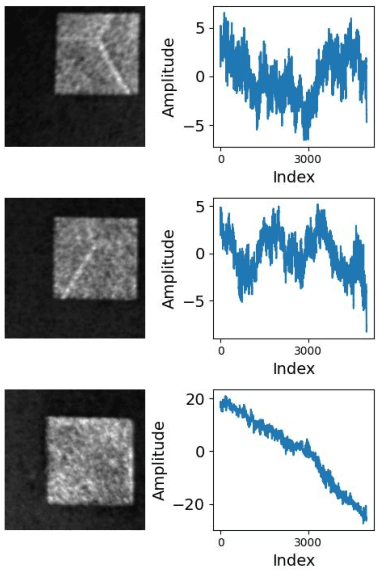
Effective monitoring of manufacturing processes is crucial for maintaining product quality and operational efficiency. Modern manufacturing environments generate vast amounts of multimodal data, including visual imagery from various perspectives and resolutions, hyperspectral data, and machine health monitoring information such as actuator positions, accelerometer readings, and temperature measurements. However, interpreting this complex, high-dimensional data presents significant challenges, particularly when labeled datasets are unavailable. This paper presents a novel approach to multimodal sensor data fusion in manufacturing processes, inspired by the Contrastive Language-Image Pre-training (CLIP) model. We leverage contrastive learning techniques to correlate different data modalities without the need for labeled data, developing encoders for five distinct modalities: visual imagery, audio signals, laser position (x and y coordinates), and laser power measurements. By compressing these high-dimensional datasets into low-dimensional representational spaces, our approach facilitates downstream tasks such as process control, anomaly detection, and quality assurance. We evaluate the effectiveness of our approach through experiments, demonstrating its potential to enhance process monitoring capabilities in advanced manufacturing systems. This research contributes to smart manufacturing by providing a flexible, scalable framework for multimodal data fusion that can adapt to diverse manufacturing environments and sensor configurations.