 Add to Chrome
 Add to Firefox
 Add to Edge
Generating synthetic computed tomography for radiotherapy: SynthRAD2025 challenge report
May 13, 2026
Radiation therapy (RT) requires precise dose delivery over multiple fractions, with CT fundamental for treatment planning due to its electron density information. Repeated CT acquisitions impose radiation exposure and logistical burdens, MRI lacks electron density, and cone-beam CT (CBCT) requires correction for dose calculation. Synthetic CT (sCT) generation addresses these by converting MRI or CBCT into CT-equivalent images with accurate Hounsfield Unit (HU) values, enabling MRI-only RT and CBCT-based adaptive workflows. Building on SynthRAD2023, SynthRAD2025 benchmarked sCT methods on 2,362 patients from five European centers across head and neck, thorax, and abdomen. Two tasks: MRI-to-CT (890 cases) and CBCT-to-CT (1,472 cases), evaluated via image similarity (MAE, PSNR, MS-SSIM), segmentation (Dice, HD95), and dosimetric metrics from photon and proton plans. With 803 participants and 12/13 valid submissions, Task 1 top performance reached MAE $64.8\pm21.3$ HU, PSNR $\sim$30 dB, MS-SSIM $\sim$0.936, Dice 0.79, photon $γ_{2\%/2\text{mm}}>98\%$, proton $γ\approx85\%$. Task 2 improved: MAE $48.3\pm13.4$ HU, PSNR 32.6 dB, MS-SSIM 0.968, Dice 0.86, photon $γ>99\%$, proton $γ\approx89\%$. Strong image--segmentation correlations ($ρ=0.78$--$0.79$) but moderate dose correlations confirmed image quality is insufficient as a dosimetric surrogate. Head-and-neck cases were most consistent; thoracic and abdominal cases showed greater variability. Residual errors at tissue interfaces propagate along beam paths, affecting proton dose more than photon. SynthRAD2025 demonstrates that deep learning yields clinically relevant sCTs, especially for CBCT-to-CT, while identifying persistent MRI-to-CT challenges and underscoring dose-based evaluation as essential for clinical validation.

Deformation-aware GAN for Medical Image Synthesis with Substantially Misaligned Pairs
Aug 18, 2024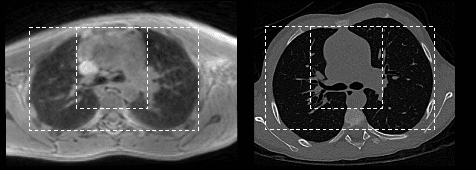
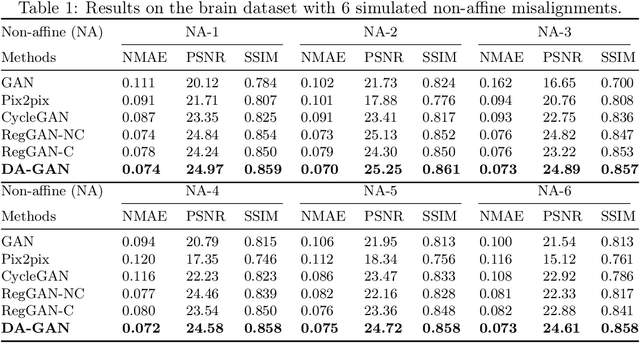
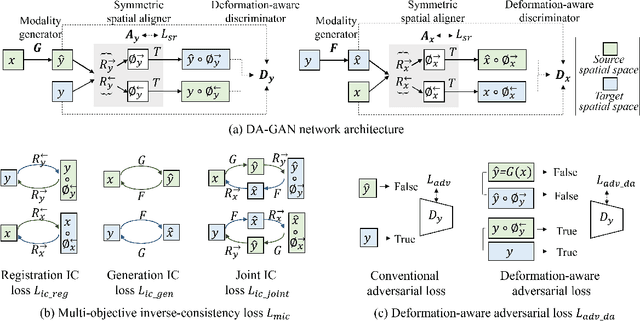
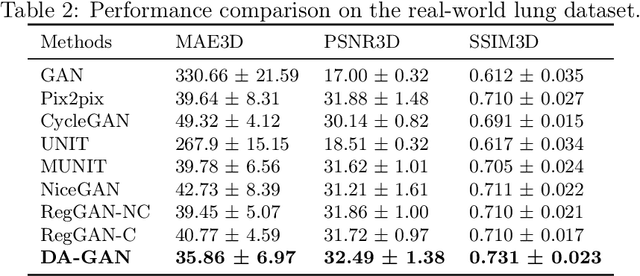
Medical image synthesis generates additional imaging modalities that are costly, invasive or harmful to acquire, which helps to facilitate the clinical workflow. When training pairs are substantially misaligned (e.g., lung MRI-CT pairs with respiratory motion), accurate image synthesis remains a critical challenge. Recent works explored the directional registration module to adjust misalignment in generative adversarial networks (GANs); however, substantial misalignment will lead to 1) suboptimal data mapping caused by correspondence ambiguity, and 2) degraded image fidelity caused by morphology influence on discriminators. To address the challenges, we propose a novel Deformation-aware GAN (DA-GAN) to dynamically correct the misalignment during the image synthesis based on multi-objective inverse consistency. Specifically, in the generative process, three levels of inverse consistency cohesively optimise symmetric registration and image generation for improved correspondence. In the adversarial process, to further improve image fidelity under misalignment, we design deformation-aware discriminators to disentangle the mismatched spatial morphology from the judgement of image fidelity. Experimental results show that DA-GAN achieved superior performance on a public dataset with simulated misalignments and a real-world lung MRI-CT dataset with respiratory motion misalignment. The results indicate the potential for a wide range of medical image synthesis tasks such as radiotherapy planning.