 Add to Chrome
 Add to Firefox
 Add to Edge
Visioning Human-Agentic AI Teaming: Continuity, Tension, and Future Research
Mar 05, 2026
Artificial intelligence is undergoing a structural transformation marked by the rise of agentic systems capable of open-ended action trajectories, generative representations and outputs, and evolving objectives. These properties introduce structural uncertainty into human-AI teaming (HAT), including uncertainty about behavior trajectories, epistemic grounding, and the stability of governing logics over time. Under such conditions, alignment cannot be secured through agreement on bounded outputs; it must be continuously sustained as plans unfold and priorities shift. We advance Team Situation Awareness (Team SA) theory, grounded in shared perception, comprehension, and projection, as an integrative anchor for this transition. While Team SA remains analytically foundational, its stabilizing logic presumes that shared awareness, once achieved, will support coordinated action through iterative updating. Agentic AI challenges this presumption. Our argument unfolds in two stages: first, we extend Team SA to reconceptualize both human and AI awareness under open-ended agency, including the sensemaking of projection congruence across heterogeneous systems. Second, we interrogate whether the dynamic processes traditionally assumed to stabilize teaming in relational interaction, cognitive learning, and coordination and control continue to function under adaptive autonomy. By distinguishing continuity from tension, we clarify where foundational insights hold and where structural uncertainty introduces strain, and articulate a forward-looking research agenda for HAT. The central challenge of HAT is not whether humans and AI can agree in the moment, but whether they can remain aligned as futures are continuously generated, revised, enacted, and governed over time.

Unraveling Human-AI Teaming: A Review and Outlook
Apr 09, 2025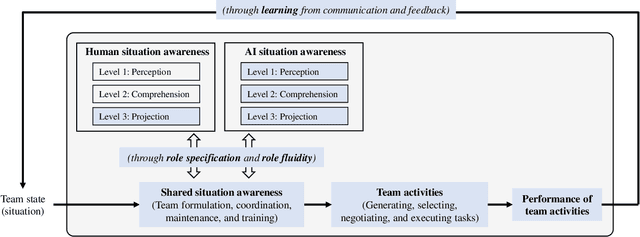
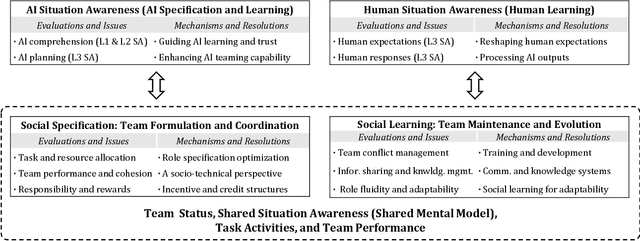
Artificial Intelligence (AI) is advancing at an unprecedented pace, with clear potential to enhance decision-making and productivity. Yet, the collaborative decision-making process between humans and AI remains underdeveloped, often falling short of its transformative possibilities. This paper explores the evolution of AI agents from passive tools to active collaborators in human-AI teams, emphasizing their ability to learn, adapt, and operate autonomously in complex environments. This paradigm shifts challenges traditional team dynamics, requiring new interaction protocols, delegation strategies, and responsibility distribution frameworks. Drawing on Team Situation Awareness (SA) theory, we identify two critical gaps in current human-AI teaming research: the difficulty of aligning AI agents with human values and objectives, and the underutilization of AI's capabilities as genuine team members. Addressing these gaps, we propose a structured research outlook centered on four key aspects of human-AI teaming: formulation, coordination, maintenance, and training. Our framework highlights the importance of shared mental models, trust-building, conflict resolution, and skill adaptation for effective teaming. Furthermore, we discuss the unique challenges posed by varying team compositions, goals, and complexities. This paper provides a foundational agenda for future research and practical design of sustainable, high-performing human-AI teams.