 Add to Chrome
 Add to Firefox
 Add to Edge
DynaGuide: A Generalizable Dynamic Guidance Framework for Unsupervised Semantic Segmentation
Feb 13, 2026
Unsupervised image segmentation is a critical task in computer vision. It enables dense scene understanding without human annotations, which is especially valuable in domains where labelled data is scarce. However, existing methods often struggle to reconcile global semantic structure with fine-grained boundary accuracy. This paper introduces DynaGuide, an adaptive segmentation framework that addresses these challenges through a novel dual-guidance strategy and dynamic loss optimization. Building on our previous work, DynaSeg, DynaGuide combines global pseudo-labels from zero-shot models such as DiffSeg or SegFormer with local boundary refinement using a lightweight CNN trained from scratch. This synergy allows the model to correct coarse or noisy global predictions and produce high-precision segmentations. At the heart of DynaGuide is a multi-component loss that dynamically balances feature similarity, Huber-smoothed spatial continuity, including diagonal relationships, and semantic alignment with the global pseudo-labels. Unlike prior approaches, DynaGuide trains entirely without ground-truth labels in the target domain and supports plug-and-play integration of diverse guidance sources. Extensive experiments on BSD500, PASCAL VOC2012, and COCO demonstrate that DynaGuide achieves state-of-the-art performance, improving mIoU by 17.5% on BSD500, 3.1% on PASCAL VOC2012, and 11.66% on COCO. With its modular design, strong generalization, and minimal computational footprint, DynaGuide offers a scalable and practical solution for unsupervised segmentation in real-world settings. Code available at: https://github.com/RyersonMultimediaLab/DynaGuide

DynaSeg: A Deep Dynamic Fusion Method for Unsupervised Image Segmentation Incorporating Feature Similarity and Spatial Continuity
May 09, 2024Our work tackles the fundamental challenge of image segmentation in computer vision, which is crucial for diverse applications. While supervised methods demonstrate proficiency, their reliance on extensive pixel-level annotations limits scalability. In response to this challenge, we present an enhanced unsupervised Convolutional Neural Network (CNN)-based algorithm called DynaSeg. Unlike traditional approaches that rely on a fixed weight factor to balance feature similarity and spatial continuity, requiring manual adjustments, our novel, dynamic weighting scheme automates parameter tuning, adapting flexibly to image details. We also introduce the novel concept of a Silhouette Score Phase that addresses the challenge of dynamic clustering during iterations. Additionally, our methodology integrates both CNN-based and pre-trained ResNet feature extraction, offering a comprehensive and adaptable approach. We achieve state-of-the-art results on diverse datasets, with a notable 12.2% and 14.12% mIOU improvement compared to the current benchmarks on COCO-All and COCO-Stuff, respectively. The proposed approach unlocks the potential for unsupervised image segmentation and addresses scalability concerns in real-world scenarios by obviating the need for meticulous parameter tuning.
A Dynamically Weighted Loss Function for Unsupervised Image Segmentation
Mar 17, 2024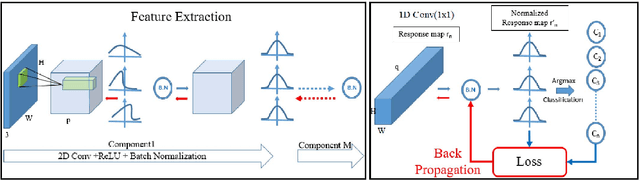
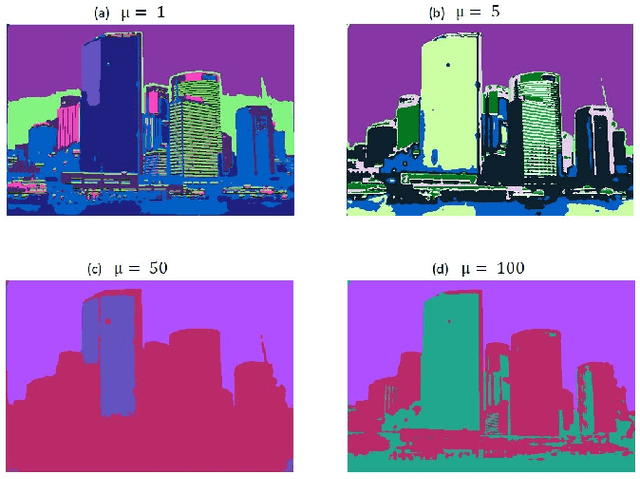
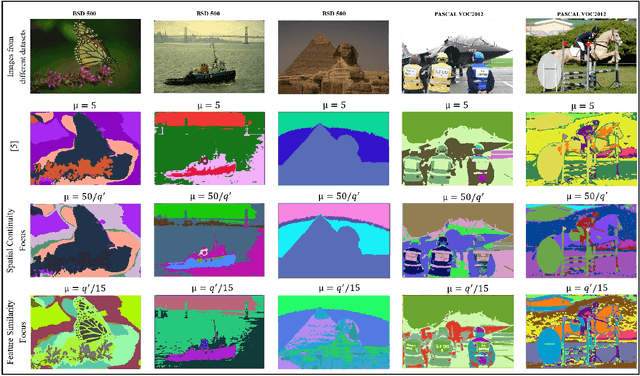
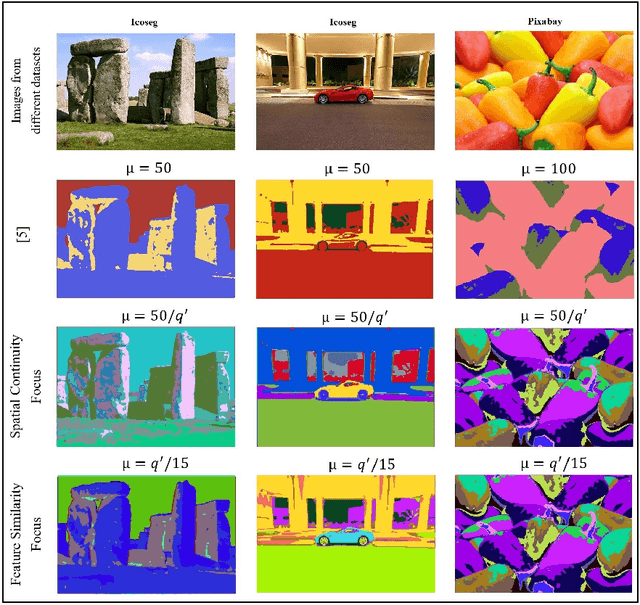
Image segmentation is the foundation of several computer vision tasks, where pixel-wise knowledge is a prerequisite for achieving the desired target. Deep learning has shown promising performance in supervised image segmentation. However, supervised segmentation algorithms require a massive amount of data annotated at a pixel level, thus limiting their applicability and scalability. Therefore, there is a need to invest in unsupervised learning for segmentation. This work presents an improved version of an unsupervised Convolutional Neural Network (CNN) based algorithm that uses a constant weight factor to balance between the segmentation criteria of feature similarity and spatial continuity, and it requires continuous manual adjustment of parameters depending on the degree of detail in the image and the dataset. In contrast, we propose a novel dynamic weighting scheme that leads to a flexible update of the parameters and an automatic tuning of the balancing weight between the two criteria above to bring out the details in the images in a genuinely unsupervised manner. We present quantitative and qualitative results on four datasets, which show that the proposed scheme outperforms the current unsupervised segmentation approaches without requiring manual adjustment.