 Add to Chrome
 Add to Firefox
 Add to Edge
Quantifying Uncertainty In Wide Two-Layer Neural Networks: On The Law Of The Limiting Fluctuation Process
Jun 04, 2026
Uncertainty quantification in neural networks prediction is a main issue for usual applications. Our approach seeks at reducing computation costs by directly evaluating uncertainty using PDE's information on the asymptotic variance, rather than the deep ensemble method which may be seen as a Monte Carlo estimation of the prediction, requiring the training of multiple networks. We thus study the law of the limiting process describing the random fluctuations around the mean-field limit of wide two-layer neural networks trained by stochastic gradient descent in a weak-noise regime. Building on a recent trajectorial central limit theorem, in which this limit is characterized as the weak solution of a linear stochastic evolution equation, we identify its law explicitly. More precisely, we show that it is a centered Gaussian process in the dual of a weighted Sobolev space, and we derive a closed covariance representation for the finite-dimensional distributions obtained by testing it against smooth functions. This covariance is expressed through the solution of a backward transport equation with a nonlocal source term, whose coefficients are driven by the mean-field trajectory. As a consequence, by testing against the activation function at a fixed input, we obtain an expression for the limiting variance of the corresponding network-output fluctuations. We illustrate this result numerically on a one-dimensional regression example.

Uniform-in-time concentration in two-layer neural networks via transportation inequalities
Mar 02, 2026We quantify, uniformly over time and with high probability, the discrepancy between the predictions of a two-layer neural network trained by stochastic gradient descent (SGD) and their mean-field limit, for quadratic loss and ridge regularization. As a key ingredient, we establish T p transportation inequalities (p $\in$ {1, 2}) for the law of the SGD parameters, with explicit constants independent of the iteration index. We then prove uniform-in-time concentration of the empirical parameter measure around its mean-field limit in the Wasserstein distance W 1 , and we translate these bounds into prediction-error estimates against a fixed test function $Φ$. We also derive analogous concentration bounds in the sliced-Wasserstein distance SW 1 , leading to dimension-free rates.
Central Limit Theorem for Bayesian Neural Network trained with Variational Inference
Jun 10, 2024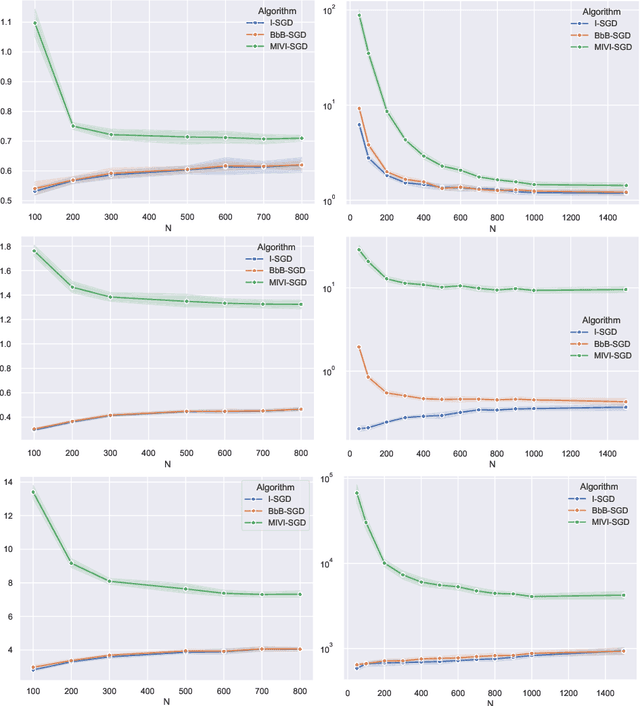
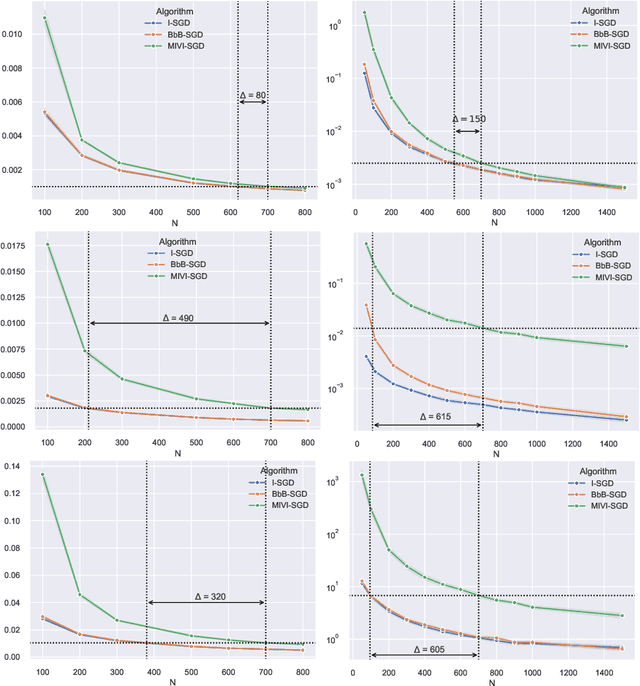
In this paper, we rigorously derive Central Limit Theorems (CLT) for Bayesian two-layerneural networks in the infinite-width limit and trained by variational inference on a regression task. The different networks are trained via different maximization schemes of the regularized evidence lower bound: (i) the idealized case with exact estimation of a multiple Gaussian integral from the reparametrization trick, (ii) a minibatch scheme using Monte Carlo sampling, commonly known as Bayes-by-Backprop, and (iii) a computationally cheaper algorithm named Minimal VI. The latter was recently introduced by leveraging the information obtained at the level of the mean-field limit. Laws of large numbers are already rigorously proven for the three schemes that admits the same asymptotic limit. By deriving CLT, this work shows that the idealized and Bayes-by-Backprop schemes have similar fluctuation behavior, that is different from the Minimal VI one. Numerical experiments then illustrate that the Minimal VI scheme is still more efficient, in spite of bigger variances, thanks to its important gain in computational complexity.
Law of Large Numbers for Bayesian two-layer Neural Network trained with Variational Inference
Jul 10, 2023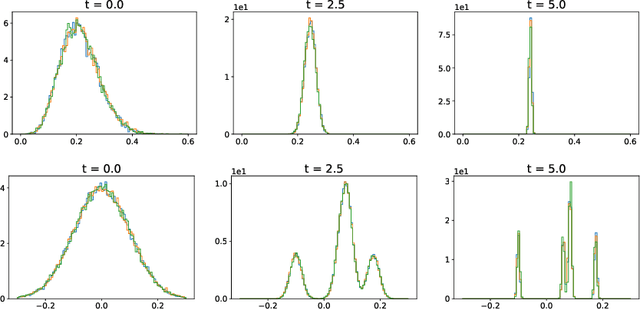
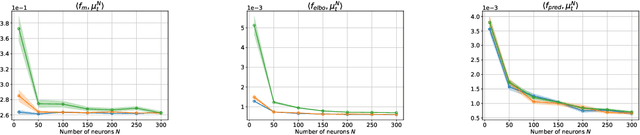
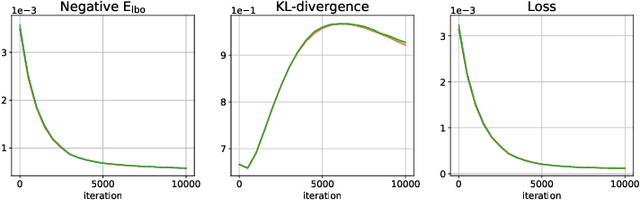
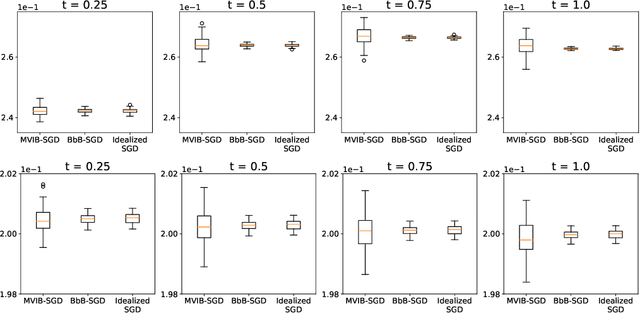
We provide a rigorous analysis of training by variational inference (VI) of Bayesian neural networks in the two-layer and infinite-width case. We consider a regression problem with a regularized evidence lower bound (ELBO) which is decomposed into the expected log-likelihood of the data and the Kullback-Leibler (KL) divergence between the a priori distribution and the variational posterior. With an appropriate weighting of the KL, we prove a law of large numbers for three different training schemes: (i) the idealized case with exact estimation of a multiple Gaussian integral from the reparametrization trick, (ii) a minibatch scheme using Monte Carlo sampling, commonly known as Bayes by Backprop, and (iii) a new and computationally cheaper algorithm which we introduce as Minimal VI. An important result is that all methods converge to the same mean-field limit. Finally, we illustrate our results numerically and discuss the need for the derivation of a central limit theorem.