 Add to Chrome
 Add to Firefox
 Add to Edge
Trade-offs Between Individual and Group Fairness in Machine Learning: A Comprehensive Review
Jan 23, 2026
Algorithmic fairness has become a central concern in computational decision-making systems, where ensuring equitable outcomes is essential for both ethical and legal reasons. Two dominant notions of fairness have emerged in the literature: Group Fairness (GF), which focuses on mitigating disparities across demographic subpopulations, and Individual Fairness (IF), which emphasizes consistent treatment of similar individuals. These notions have traditionally been studied in isolation. In contrast, this survey examines methods that jointly address GF and IF, integrating both perspectives within unified frameworks and explicitly characterizing the trade-offs between them. We provide a systematic and critical review of hybrid fairness approaches, organizing existing methods according to the fairness mechanisms they employ and the algorithmic and mathematical strategies used to reconcile multiple fairness criteria. For each class of methods, we examine their theoretical foundations, optimization mechanisms, and empirical evaluation practices, and discuss their limitations. Additionally, we discuss the challenges and identify open research directions for developing principled, context-aware hybrid fairness methods. By synthesizing insights across the literature, this survey aims to serve as a comprehensive resource for researchers and practitioners seeking to design hybrid algorithms that provide reliable fairness guarantees at both the individual and group levels.

Rhythm and form in music: a complex systems approach
Jul 07, 2022
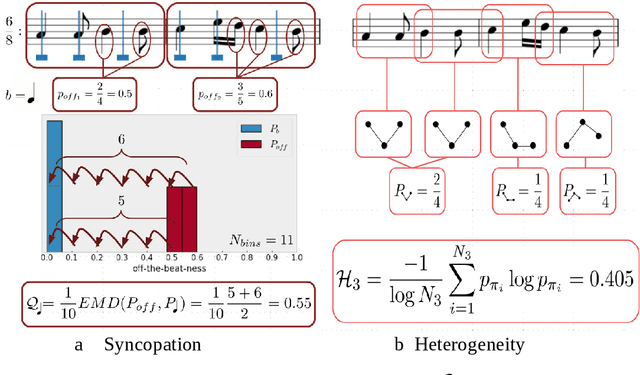
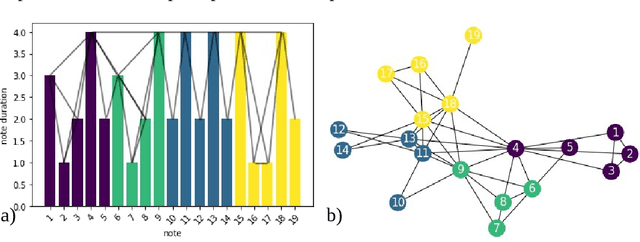
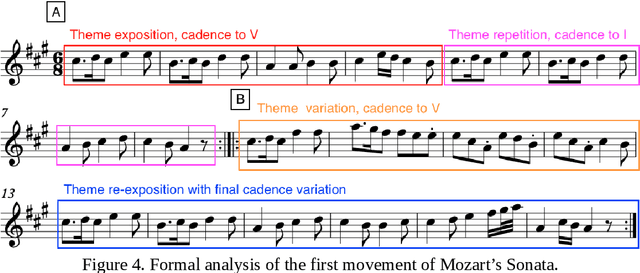
There has been an everlasting discussion around the concept of form in music. This work is motivated by such debate by using a complex systems framework in which we study the form as an emergent property of rhythm. Such a framework corresponds with the traditional notion of musical form and allows us to generalize this concept to more general shapes and structures in music. We develop the three following metrics of the rhythmic complexity of a musical piece and its parts: 1) the rhythmic heterogeneity, based on the permutation entropy, where high values indicate a wide variety of rhythmic patterns; 2) the syncopation, based on the distribution of on-beat onsets, where high values indicate a high proportion of off-the-beat notes; and 3) the component extractor, based on the communities of a visibility graph of the rhythmic figures over time, where we identify structural components that constitute the piece at a (to be explained) perceptual level. With the same parameters, our metrics are comparable within a piece or between pieces.