 Add to Chrome
 Add to Firefox
 Add to Edge
Robust Bidirectional Associative Memory via Regularization Inspired by the Subspace Rotation Algorithm
Nov 14, 2025
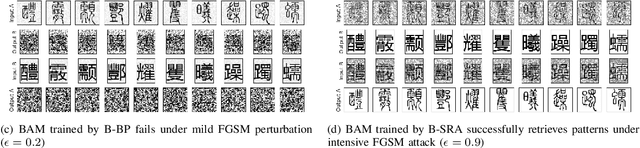
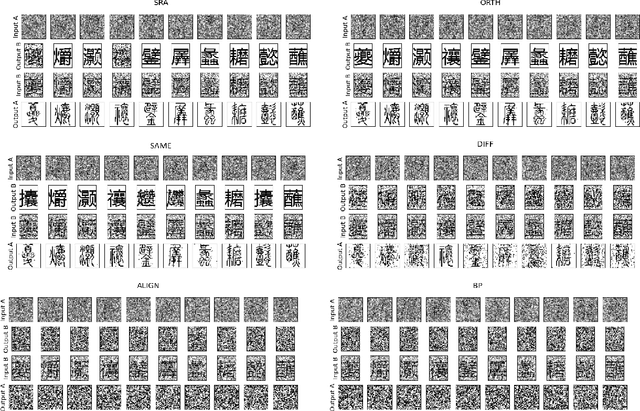
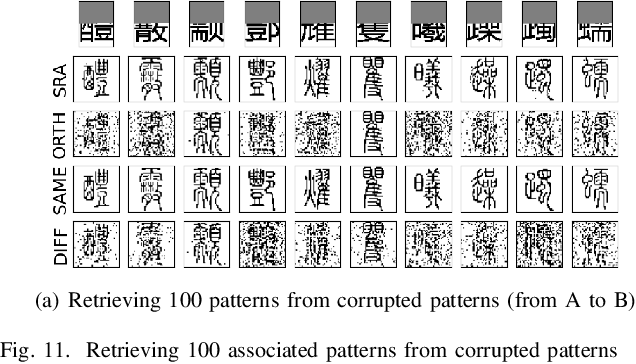
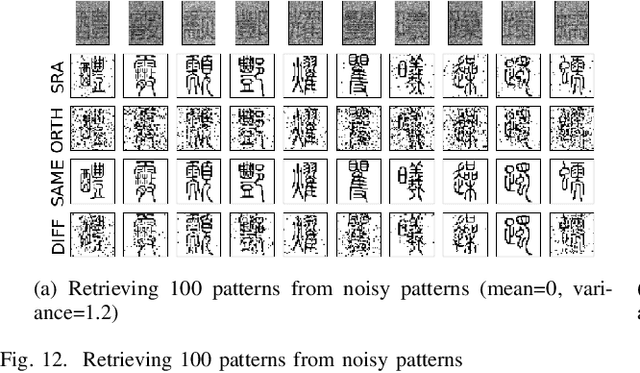
Bidirectional Associative Memory (BAM) trained with Bidirectional Backpropagation (B-BP) often suffers from poor robustness and high sensitivity to noise and adversarial attacks. To address these issues, we propose a novel gradient-free training algorithm, the Bidirectional Subspace Rotation Algorithm (B-SRA), which significantly improves the robustness and convergence behavior of BAM. Through comprehensive experiments, we identify two key principles -- orthogonal weight matrices (OWM) and gradient-pattern alignment (GPA) -- as central to enhancing the robustness of BAM. Motivated by these findings, we introduce new regularization strategies into B-BP, resulting in models with greatly improved resistance to corruption and adversarial perturbations. We further conduct an ablation study across different training strategies to determine the most robust configuration and evaluate BAM's performance under a variety of attack scenarios and memory capacities, including 50, 100, and 200 associative pairs. Among all methods, the SAME configuration, which integrates both OWM and GPA, achieves the strongest resilience. Overall, our results demonstrate that B-SRA and the proposed regularization strategies lead to substantially more robust associative memories and open new directions for building resilient neural architectures.

DeepDefense: Layer-Wise Gradient-Feature Alignment for Building Robust Neural Networks
Nov 13, 2025Deep neural networks are known to be vulnerable to adversarial perturbations, which are small and carefully crafted inputs that lead to incorrect predictions. In this paper, we propose DeepDefense, a novel defense framework that applies Gradient-Feature Alignment (GFA) regularization across multiple layers to suppress adversarial vulnerability. By aligning input gradients with internal feature representations, DeepDefense promotes a smoother loss landscape in tangential directions, thereby reducing the model's sensitivity to adversarial noise. We provide theoretical insights into how adversarial perturbation can be decomposed into radial and tangential components and demonstrate that alignment suppresses loss variation in tangential directions, where most attacks are effective. Empirically, our method achieves significant improvements in robustness across both gradient-based and optimization-based attacks. For example, on CIFAR-10, CNN models trained with DeepDefense outperform standard adversarial training by up to 15.2% under APGD attacks and 24.7% under FGSM attacks. Against optimization-based attacks such as DeepFool and EADEN, DeepDefense requires 20 to 30 times higher perturbation magnitudes to cause misclassification, indicating stronger decision boundaries and a flatter loss landscape. Our approach is architecture-agnostic, simple to implement, and highly effective, offering a promising direction for improving the adversarial robustness of deep learning models.