 Add to Chrome
 Add to Firefox
 Add to Edge
In-Context and Few-Shots Learning for Forecasting Time Series Data based on Large Language Models
Dec 08, 2025
Existing data-driven approaches in modeling and predicting time series data include ARIMA (Autoregressive Integrated Moving Average), Transformer-based models, LSTM (Long Short-Term Memory) and TCN (Temporal Convolutional Network). These approaches, and in particular deep learning-based models such as LSTM and TCN, have shown great results in predicting time series data. With the advancement of leveraging pre-trained foundation models such as Large Language Models (LLMs) and more notably Google's recent foundation model for time series data, {\it TimesFM} (Time Series Foundation Model), it is of interest to investigate whether these foundation models have the capability of outperforming existing modeling approaches in analyzing and predicting time series data. This paper investigates the performance of using LLM models for time series data prediction. We investigate the in-context learning methodology in the training of LLM models that are specific to the underlying application domain. More specifically, the paper explores training LLMs through in-context, zero-shot and few-shot learning and forecasting time series data with OpenAI {\tt o4-mini} and Gemini 2.5 Flash Lite, as well as the recent Google's Transformer-based TimesFM, a time series-specific foundation model, along with two deep learning models, namely TCN and LSTM networks. The findings indicate that TimesFM has the best overall performance with the lowest RMSE value (0.3023) and the competitive inference time (266 seconds). Furthermore, OpenAI's o4-mini also exhibits a good performance based on Zero Shot learning. These findings highlight pre-trained time series foundation models as a promising direction for real-time forecasting, enabling accurate and scalable deployment with minimal model adaptation.

A Survey on Blockchain-Based Federated Learning and Data Privacy
Jun 29, 2023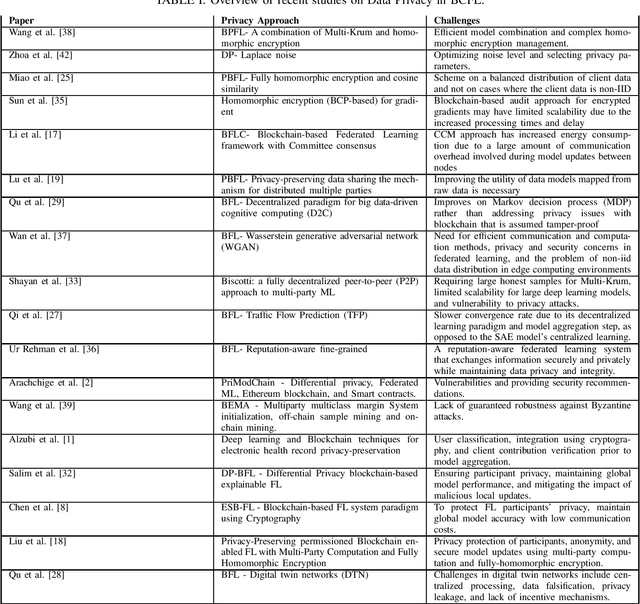
Federated learning is a decentralized machine learning paradigm that allows multiple clients to collaborate by leveraging local computational power and the models transmission. This method reduces the costs and privacy concerns associated with centralized machine learning methods while ensuring data privacy by distributing training data across heterogeneous devices. On the other hand, federated learning has the drawback of data leakage due to the lack of privacy-preserving mechanisms employed during storage, transfer, and sharing, thus posing significant risks to data owners and suppliers. Blockchain technology has emerged as a promising technology for offering secure data-sharing platforms in federated learning, especially in Industrial Internet of Things (IIoT) settings. This survey aims to compare the performance and security of various data privacy mechanisms adopted in blockchain-based federated learning architectures. We conduct a systematic review of existing literature on secure data-sharing platforms for federated learning provided by blockchain technology, providing an in-depth overview of blockchain-based federated learning, its essential components, and discussing its principles, and potential applications. The primary contribution of this survey paper is to identify critical research questions and propose potential directions for future research in blockchain-based federated learning.