 Add to Chrome
 Add to Firefox
 Add to Edge
MMTM: Tri-Modal Topic Modeling for Long-Form Video via Similarity-Gated Fusion
May 28, 2026
We introduce MMTM, a modular pipeline for topic discovery in long-form video that integrates speech recognition, audio and visual embeddings, and BERTopic clustering through a deterministic similarity-gated fusion. Evaluated cross-lingually on German (Tagesschau) and English (NBC) broadcast news, joint tri-modal modeling substantially improves topic quality: noise drops from 0.27 to 0.06, transition rate from 0.70 to 0.21, and normalized entropy rises from 0.84 to 0.92, indicating more coherent and temporally stable topics. Cluster validity (Calinski-Harabasz) improves by 5-12X across embedding spaces. Lexical coherence (NPMI) rises from 0.77 to 0.86 on German but is corpus-dependent and does not transfer to the shorter NBC broadcasts. We release the pipeline code and a human-validated 54-hour multimodal video topic corpus with dual-annotator visual evaluation and LLM-assisted labeling.

Large Language Models Decide Early and Explain Later
Apr 24, 2026Large Language Models often achieve strong performance by generating long intermediate chain-of-thought reasoning. However, it remains unclear when a model's final answer is actually determined during generation. If the answer is already fixed at an intermediate stage, subsequent reasoning tokens may constitute post-decision explanation, increasing inference cost and latency without improving correctness. We study the evolution of predicted answers over reasoning steps using forced answer completion, which elicits the model's intermediate predictions at partial reasoning prefixes. Focusing on Qwen3-4B and averaging results across all datasets considered, we find that predicted answers change in only 32% of queries. Moreover, once the final answer switch occurs, the model generates an average of 760 additional reasoning tokens per query, accounting for a substantial fraction of the total reasoning budget. Motivated by these findings, we investigate early stopping strategies that halt generation once the answer has stabilized. We show that simple heuristics, including probe-based stopping, can reduce reasoning token usage by 500 tokens per query while incurring only a 2% drop in accuracy. Together, our results indicate that a large portion of chain-of-thought generation is redundant and can be reduced with minimal impact on performance.
DFKI-NLP at SemEval-2024 Task 2: Towards Robust LLMs Using Data Perturbations and MinMax Training
May 01, 2024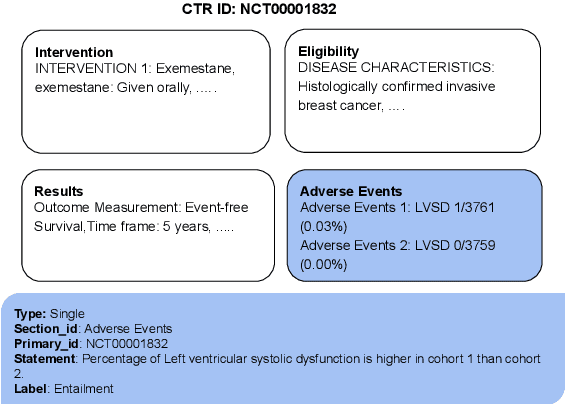
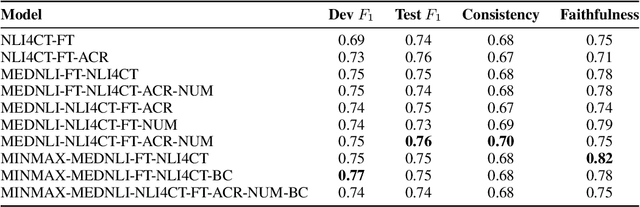

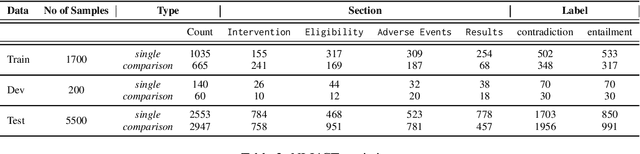
The NLI4CT task at SemEval-2024 emphasizes the development of robust models for Natural Language Inference on Clinical Trial Reports (CTRs) using large language models (LLMs). This edition introduces interventions specifically targeting the numerical, vocabulary, and semantic aspects of CTRs. Our proposed system harnesses the capabilities of the state-of-the-art Mistral model, complemented by an auxiliary model, to focus on the intricate input space of the NLI4CT dataset. Through the incorporation of numerical and acronym-based perturbations to the data, we train a robust system capable of handling both semantic-altering and numerical contradiction interventions. Our analysis on the dataset sheds light on the challenging sections of the CTRs for reasoning.
Full-Text Argumentation Mining on Scientific Publications
Oct 24, 2022
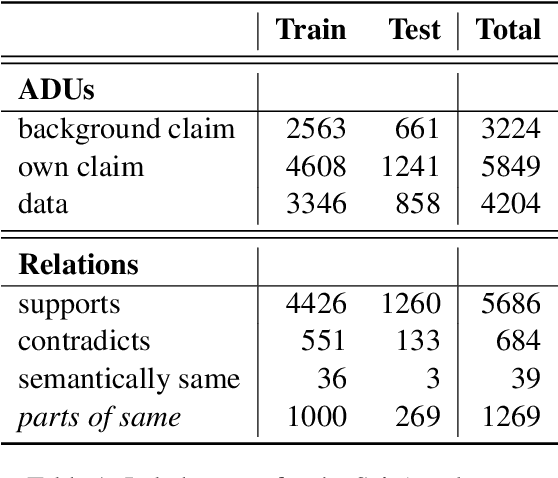
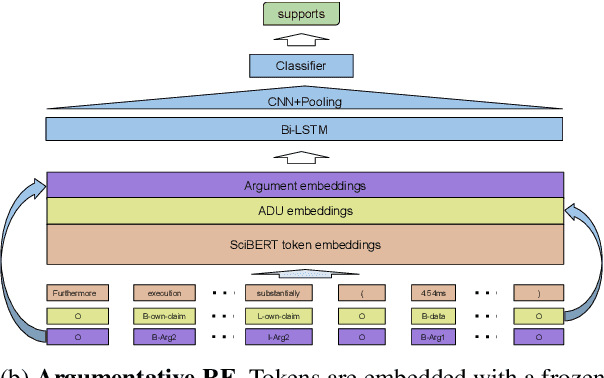

Scholarly Argumentation Mining (SAM) has recently gained attention due to its potential to help scholars with the rapid growth of published scientific literature. It comprises two subtasks: argumentative discourse unit recognition (ADUR) and argumentative relation extraction (ARE), both of which are challenging since they require e.g. the integration of domain knowledge, the detection of implicit statements, and the disambiguation of argument structure. While previous work focused on dataset construction and baseline methods for specific document sections, such as abstract or results, full-text scholarly argumentation mining has seen little progress. In this work, we introduce a sequential pipeline model combining ADUR and ARE for full-text SAM, and provide a first analysis of the performance of pretrained language models (PLMs) on both subtasks. We establish a new SotA for ADUR on the Sci-Arg corpus, outperforming the previous best reported result by a large margin (+7% F1). We also present the first results for ARE, and thus for the full AM pipeline, on this benchmark dataset. Our detailed error analysis reveals that non-contiguous ADUs as well as the interpretation of discourse connectors pose major challenges and that data annotation needs to be more consistent.