 Add to Chrome
 Add to Firefox
 Add to Edge
Reducing Diffusion Model Memorization with Higher Order Langevin Dynamics
May 18, 2026
Diffusion/score-based models have emerged as powerful generative models, capable of generating high-quality samples that mimic the training data distribution. However, it has been observed that they are prone to reproducing training samples-known as "memorization"-potentially violating copyright and privacy. In this paper, we study the effect of Higher-Order Langevin Dynamics (HOLD) on this phenomenon. HOLD diffusion processes introduce auxiliary variables; if the data variable is interpreted as "position," then the auxiliary variables can be interpreted as "velocity" and "acceleration," depending on the chosen order of the model. They were originally proposed based on the intuition that they regularize the trajectories of the data variable by implicitly imposing additional dynamical constraints. Our work provides, to our knowledge, the first theoretical characterization of the regularization effect of HOLD. Specifically, we show that in HOLD, the dynamics of the data variable are governed by a low-pass-filtered version of the learned score function, with smoothness increasing with the order of HOLD. We then analyze the optimal empirical score and the possibility of distribution collapse. Together, our results explain the mitigation of memorization as the model order increases. Finally, we present an empirical study on real-world data that supports our theory and highlights this distinct advantage of HOLD over standard diffusion in practice.

Defending Diffusion Models Against Membership Inference Attacks via Higher-Order Langevin Dynamics
Sep 17, 2025Recent advances in generative artificial intelligence applications have raised new data security concerns. This paper focuses on defending diffusion models against membership inference attacks. This type of attack occurs when the attacker can determine if a certain data point was used to train the model. Although diffusion models are intrinsically more resistant to membership inference attacks than other generative models, they are still susceptible. The defense proposed here utilizes critically-damped higher-order Langevin dynamics, which introduces several auxiliary variables and a joint diffusion process along these variables. The idea is that the presence of auxiliary variables mixes external randomness that helps to corrupt sensitive input data earlier on in the diffusion process. This concept is theoretically investigated and validated on a toy dataset and a speech dataset using the Area Under the Receiver Operating Characteristic (AUROC) curves and the FID metric.
Critically Damped Third-Order Langevin Dynamics
Sep 12, 2024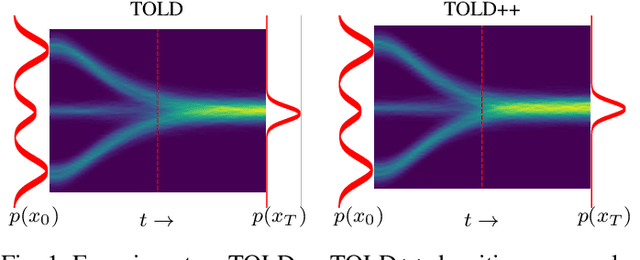
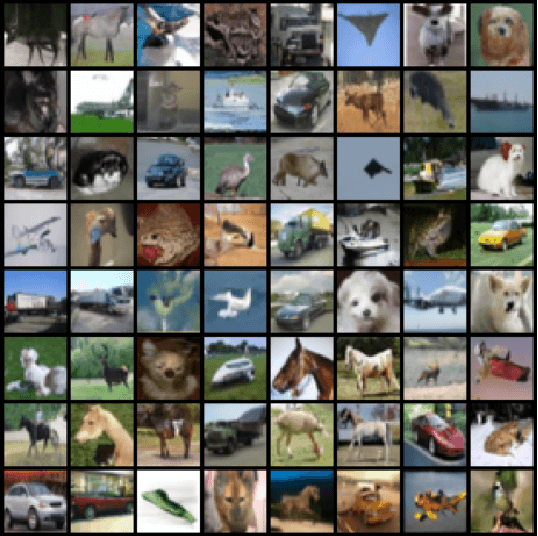
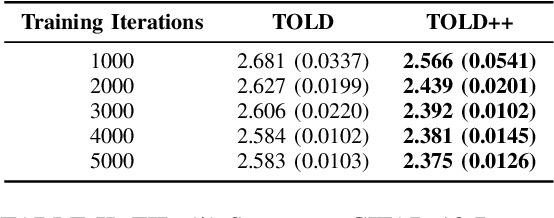
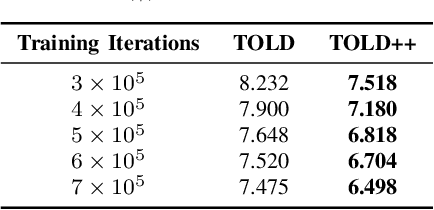
While systems analysis has been studied for decades in the context of control theory, it has only been recently used to improve the convergence of Denoising Diffusion Probabilistic Models. This work describes a novel improvement to Third- Order Langevin Dynamics (TOLD), a recent diffusion method that performs better than its predecessors. This improvement, abbreviated TOLD++, is carried out by critically damping the TOLD forward transition matrix similarly to Dockhorn's Critically-Damped Langevin Dynamics (CLD). Specifically, it exploits eigen-analysis of the forward transition matrix to derive the optimal set of dynamics under the original TOLD scheme. TOLD++ is theoretically guaranteed to converge faster than TOLD, and its faster convergence is verified on the Swiss Roll toy dataset and CIFAR-10 dataset according to the FID metric.