 Add to Chrome
 Add to Firefox
 Add to Edge
Foundation models for movement data: Are they ready for prime-time?
Aug 13, 2026
Foundation models (FMs) trained on large-scale accelerometer data have been proposed as general-purpose feature extractors for health monitoring, but systematic evidence of their advantages is lacking. We present the first comprehensive evaluation of four open-source accelerometer FMs against supervised baselines covering 19 tasks across the domains of activity recognition including activities of daily living, clinical monitoring, and physiological inference. We find task-dependent performance results: supervised models remain competitive with FMs on human action recognition (HAR), with no consistent advantage for either, while selected FMs lead on fall and stress detection and are the most robust to sensor-placement variation. As frozen feature extractors, FMs are strongest for demographic inference, whereas sleep staging performance remains near chance level for all models. The internal FM representations show strong similarity across layers, highlighting potential for future FM improvements. Linear and frozen probing reveals that UniMTS provides the strongest representations and is the only FM that surpasses the supervised baselines without finetuning. Concept discovery analysis shows all models capture high-intensity activities clearly but struggle with sedentary, complex or ambiguous activities. We provide scenario-based deployment recommendations. Furthermore, we identify FM-derived activity profile inference-moving beyond fixed category classification-as a promising research direction.

Non-Intrusive Binaural Speech Intelligibility Prediction from Discrete Latent Representations
Nov 24, 2021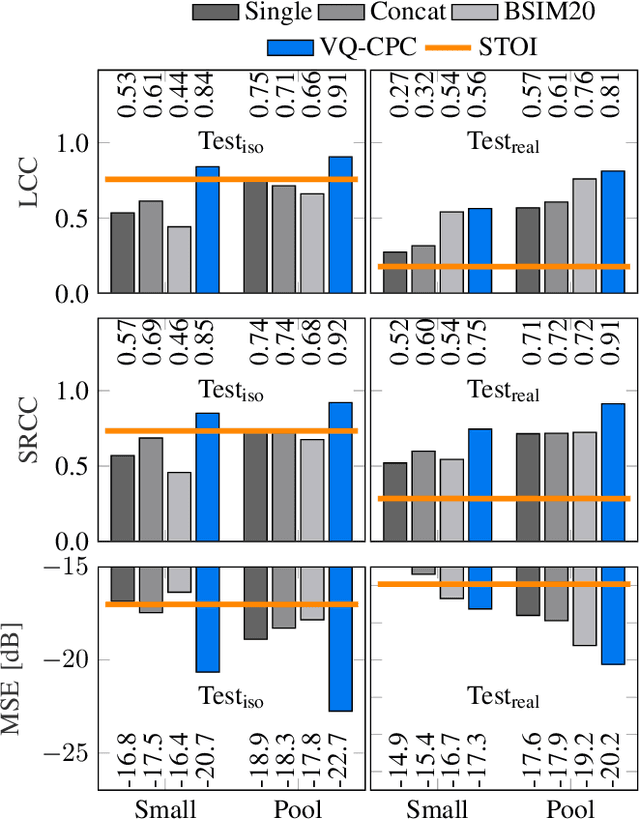
Non-intrusive speech intelligibility (SI) prediction from binaural signals is useful in many applications. However, most existing signal-based measures are designed to be applied to single-channel signals. Measures specifically designed to take into account the binaural properties of the signal are often intrusive - characterised by requiring access to a clean speech signal - and typically rely on combining both channels into a single-channel signal before making predictions. This paper proposes a non-intrusive SI measure that computes features from a binaural input signal using a combination of vector quantization (VQ) and contrastive predictive coding (CPC) methods. VQ-CPC feature extraction does not rely on any model of the auditory system and is instead trained to maximise the mutual information between the input signal and output features. The computed VQ-CPC features are input to a predicting function parameterized by a neural network. Two predicting functions are considered in this paper. Both feature extractor and predicting functions are trained on simulated binaural signals with isotropic noise. They are tested on simulated signals with isotropic and real noise. For all signals, the ground truth scores are the (intrusive) deterministic binaural STOI. Results are presented in terms of correlations and MSE and demonstrate that VQ-CPC features are able to capture information relevant to modelling SI and outperform all the considered benchmarks - even when evaluating on data comprising of different noise field types.