 Add to Chrome
 Add to Firefox
 Add to Edge
Agentic, Context-Aware Risk Intelligence in the Internet of Value
May 07, 2026
The Internet of Value (IoV) is a heterogeneous, partially-trusted network in which the dominant marginal risk is composite (route, sentiment, liquidity, and the policy a system is willing to commit to) rather than a property of any single chain. We argue that a risk primitive adequate for this regime is a composition of five engines: a prediction engine over price, liquidity, volatility, and route health; a Bittensor verification subnet that decentralises and economically scores prediction outputs; a sentiment-fusion engine over text, on-chain flow, and grey-literature feeds; an agentic engine under constitutional, role-bound action constraints; and an API-risk and scenario engine that converts forecasts into pre-committed action programs in the sense of Monte-Carlo scenario generation. We anchor the architecture in two empirical artefacts: a 27-hour policy-constrained liquidity stress-response experiment on Solana, and a 168-hour prediction-router calibration arc reported with explicit class-imbalance honesty. The case study supports deployability; the validator-loss decomposition is stated formally and is falsifiable.

A Deep Recurrent Q Network towards Self-adapting Distributed Microservices architecture
Jan 15, 2019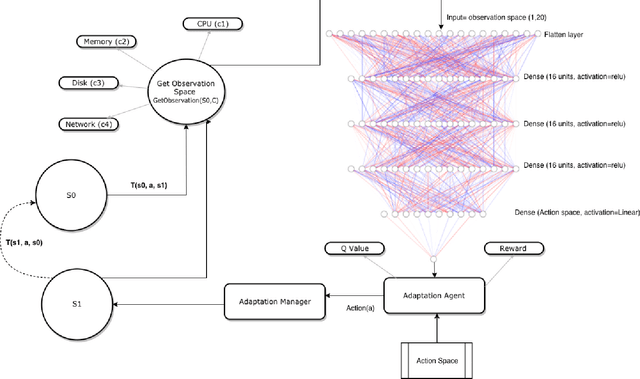
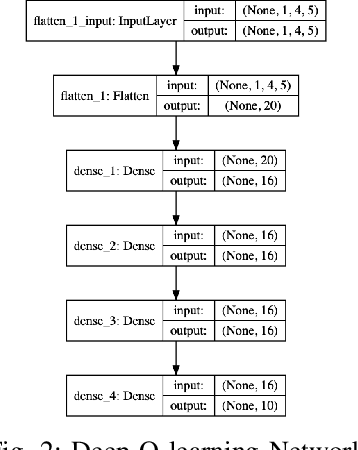
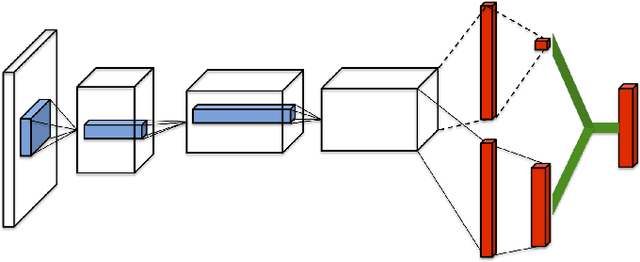
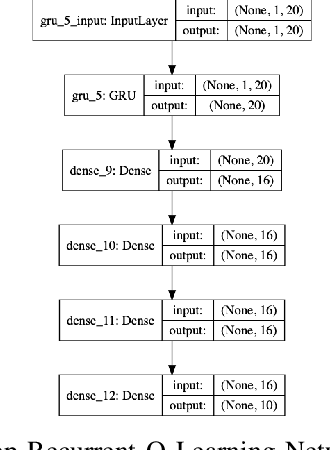
One desired aspect of microservices architecture is the ability to self-adapt its own architecture and behaviour in response to changes in the operational environment. To achieve the desired high levels of self-adaptability, this research implements the distributed microservices architectures model, as informed by the MAPE-K model. The proposed architecture employs a multi adaptation agents supported by a centralised controller, that can observe the environment and execute a suitable adaptation action. The adaptation planning is managed by a deep recurrent Q-network (DRQN). It is argued that such integration between DRQN and MDP agents in a MAPE-K model offers distributed microservice architecture with self-adaptability and high levels of availability and scalability. Integrating DRQN into the adaptation process improves the effectiveness of the adaptation and reduces any adaptation risks, including resources over-provisioning and thrashing. The performance of DRQN is evaluated against deep Q-learning and policy gradient algorithms including: i) deep q-network (DQN), ii) dulling deep Q-network (DDQN), iii) a policy gradient neural network (PGNN), and iv) deep deterministic policy gradient (DDPG). The DRQN implementation in this paper manages to outperform the above mentioned algorithms in terms of total reward, less adaptation time, lower error rates, plus faster convergence and training times. We strongly believe that DRQN is more suitable for driving the adaptation in distributed services-oriented architecture and offers better performance than other dynamic decision-making algorithms.
Context Oriented Software Middleware
Jan 13, 2019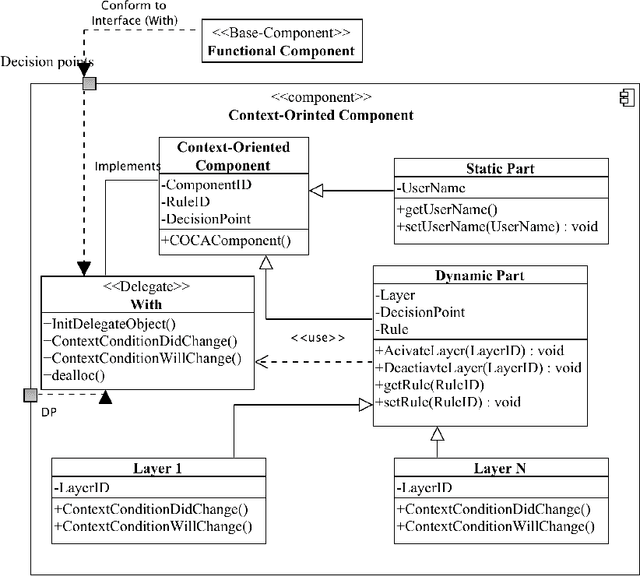
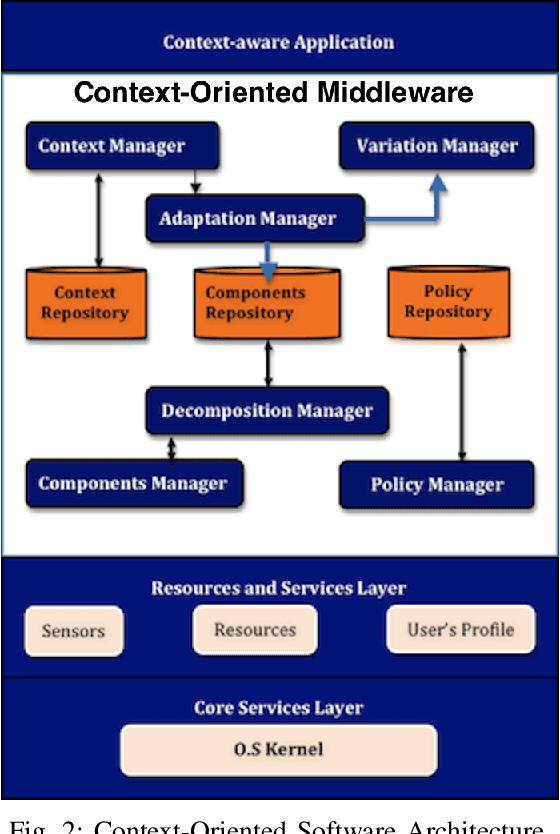
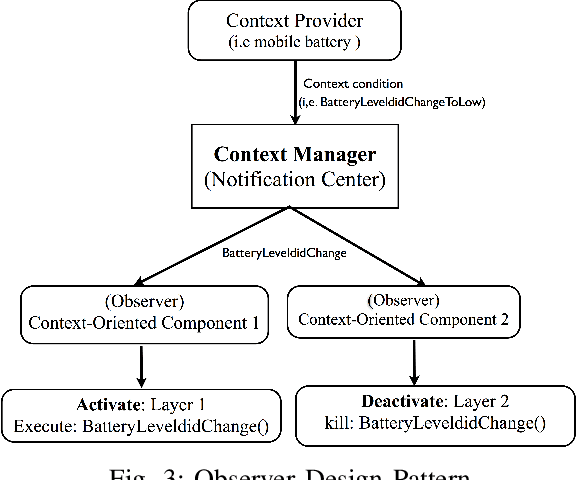
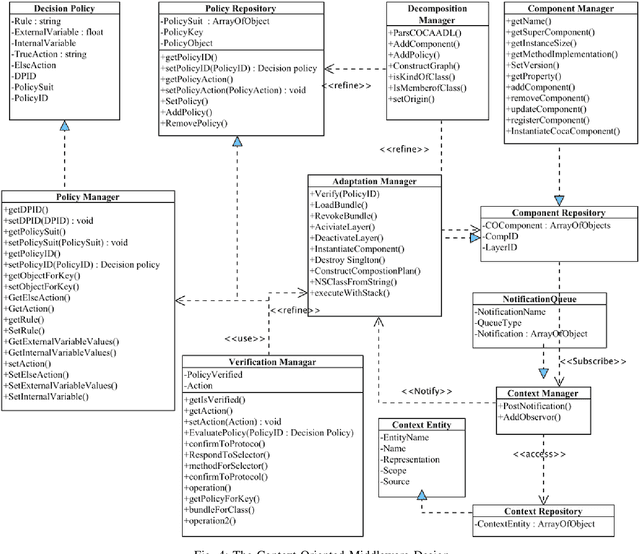
Our middleware approach, Context-Oriented Software Middleware (COSM), supports context-dependent software with self-adaptability and dependability in a mobile computing environment. The COSM-middleware is a generic and platform-independent adaptation engine, which performs a runtime composition of the software's context-dependent behaviours based on the execution contexts. Our middleware distinguishes between the context-dependent and context-independent functionality of software systems. This enables the COSM-middleware to adapt the application behaviour by composing a set of context-oriented components, that implement the context-dependent functionality of the software. Accordingly, the software dependability is achieved by considering the functionality of the COSM-middleware and the adaptation impact/costs. The COSM-middleware uses a dynamic policy-based engine to evaluate the adaptation outputs and verify the fitness of the adaptation output with the application's objectives, goals and the architecture quality attributes. These capabilities are demonstrated through an empirical evaluation of a case study implementation.