 Add to Chrome
 Add to Firefox
 Add to Edge
Visualizing the Structure of Lenia Parameter Space
Jan 05, 2026
Continuous cellular automata are rocketing in popularity, yet developing a theoretical understanding of their behaviour remains a challenge. In the case of Lenia, a few fundamental open problems include determining what exactly constitutes a soliton, what is the overall structure of the parameter space, and where do the solitons occur in it. In this abstract, we present a new method to automatically classify Lenia systems into four qualitatively different dynamical classes. This allows us to detect moving solitons, and to provide an interactive visualization of Lenia's parameter space structure on our website https://lenia-explorer.vercel.app/. The results shed new light on the above-mentioned questions and lead to several observations: the existence of new soliton families for parameters where they were not believed to exist, or the universality of the phase space structure across various kernels.

Classification of Discrete Dynamical Systems Based on Transients
Aug 03, 2021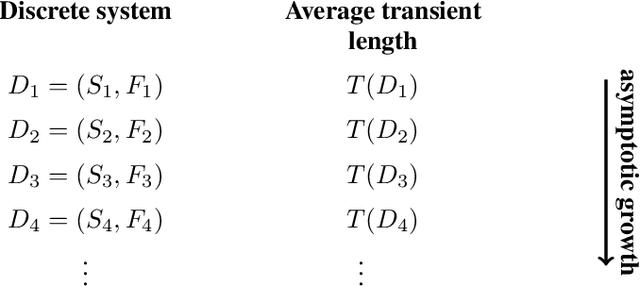
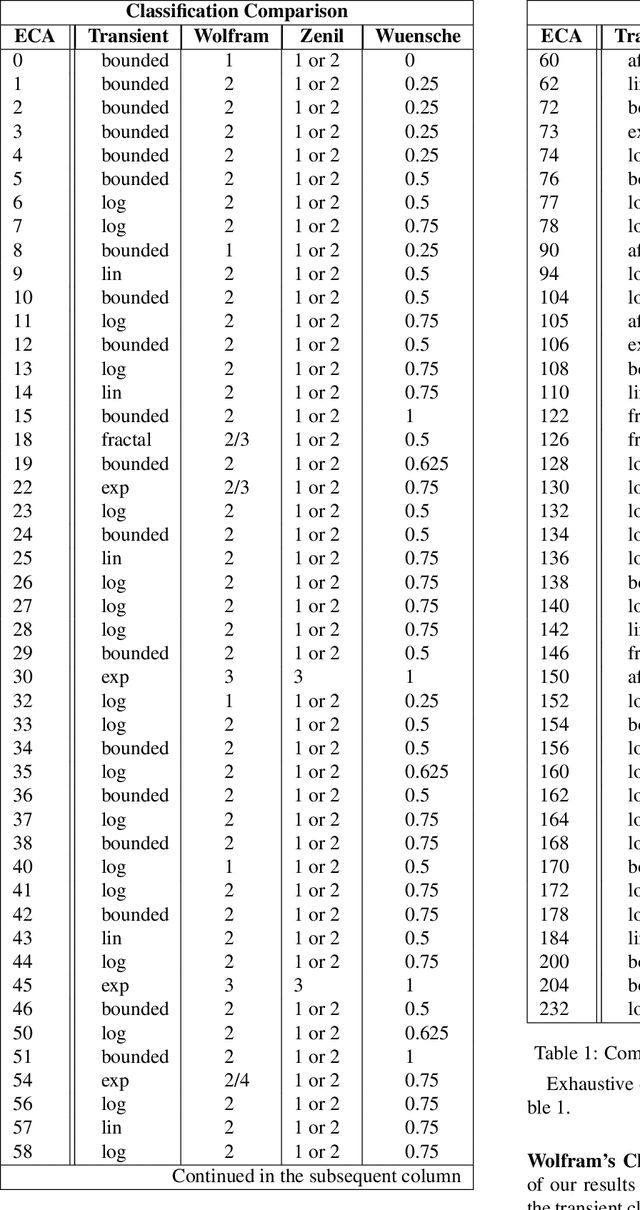
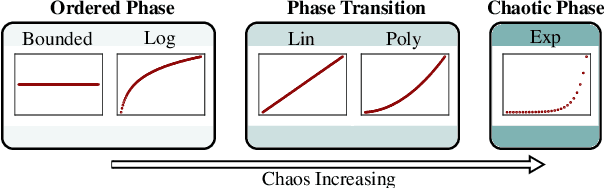
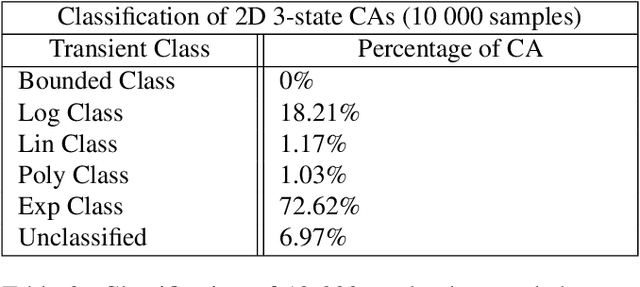
In order to develop systems capable of artificial evolution, we need to identify which systems can produce complex behavior. We present a novel classification method applicable to any class of deterministic discrete space and time dynamical systems. The method is based on classifying the asymptotic behavior of the average computation time in a given system before entering a loop. We were able to identify a critical region of behavior that corresponds to a phase transition from ordered behavior to chaos across various classes of dynamical systems. To show that our approach can be applied to many different computational systems, we demonstrate the results of classifying cellular automata, Turing machines, and random Boolean networks. Further, we use this method to classify 2D cellular automata to automatically find those with interesting, complex dynamics. We believe that our work can be used to design systems in which complex structures emerge. Also, it can be used to compare various versions of existing attempts to model open-ended evolution (Ray (1991), Ofria et al. (2004), Channon (2006)).
Computational Hierarchy of Elementary Cellular Automata
Aug 01, 2021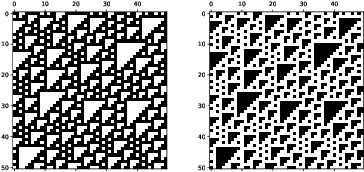
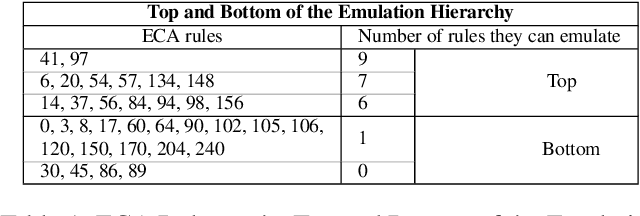
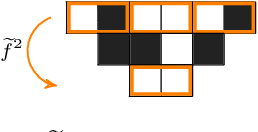
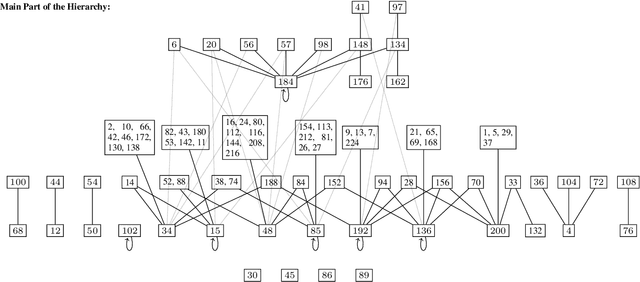
The complexity of cellular automata is traditionally measured by their computational capacity. However, it is difficult to choose a challenging set of computational tasks suitable for the parallel nature of such systems. We study the ability of automata to emulate one another, and we use this notion to define such a set of naturally emerging tasks. We present the results for elementary cellular automata, although the core ideas can be extended to other computational systems. We compute a graph showing which elementary cellular automata can be emulated by which and show that certain chaotic automata are the only ones that cannot emulate any automata non-trivially. Finally, we use the emulation notion to suggest a novel definition of chaos that we believe is suitable for discrete computational systems. We believe our work can help design parallel computational systems that are Turing-complete and also computationally efficient.
* 8 pages