 Add to Chrome
 Add to Firefox
 Add to Edge
Integrating gene regulatory priors into Transformer attention with scTransformer for interpretable scRNA-seq analysis
Jun 08, 2026
Motivation: Transformer-based models are increasingly applied to large-scale single-cell transcriptomics, showing strong performance through self-supervised learning on millions of cells. However, most existing approaches treat genes as independent features, and largely ignore prior biological knowledge, which limits interpretability and robustness. In this paper, we explore whether explicitly incorporating gene regulatory information can improve both model performance and biological insight. Results: We present scTransformer, the first Transformer-based approach that builds a priori knowledge of biological mechanisms into the model's attention patterns. By constraining information flow according to known regulatory structures, the model learns representations that are more biologically meaningful. We evaluate scTransformer on a disease-relevant single-nucleus RNA-seq dataset using supervised cell-type classification. Compared to standard Transformers, our approach improves classification accuracy, enhances separation of cell types in embedding space, and produces attention patterns consistent with known regulatory programs. Overall, our results demonstrate that embedding biological structure into Transformer models can enhance interpretability without sacrificing performance, offering a principled step toward biologically grounded foundation models for single-cell omics.

Exploring the Impact of Environmental Pollutants on Multiple Sclerosis Progression
Aug 30, 2024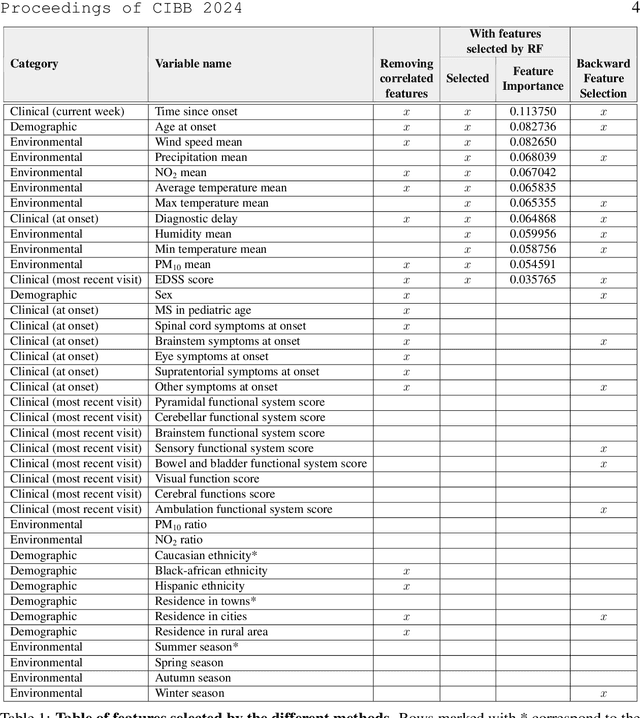
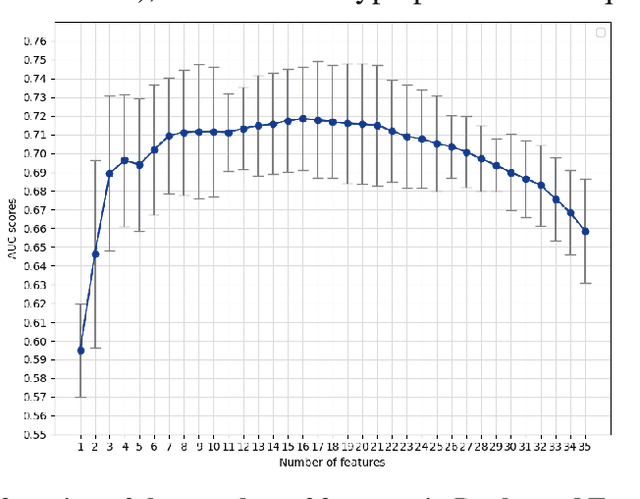

Multiple Sclerosis (MS) is a chronic autoimmune and inflammatory neurological disorder characterised by episodes of symptom exacerbation, known as relapses. In this study, we investigate the role of environmental factors in relapse occurrence among MS patients, using data from the H2020 BRAINTEASER project. We employed predictive models, including Random Forest (RF) and Logistic Regression (LR), with varying sets of input features to predict the occurrence of relapses based on clinical and pollutant data collected over a week. The RF yielded the best result, with an AUC-ROC score of 0.713. Environmental variables, such as precipitation, NO2, PM2.5, humidity, and temperature, were found to be relevant to the prediction.