 Add to Chrome
 Add to Firefox
 Add to Edge
Can AI Scientist Agents Learn from Lab-in-the-Loop Feedback? Evidence from Iterative Perturbation Discovery
Mar 27, 2026
Recent work has questioned whether large language models (LLMs) can perform genuine in-context learning (ICL) for scientific experimental design, with prior studies suggesting that LLM-based agents exhibit no sensitivity to experimental feedback. We shed new light on this question by carrying out 800 independently replicated experiments on iterative perturbation discovery in Cell Painting high-content screening. We compare an LLM agent that iteratively updates its hypotheses using experimental feedback to a zero-shot baseline that relies solely on pretraining knowledge retrieval. Access to feedback yields a $+53.4\%$ increase in discoveries per feature on average ($p = 0.003$). To test whether this improvement arises from genuine feedback-driven learning rather than prompt-induced recall of pretraining knowledge, we introduce a random feedback control in which hit/miss labels are permuted. Under this control, the performance gain disappears, indicating that the observed improvement depends on the structure of the feedback signal ($+13.0$ hits, $p = 0.003$). We further examine how model capability affects feedback utilization. Upgrading from Claude Sonnet 4.5 to 4.6 reduces gene hallucination rates from ${\sim}33\%$--$45\%$ to ${\sim}3$--$9\%$, converting a non-significant ICL effect ($+0.8$, $p = 0.32$) into a large and highly significant improvement ($+11.0$, $p=0.003$) for the best ICL strategy. These results suggest that effective in-context learning from experimental feedback emerges only once models reach a sufficient capability threshold.

Predicting gene essentiality and drug response from perturbation screens in preclinical cancer models with LEAP: Layered Ensemble of Autoencoders and Predictors
Feb 21, 2025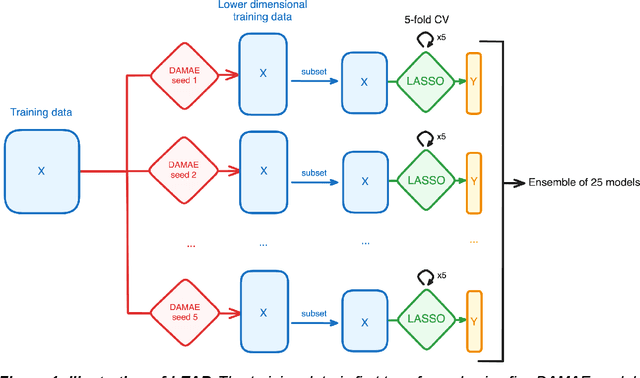
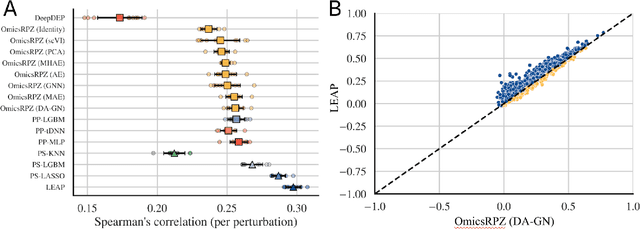
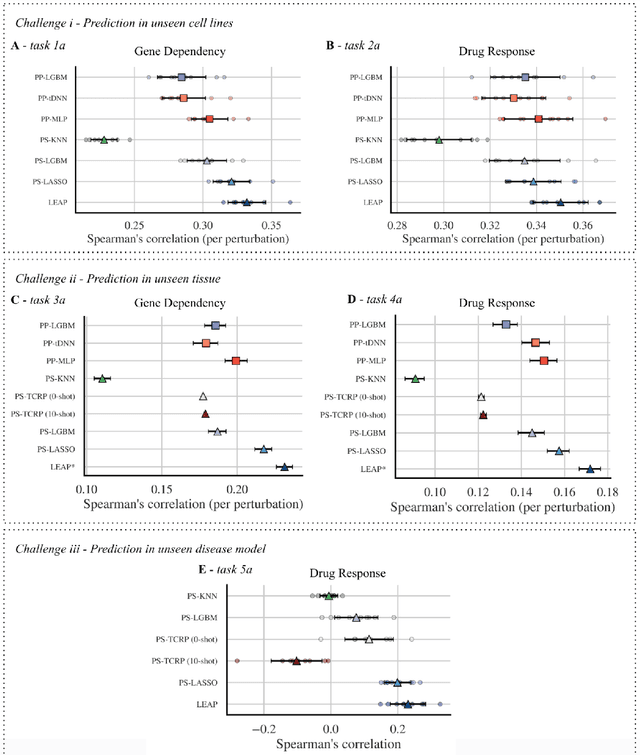
Preclinical perturbation screens, where the effects of genetic, chemical, or environmental perturbations are systematically tested on disease models, hold significant promise for machine learning-enhanced drug discovery due to their scale and causal nature. Predictive models can infer perturbation responses for previously untested disease models based on molecular profiles. These in silico labels can expand databases and guide experimental prioritization. However, modelling perturbation-specific effects and generating robust prediction performances across diverse biological contexts remain elusive. We introduce LEAP (Layered Ensemble of Autoencoders and Predictors), a novel ensemble framework to improve robustness and generalization. LEAP leverages multiple DAMAE (Data Augmented Masked Autoencoder) representations and LASSO regressors. By combining diverse gene expression representation models learned from different random initializations, LEAP consistently outperforms state-of-the-art approaches in predicting gene essentiality or drug responses in unseen cell lines, tissues and disease models. Notably, our results show that ensembling representation models, rather than prediction models alone, yields superior predictive performance. Beyond its performance gains, LEAP is computationally efficient, requires minimal hyperparameter tuning and can therefore be readily incorporated into drug discovery pipelines to prioritize promising targets and support biomarker-driven stratification. The code and datasets used in this work are made publicly available.