 Add to Chrome
 Add to Firefox
 Add to Edge
Variance-Preserving Orthogonal Selection (VPOS): Greedy Feature Selection via Orthogonal Deflation in PCA Loading Space
Jul 25, 2026
We propose Variance-Preserving Orthogonal Selection (VPOS), a greedy framework for unsupervised feature selection that operates in the weighted PCA loading space. After each selection, VPOS projects out the chosen feature's variance direction via null-space deflation, forcing subsequent selections to cover orthogonal parts of the covariance structure. Each step provably reduces the loading matrix rank by one, and the greedy objective connects to monotone submodular maximization. The single hyperparameter $d$ is selected via a reproducible rule: the value minimising reconstruction MSE in a sensitivity sweep. On eight benchmarks, VPOS achieves the lowest reconstruction MSE on all eight while running 10-140x faster than graph-based methods at scale. Comparing against PCA (no deflation) at matched $d$ confirms deflation as the primary driver, reducing MSE by 10-73%.

Shap-Select: Lightweight Feature Selection Using SHAP Values and Regression
Oct 09, 2024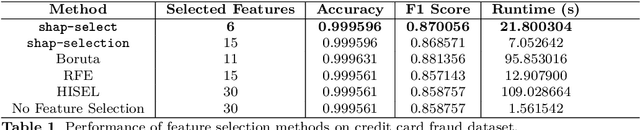
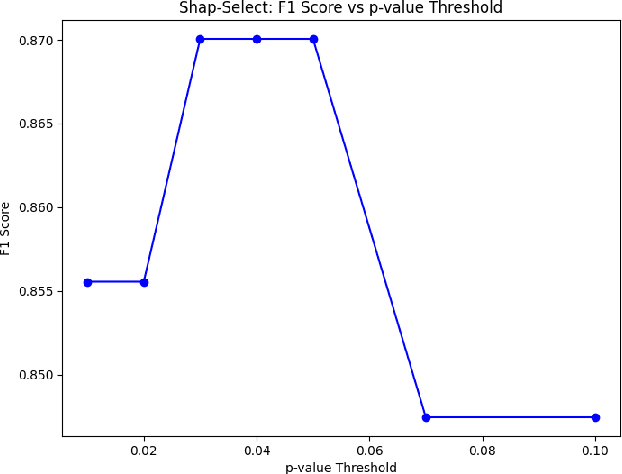
Feature selection is an essential process in machine learning, especially when dealing with high-dimensional datasets. It helps reduce the complexity of machine learning models, improve performance, mitigate overfitting, and decrease computation time. This paper presents a novel feature selection framework, shap-select. The framework conducts a linear or logistic regression of the target on the Shapley values of the features, on the validation set, and uses the signs and significance levels of the regression coefficients to implement an efficient heuristic for feature selection in tabular regression and classification tasks. We evaluate shap-select on the Kaggle credit card fraud dataset, demonstrating its effectiveness compared to established methods such as Recursive Feature Elimination (RFE), HISEL (a mutual information-based feature selection method), Boruta and a simpler Shapley value-based method. Our findings show that shap-select combines interpretability, computational efficiency, and performance, offering a robust solution for feature selection.
OTLP: Output Thresholding Using Mixed Integer Linear Programming
May 18, 2024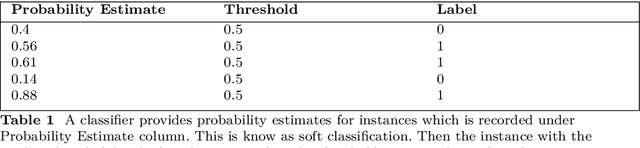
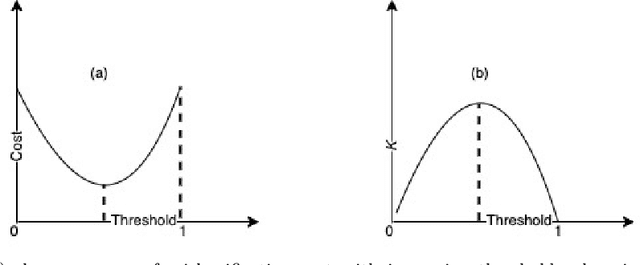
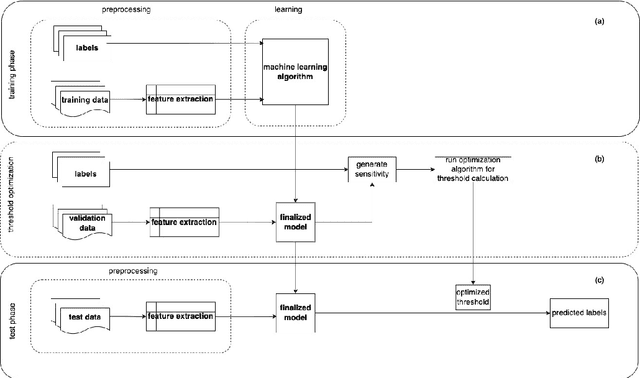
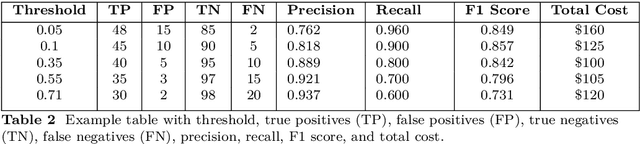
Output thresholding is the technique to search for the best threshold to be used during inference for any classifiers that can produce probability estimates on train and testing datasets. It is particularly useful in high imbalance classification problems where the default threshold is not able to refer to imbalance in class distributions and fail to give the best performance. This paper proposes OTLP, a thresholding framework using mixed integer linear programming which is model agnostic, can support different objective functions and different set of constraints for a diverse set of problems including both balanced and imbalanced classification problems. It is particularly useful in real world applications where the theoretical thresholding techniques are not able to address to product related requirements and complexity of the applications which utilize machine learning models. Through the use of Credit Card Fraud Detection Dataset, we evaluate the usefulness of the framework.